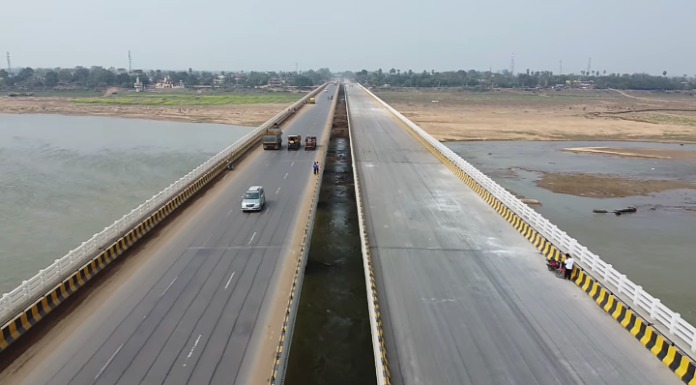
The Digha-Sonepur six-lane bridge, being constructed parallel to the JP Digha Bridge over the Ganga, is facing a significant delay, with only 17.24% of the project completed nearly three years after construction began.

The project was launched in August 2024 and was originally scheduled for completion by November 2027. The deadline has now been extended to December 2028, raising questions over the pace of construction.
The bridge is being built at an estimated cost of Rs 3,064.45 crore and is expected to strengthen connectivity between Patna and north Bihar.

No Major Land Acquisition Hurdle
One of the notable aspects of the project is that land acquisition has not emerged as a major obstacle.
Approach roads on both sides of the bridge are already available, while additional land is reportedly not required for the project.
Despite this, construction has not progressed at the expected pace. The slow progress has led to an extension of the project’s original completion schedule.
Completion Deadline Extended To 2028
The bridge was initially scheduled to be completed by November 2027.
With only 17.24% of the work completed after nearly three years, the deadline has now been revised to December 2028.
The extended timeline means the project will take considerably longer than originally planned. Whether construction can accelerate sufficiently to meet the new deadline will remain a key concern.
Why Is The New Bridge Important?
The six-lane bridge is planned to provide an additional high-capacity road connection between Patna and Sonepur.
The existing JP Setu has faced increasing traffic pressure as movement between Patna and north Bihar has grown.
The new bridge is therefore expected to provide an alternative route and help ease congestion on the existing crossing.
Patna’s Expansion Towards Sonepur
Patna’s urban expansion is increasingly extending towards the areas across the Ganga, including Sonepur and parts of Saran district.
Development activity in the region is expected to increase traffic movement in the coming years, making reliable road connectivity between Patna and Sonepur increasingly important.
The proposed bridge could play a significant role in handling this future traffic demand.
Sonepur’s Growing Infrastructure Importance
Sonepur and surrounding areas are also gaining importance because of major infrastructure and development projects.
A greenfield airport has been approved in the Dariapur Chaur area of Sonepur, while the Bela rail wheel factory is another major facility located in the region.
The development of such projects could increase passenger and commercial movement between Patna and Sonepur.
A wider six-lane connection is consequently expected to become increasingly important for the region’s future transport requirements.
Eight North Bihar Districts Could Benefit
The new bridge is expected to improve access to Patna for people travelling from several districts of north Bihar.
These include Saran, Siwan, Gopalganj, East Champaran, West Champaran, Sitamarhi, Sheohar and Vaishali.
The improved road link could also benefit people travelling to Patna from parts of eastern Uttar Pradesh.
Once operational, the bridge is expected to add significant road capacity to the Patna-Sonepur corridor.
Key Link In Patna-Bettiah Highway
The Digha-Sonepur six-lane bridge is also important for the proposed Patna-Bettiah National Highway (NH-139W).
The highway is being developed under the Bharatmala programme and is planned to connect the Patna AIIMS area with Bettiah.
The wider route is also expected to provide connectivity towards the Nepal border and the Buddhist circuit, making the bridge relevant beyond the immediate Patna-Sonpur corridor.
Three Years, Just 17.24% Work
The Digha-Sonepur six-lane bridge is intended to support Patna’s growing transport needs and strengthen connectivity with north Bihar.
However, the pace of construction remains the central concern. With 17.24% of the work completed in nearly three years, the project has fallen well behind its original schedule.
The absence of a major land-acquisition hurdle makes the slow progress particularly notable.
The deadline has now been extended from November 2027 to December 2028. The pace of construction over the coming months will determine whether the project can finally move towards completion within the revised timeline.