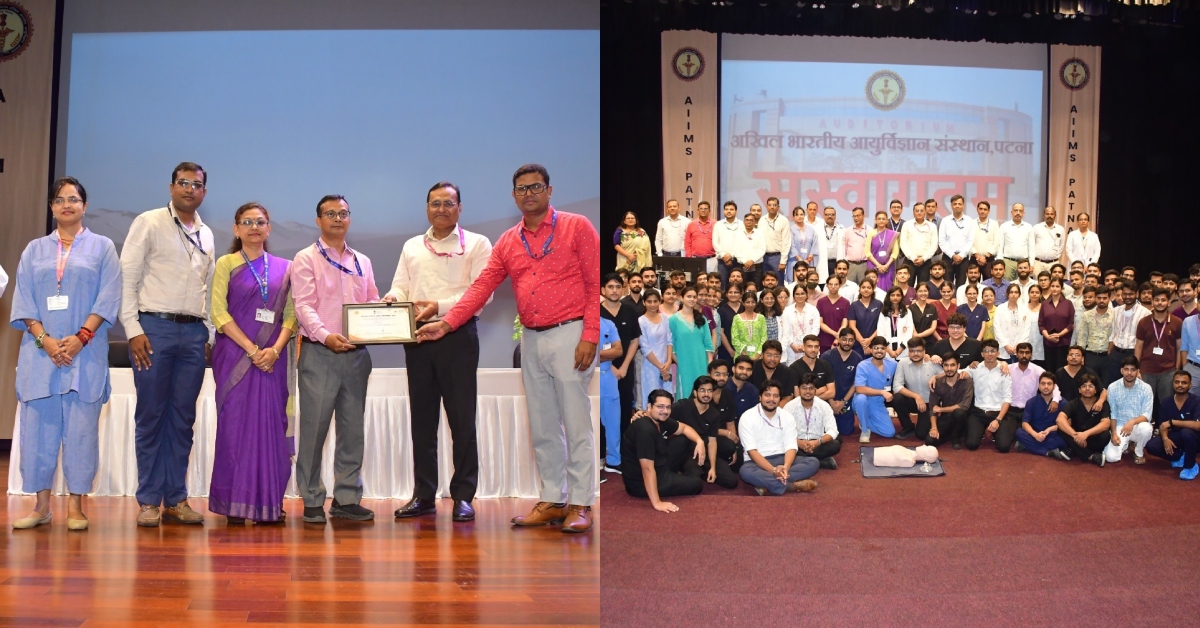
Patna: The Patient Safety Cell of AIIMS Patna organised a one-day orientation programme for medical interns on September 15, focusing on the importance of making patient safety an integral part of clinical practice from the beginning of a medical professional’s career.

The programme was held at the AIIMS Patna Auditorium and was inaugurated by Executive Director and CEO Prof. (Brig.) Dr. Raju Agarwal. Medical Superintendent Prof. Dr. Prashant Kumar Singh and Dean Academics Prof. (Dr.) Punam Prasad Bhadani were also present.
The programme introduced interns to essential practices for safe, effective and patient-centred healthcare delivery, covering both clinical care and wider hospital safety systems.

BLS And ACLS Training For Medical Interns
The orientation began with a two-hour Basic Life Support (BLS) and Advanced Cardiovascular Life Support (ACLS) training conducted by faculty members from the Department of Emergency Medicine.
The session focused on equipping interns with essential skills to respond promptly and appropriately during medical emergencies.
Dr. Divendu Bhushan, Additional Professor and Head of the Department of Emergency Medicine, conducted a session on Safe Prescription, emphasising accuracy, vigilance and rational prescribing.
Dr. Bankim Das, Additional Professor and Head of the Department of Transfusion Medicine, led the session on Safe Transfusion, highlighting standard transfusion protocols and correct patient identification.
Safe Surgery And Hospital Systems
Dr. Ashesh Kumar Jha, Professor in the Department of General Surgery, addressed Safe Surgical Practices, focusing on safety at different stages of surgical care.
The post-lunch sessions expanded the focus to hospital systems and preparedness. Dr. Abhyuday Kumar, Additional Professor in the Department of Anaesthesia and Faculty In-Charge of IT, along with the IT team, introduced interns to the Hospital Information Management System (HIMS).
The programme also included a dedicated session on Fire Safety, conducted by the Fire Engineer.
Medical Records, Communication And Infection Control
Dr. Ramkrishna Mondal, Associate Professor in the Department of Hospital Administration, conducted the session on Medical Records, explaining the importance of accurate documentation for continuity and quality of patient care.
Dr. Ratish Nair, Principal of the College of Nursing, AIIMS Patna, conducted a session on Communication, highlighting effective communication as an important component of patient safety.
The programme also covered Workplace Safety, with a session by Dr. Sadhana Sharma, Professor and Head of the Department of Biochemistry.
Dr. Amarjeet Kumar, Associate Professor in the Department of Microbiology, conducted the session on the Hospital Infection Control Committee (HICC) and related infection-control practices.
The orientation emphasised that patient safety extends beyond clinical treatment and depends on coordinated efforts involving communication, documentation, emergency preparedness, infection prevention, workplace safety and adherence to standard operating procedures.
AIIMS Patna Receives National Patient Safety Recognition
The orientation programme comes at a time when AIIMS Patna is receiving national recognition for its patient-safety initiatives.
At the National Patient Safety Conference held at AIIMS Nagpur, AIIMS Patna was felicitated for activities promoting good and safe healthcare practices, including its contribution towards mentoring Neonatal Safety Master Training.
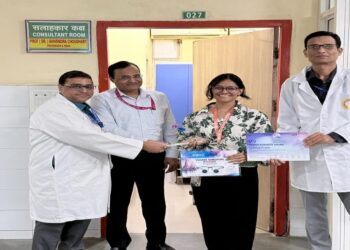
The Department of Transfusion Medicine at AIIMS Patna also received the Best Practice Award for adherence to standard operating procedures and established protocols related to safe transfusion practices.
Focus On A Safer Healthcare Culture
The institute said the national recognition and the orientation programme reflect its continued commitment to creating a safe, accountable and quality-driven healthcare environment.
Through regular training, mentoring and adherence to standardised protocols, AIIMS Patna is working towards making patient safety an integral part of the professional culture of every healthcare worker.
The programme brought together multiple clinical and hospital functions, reinforcing the message that safer patient care depends on attention to every stage of the healthcare process.