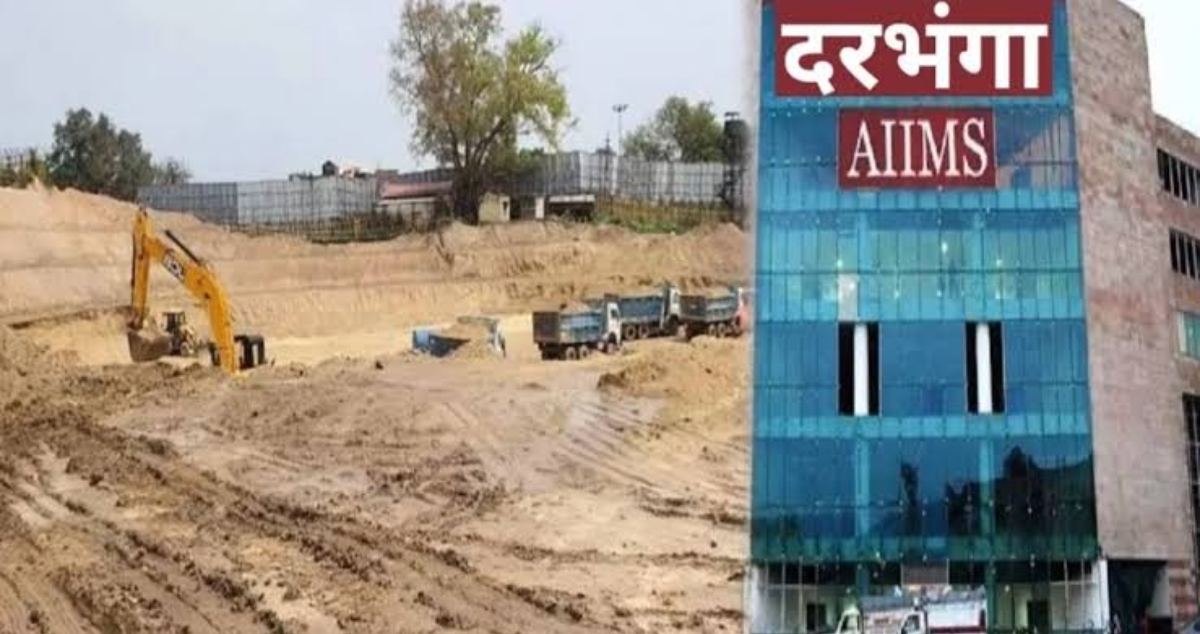
Darbhanga: The construction of Darbhanga AIIMS near the Ekmi-Shobhan Bypass is expected to have an impact beyond healthcare. As the project progresses, nearby villages could see changes in land demand, employment, local businesses, rental housing and transport services.

The development of a major medical institution typically creates demand for a range of supporting services. In Darbhanga, construction activity has already increased movement of workers, contractors and suppliers around the project area.
The project is therefore being viewed as a potential catalyst for the local economy, although the scale of its long-term impact will depend on the pace of construction and eventual operationalisation of the institute.

Land Demand Could Increase Around AIIMS
Around 187 acres of land have been transferred to the Centre for the Darbhanga AIIMS project.
Construction-related activities, including land levelling and boundary work, are already taking place. A boundary wall extending for around 5.3 kilometres is also part of the initial development.
As construction progresses, demand for land and commercial spaces around the project area could increase. This may create new opportunities for landowners, property-related businesses and local traders.
Small Shops Could Give Rise to a New Local Market
The growing workforce around a large construction project can create demand for everyday services.
Tea and snack stalls, grocery shops, general stores, hardware outlets, mobile repair shops, photocopy centres and printing businesses could benefit from the expanding customer base.
Once AIIMS becomes operational, the arrival of doctors, nurses, employees, patients and their families could further increase demand for medical stores, diagnostic services, restaurants and other businesses around the campus.
Rental Homes and PGs May See Higher Demand
Housing could become another important source of income for residents of nearby villages.
During the construction phase, workers and supervisors may require accommodation. Once the institute becomes operational, employees, students and other people associated with the medical campus could create additional demand for rented rooms and paying guest (PG) accommodation.
Local residents with suitable houses or additional rooms could potentially use them as an additional source of rental income.
Local Youth Could Find New Employment Opportunities
The operation of a large medical institution is likely to generate demand for both medical and non-medical services.
Apart from healthcare professionals, opportunities could emerge in areas such as data entry, reception, housekeeping, cleaning, catering and other support services, depending on the institute’s staffing requirements.
The surrounding service economy could also expand, creating work opportunities in auto-rickshaws, e-rickshaws, taxis, laundry services and food delivery.
Connectivity and Civic Infrastructure Could Improve
A major medical institute requires reliable road connectivity and supporting infrastructure.
As development around Darbhanga AIIMS progresses, attention may increase on approach roads, street lighting, electricity, water supply and drainage.
The growth of the area could also encourage the development of banks, ATMs, hotels, restaurants and other urban services, although the extent of such development will depend on planning and private investment.
Economic Opportunities Could Come With New Challenges
The expected economic activity could bring new sources of income for nearby villages, but rapid development may also create challenges.
Higher traffic, congestion, waste generation, sewage management and rising rents could become issues as the area attracts more people and businesses.
The land transfer, boundary construction and levelling work undertaken during 2024–2026 represent the initial stages of the project. Further development of the main hospital building, academic facilities and residential infrastructure could have a greater impact on the surrounding area.
The project’s completion target has been reported as 2029. As construction advances, the development around Darbhanga AIIMS could gradually influence the economic landscape of nearby villages, particularly through employment, services, rentals and supporting businesses.