Patna : The Bihar Transport Department is expanding the state’s electric vehicle (EV) charging infrastructure, with charging stations for electric buses and private vehicles being developed across five cities. A bus charging station in Purnia has been completed, while construction is underway in Patna, Muzaffarpur, Darbhanga and Gaya.

The initiative aims to improve access to charging facilities for electric buses, cars, two-wheelers and three-wheelers. It also includes fast-charging stations at government premises in Patna that will be open to the general public.
According to the department, the planned infrastructure will reduce charging time for electric vehicles and support the wider adoption of electric transport across Bihar.

Eight Charging Points Planned At Each Bus Depot
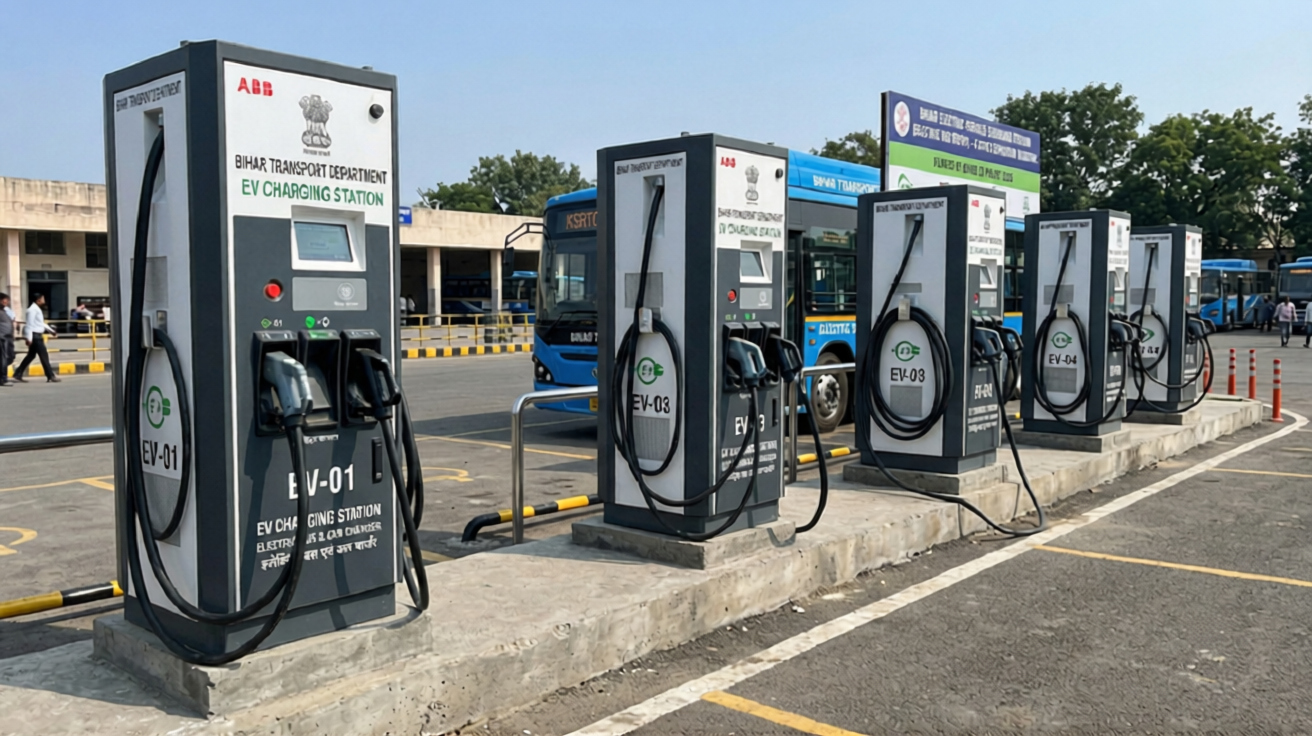
The Transport Department is developing charging facilities at bus depots to support electric bus operations. Each depot designed to accommodate 50 buses is being equipped with eight charging points.
According to the report, an electric bus will be able to charge in approximately one to one-and-a-half hours, depending on the charging conditions.
The charging station in Purnia has been completed, while work is continuing in Patna, Muzaffarpur, Darbhanga and Gaya.
Charging stations are already operational at bus depots in Phulwarisharif, Rajgir and Muzaffarpur, providing facilities for electric bus operations.
Ten Government Premises In Patna To Get Fast Chargers
Fast DC charging stations are being installed at 10 major government premises in Patna for private electric vehicles.
The locations listed in the report include the Chief Secretariat, Bihar Legislative Assembly, Collectorate, Visvesvaraya Bhawan, Vikas Bhawan, Irrigation Bhawan, Kankarbagh Multi-Modal Hub, Beur Mor and Harding Road.
The stations are being developed under a memorandum of understanding between the Bihar Transport Department and Indian Oil Corporation Limited (IOCL).
Once operational, the fast chargers are expected to charge electric cars in approximately 45 to 60 minutes. Facilities for electric two-wheelers and three-wheelers will also be available.
Although the stations are being established on government premises, members of the public will also be able to use them, according to the report.
Bihar EV Policy 2026 Offers Charging Station Subsidy
The Bihar Electric Vehicle Policy 2026 provides financial incentives for setting up eligible public charging stations. Under the reported provision, applicants can receive a subsidy covering 25% of the cost of machinery and equipment, up to a maximum of Rs 10 lakh.
Charging stations can be established at government buildings, commercial complexes, hotels, hospitals, shopping malls, multiplexes, residential apartments and housing societies with more than five families.
The policy also allows charging infrastructure at petrol pumps, highway-side restaurants and eateries, bus stands and parking areas.
The incentives are intended to encourage investment in charging infrastructure and increase the availability of charging points beyond dedicated bus depots.
Charging Network To Support Wider EV Adoption
The expansion of charging facilities is part of Bihar’s efforts to make electric vehicles more practical for everyday travel and public transport.
Charging points at bus depots can support electric bus fleets, while fast chargers at accessible locations can help private vehicle owners recharge during their journeys.
The network’s expansion will depend on the completion and commissioning of ongoing projects, as well as the availability of charging facilities at additional public and commercial locations.
With projects planned across five cities and fast-charging stations being developed at 10 government premises in Patna, the Transport Department is working to strengthen the infrastructure needed to support electric mobility in Bihar.