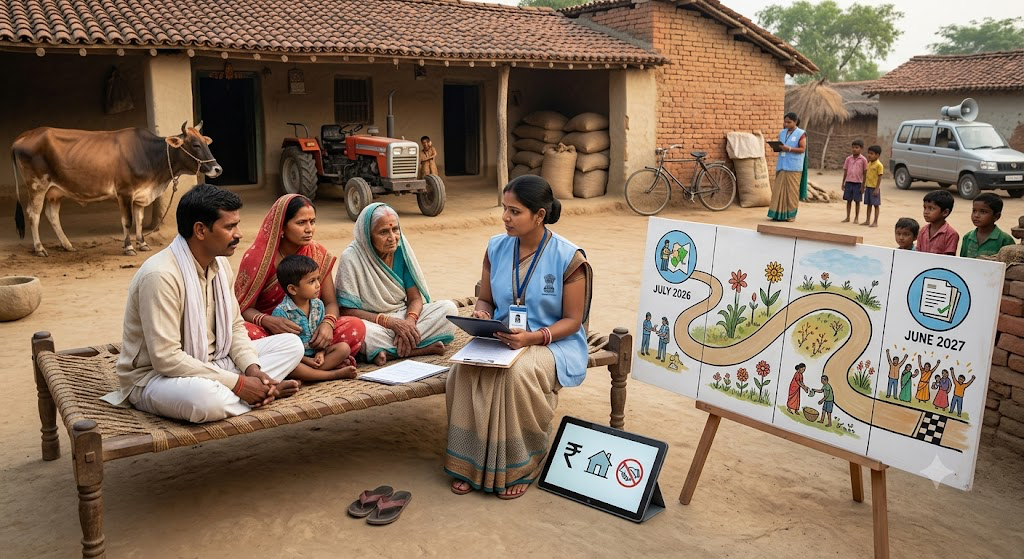
Patna: Households across Bihar will be approached by government survey teams to provide details about their economic conditions, including income, expenditure, property, agricultural earnings and outstanding loans. The exercise is part of the 81st round of the National Sample Survey (NSS) and is scheduled to continue until June 2027.

The Directorate of Economics and Statistics, Bihar, has begun fieldwork under the survey to collect information from selected households in rural and urban areas. The data will help the government assess household finances, understand economic challenges and improve the formulation of welfare and development policies.
Officials have clarified that the personal information collected during the exercise will remain confidential. According to the state’s Planning and Development Department, the data will be used for statistical analysis and will not be used to determine an individual’s tax liability or initiate legal action against them.

Two Major Surveys to Assess Household Finances
The ongoing exercise focuses on two key areas: assessing the economic condition of agricultural households and examining household debt and investment across the country.
The findings are expected to provide insights into income sources, household assets, liabilities and the financial challenges faced by different sections of society.
Agricultural Households’ Income Under Review
The agricultural household survey will assess the financial condition of farming families in rural areas. Enumerators will collect information about earnings from farming, horticulture, animal husbandry and other sources.
The survey will also examine agricultural expenditure and the income households generate through farming and non-farming activities. This information could help policymakers understand farmers’ dependence on different income sources and the relationship between cultivation costs and earnings.
The findings may inform decisions related to agricultural support programmes, farming policies and rural development initiatives.
Property, Investments and Outstanding Loans
The All-India Debt and Investment Survey will examine households’ assets and financial liabilities. The information collected will include details about property such as houses and land, vehicles and other assets, along with loans taken from banks, moneylenders and other sources.
The survey will also assess household investments and outstanding liabilities to develop a broader picture of families’ financial positions and debt burdens.
These findings could help policymakers identify economic vulnerabilities, assess access to credit and review the financial challenges faced by households in rural and urban areas.
How Will the Government Use the Data?
The information gathered through the surveys will be used for broader statistical analysis rather than to disclose individual households’ finances, officials have said.
The findings could support the assessment of poverty alleviation programmes, agricultural assistance, employment generation initiatives and other financial and development policies. They may also help the government understand differences in income sources, expenditure patterns and debt levels across household groups.
What Should Residents Do When Survey Teams Visit?
The Directorate of Economics and Statistics has urged residents to cooperate with authorised enumerators and provide accurate information.
Residents should first check the enumerator’s identity card before answering questions. They should then provide complete and truthful details about their income, expenditure, assets and loans.
Accurate responses are important to ensure that the survey reflects the actual economic conditions of the households included in the exercise.
The survey, scheduled to continue until June 2027, is intended to provide a clearer picture of household finances and help the government make more informed decisions on development and welfare policies.