Patna: Nearly 92% of Bihar’s non-agricultural unorganised business establishments are located outside Patna, highlighting the importance of smaller cities, towns and rural markets in the state’s economy, according to the figures provided from the National Statistical Office (NSO) report.

Bihar has more than 4.319 million (43.19 lakh) establishments in the non-agricultural unorganised sector, employing approximately 5.851 million (58.51 lakh) people. Patna accounts for 8.23% of these establishments, while the remaining districts account for 91.77%.
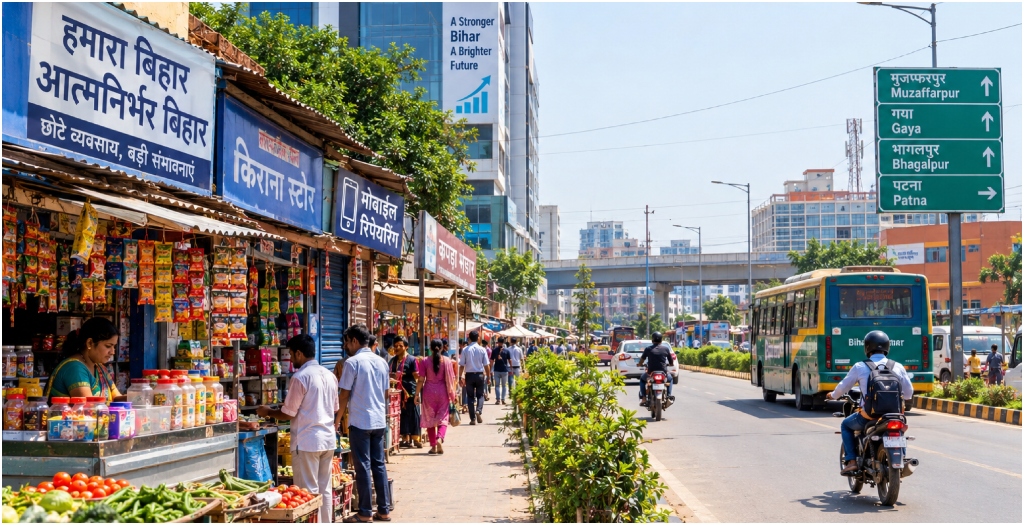
The figures point to a widely distributed network of small businesses, including retail shops, repair units, food businesses, transport services and small-scale manufacturing enterprises.

Rural And Semi-Urban Areas Drive Employment
Rural and semi-urban areas account for approximately 4.36 million (43.6 lakh) workers, or nearly 74% of employment in the sector. Urban areas account for around 1.66 million (16.6 lakh) workers, representing the remaining 26%.
The data indicates that small businesses are an important source of livelihoods beyond Bihar’s major cities. Local markets, agricultural services, food processing, transport and repair businesses support economic activity in districts where formal industrial employment may be limited.
Women account for approximately 927,000 (9.27 lakh) workers in the state’s non-agricultural unorganised sector, according to the supplied figures.
Muzaffarpur, Gaya And Bhagalpur Emerge As Commercial Centres
Beyond Patna, Muzaffarpur in North Bihar, Gaya in South Bihar, Bhagalpur in the Anga region and Chhapra in the Saran division are identified as important centres for trade, services and small-scale manufacturing.
Their commercial activity is supported by local populations, established marketplaces and transport connectivity. Businesses in these centres include trading units, manufacturing workshops and repair services that cater to surrounding towns and villages.
The wider network of commercial activity also extends across districts such as East Champaran, West Champaran, Samastipur, Madhubani and Darbhanga, where small enterprises support retail trade, handloom work, traditional crafts, agricultural equipment repair and food processing.
In Purnia, Katihar, Araria, Kishanganj, Saharsa and Supaul, local economic activity is closely linked to agriculture-related businesses, weekly markets and transport services.
Sole Proprietorships Account For 99.3% Of Establishments
The figures show that 99.3% of Bihar’s non-agricultural unorganised establishments operate as sole proprietorships, underlining the predominance of individually owned businesses.
These enterprises range from neighbourhood shops and market stalls to small workshops and service providers. Their presence across rural and semi-urban locations makes them a significant part of the state’s local economic network.
However, the figures alone do not establish how many of these businesses are newly created, how quickly they are growing or how much income they generate.
Food Businesses Provide Employment Opportunities
Bihar’s food sector also contributes to employment, particularly through small and informal enterprises.
The supplied figures indicate that women account for 52% of the workforce in the state’s food sector, compared with a national average of 41%. Around 190,000 workers from Bihar’s food sector are registered on the e-Shram portal, placing the state second nationally after Uttar Pradesh, which has approximately 382,000 registered workers.
More than 436,000 people are also engaged in street food businesses, roadside eateries known as dhabas, and mobile vending or cart-based enterprises.
These activities provide opportunities for self-employment and support local demand across cities, towns and villages.
Small Enterprises Expand Across Southern And Central Bihar
Districts including Rohtas, Bhojpur, Nalanda, Nawada, Aurangabad, Jamui, Banka, Lakhisarai, Sheikhpura, Jehanabad and Arwal have a range of small businesses linked to local demand and self-employment.
In Rohtas, Bhojpur and Nalanda, education, transport, repair services and trading are among the activities supporting rural and semi-urban economies.
In Nawada, Aurangabad, Lakhisarai, Sheikhpura, Jehanabad and Arwal, small businesses and self-employment initiatives form part of the local economic landscape. Access to finance, including microcredit, may support these activities, although the supplied figures do not quantify its specific contribution.
In parts of Jamui, Banka and Rohtas, small-scale manufacturing and activities linked to local forest produce also contribute to livelihoods.
What The Figures Reveal About Bihar’s Economy
The distribution of establishments suggests that Bihar’s small-business economy extends well beyond Patna. Commercial centres such as Muzaffarpur, Gaya, Bhagalpur and Saran serve wider regional markets, while smaller enterprises sustain employment in rural and semi-urban districts.
With more than 43 lakh establishments and nearly 59 lakh workers in the non-agricultural unorganised sector, these businesses represent a substantial part of the state’s employment base.
The figures also highlight the importance of understanding economic activity at the district level, particularly when assessing employment opportunities, access to finance and the development of local markets.