
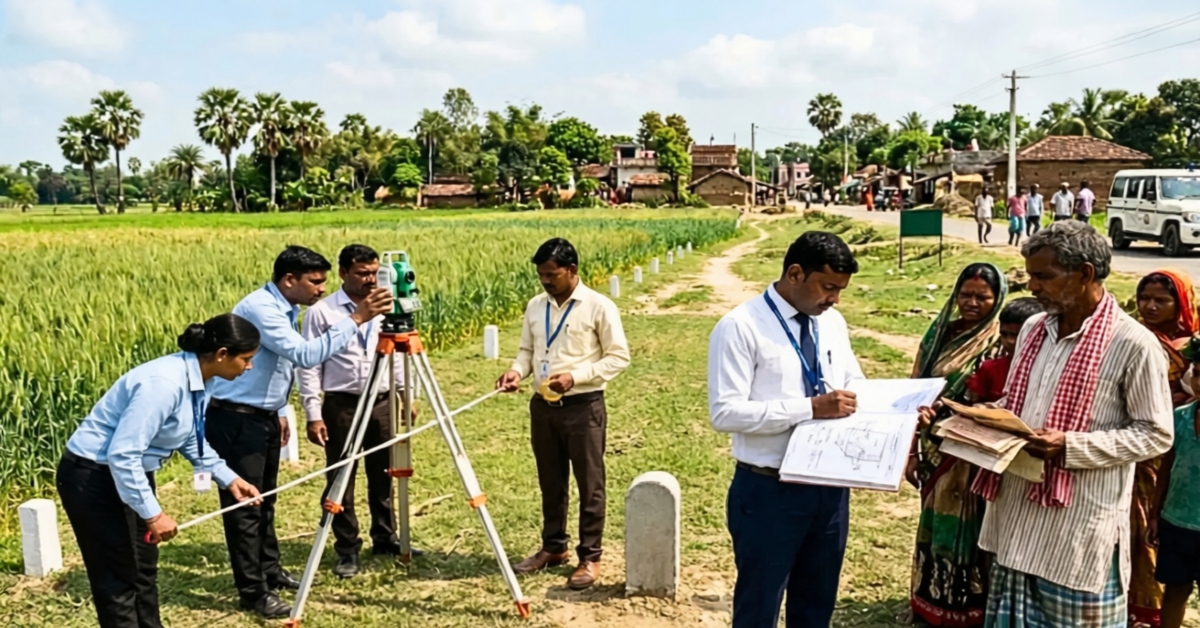
Patna : The Bihar government has approved the Bihar Raiyati Land Purchase Policy 2026, introducing a framework to purchase privately owned land for government projects through mutual consent. The policy provides for compensation of up to four times the applicable land value in rural areas and twice the value in urban areas, along with an additional 10% incentive for landowners.

The policy also provides exemptions from stamp duty and registration fees for land purchased under the new arrangement. The government aims to simplify land procurement, reduce prolonged legal disputes and facilitate infrastructure development, including proposed satellite townships in Patna and Gaya.
Rural Landowners To Get Up To Four Times Compensation

Under the new policy, compensation for rural land will be calculated at up to four times the higher of the market value or the applicable circle rate. In urban areas, compensation will be up to twice the applicable value.
Landowners will also receive an additional 10% incentive over the prescribed compensation. The exemption from stamp duty and registration fees is intended to reduce the financial burden associated with land transactions for government projects.
The policy is designed to make land procurement more attractive to private landowners while helping the government secure land for public infrastructure.
Land To Be Purchased Through Mutual Consent
A key feature of the policy is that the government will negotiate directly with landowners to purchase their property with their consent. The arrangement is intended to provide an alternative to compulsory land acquisition and help minimise disputes over land procurement.
Projects covered by the broader land procurement framework may include roads, bridges, railway infrastructure and hospitals, among other public facilities.
The government has also emphasised a more transparent and convenient process for acquiring land for development projects.
District Panels To Decide On Projects Worth Up To Rs 100 Crore
The policy establishes separate decision-making arrangements based on project costs.
For projects costing up to Rs 100 crore, a district-level committee chaired by the District Magistrate will take decisions on land purchases. For projects exceeding Rs 100 crore, the decision will be taken by a committee headed by the divisional commissioner.
The tiered structure is intended to ensure that land procurement decisions are handled at the appropriate administrative level, depending on the scale of the project.
Three Options For Procuring Land In Bihar
The state government will have three options for securing land for public projects: the new Raiyati Land Purchase Policy 2026, direct land acquisition and land pooling.
Under the new purchase policy, land will be bought through mutual consent. The government may also use the formal land acquisition process, under which the stated compensation provisions provide for up to four times the applicable value in rural areas and twice the value in urban areas.
The third option, land pooling, involves collecting land from owners, developing the area and returning a portion of the developed land to them.
Under the arrangement described in the policy framework, 55% of the land taken for pooling will be returned to landowners in a developed form. The returned plots are expected to benefit from infrastructure such as roads, electricity, water supply and sewerage.
How Land Pooling Could Benefit Owners
Land pooling allows landowners to participate in the development of an area rather than receive only monetary compensation for their land.
After the land is pooled, infrastructure and other facilities are developed across the project area. Landowners then receive their designated share of the developed land, which may gain value as the township or surrounding area develops.
The model is intended to balance the government’s land requirements with the interests of existing landowners by giving them a stake in the future development of the area.
Talks With Farmers Underway For Patna And Gaya Townships
Following the policy’s approval, the Urban Development and Housing Department has begun discussions with farmers for proposed townships in Pataliputra in Patna and Gaya.
Officials are explaining the three available options—land purchase through mutual consent, direct acquisition and land pooling—to help landowners understand the arrangements and make an informed choice.
The government expects the new framework to make it easier to assemble land for satellite townships while offering landowners compensation or participation in development, depending on the option adopted.
The effectiveness of the policy will depend on its implementation, the terms offered to individual landowners and the progress of negotiations for the proposed projects.