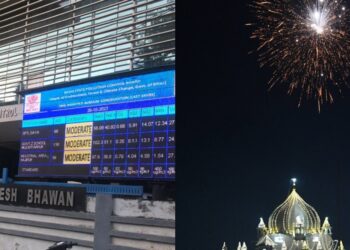
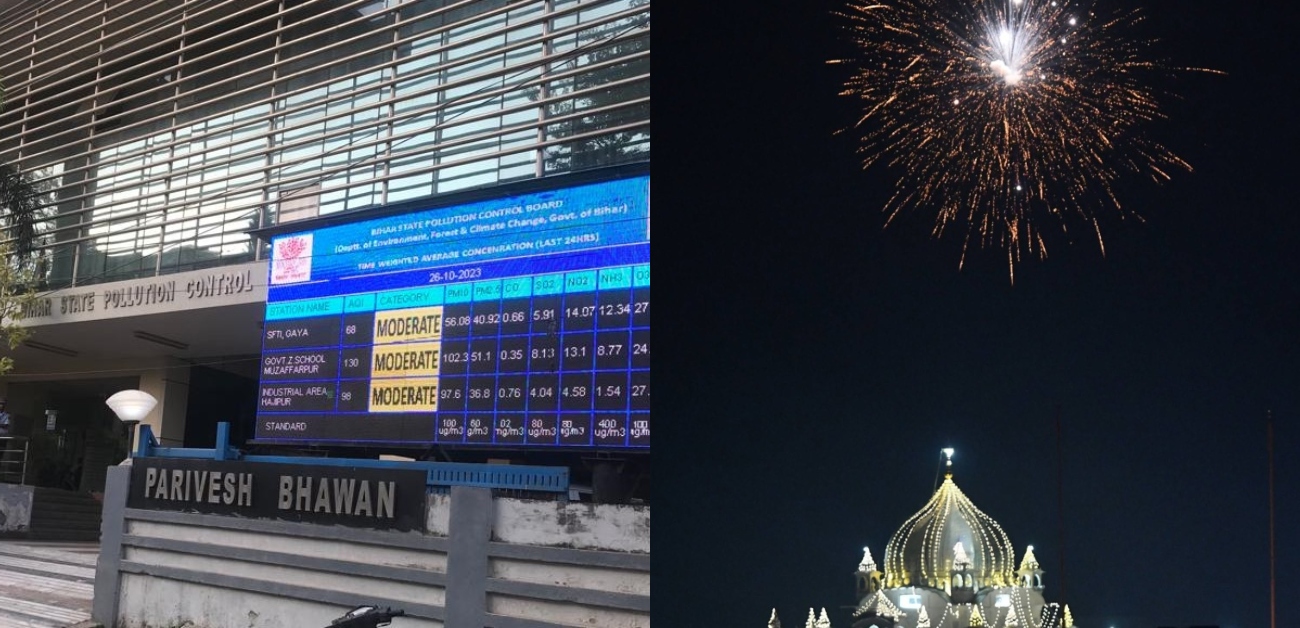
Patna: Air quality across Bihar remained comparatively better after Diwali this year than in the previous three years, with the state’s average Air Quality Index (AQI) recorded at 188 on November 9, according to a statement issued by the Bihar State Pollution Control Board (BSPCB) on Monday.

The average AQI was 276 in 2023, 207 in 2024 and 117 in 2025, before rising to 188 this year. Despite the increase compared with last year, the board said the overall air quality situation had improved by around 32% compared with 2023.
The number of cities falling in the ‘very poor’ category also declined from 12 last year to two this year, according to the board’s assessment based on the Central Pollution Control Board (CPCB) bulletin.

Hajipur Records Highest AQI In Bihar
Among the 30 cities monitored, Hajipur recorded the highest AQI at 335, placing it in the ‘very poor’ category. It was ranked 16th among the 20 most polluted cities in the country on November 9.
Bettiah was the other Bihar city in the ‘very poor’ category, with an AQI of 304.
Patna recorded an AQI of 280, followed by Arrah at 290, Muzaffarpur at 286, Siwan at 256 and Begusarai at 228. All these cities fell in the ‘poor’ category.
The AQI readings for other cities included:
- Kiul: 228
- Madhubani: 212
- Buxar: 202
- Bhagalpur: 191
- Motihari: 190
- Gopalganj: 190
- Bihar Sharif: 190
- Araria: 175
- Manguraha: 167
- Rajgir: 165
- Gayaji: 161
- Jamui: 155
- Chhapra: 154
- Darbhanga: 153
- Kishanganj: 148
- Samastipur: 142
- Aurangabad: 139
- Katihar: 136
- Saharsa: 128
- Purnia: 124
- Munger: 119
- Sitamarhi: 110
- Sasaram: 87
The board noted that Kiul, Madhubani, Gopalganj, Jamui, Darbhanga and Sitamarhi have newly established air-quality monitoring stations that became operational in September-October 2026. Therefore, comparable data for previous years is unavailable for these locations.
Lower AQI Compared With 2023 And 2024
The board’s comparative assessment shows that Bihar’s average post-Diwali AQI was 276 in 2023, 208 in 2024, 117 in 2025 and 188 in 2026.
While the state recorded a higher average than last year, the figure remained substantially below the levels recorded in 2023 and 2024.
The number of cities in the ‘very poor’ category has also declined to two, compared with 12 in 2025, according to the press release.
Weather Conditions May Affect Pollution Levels
The BSPCB said this year’s Diwali was celebrated in November, when meteorological conditions differ from those prevailing during October, when the festival was observed last year.
According to the board, the entire Indo-Gangetic Plain experienced conditions favourable to the slower dispersal of pollutants, including a lower mixing height, nocturnal temperature inversion, slow wind speeds and fog.
These conditions can contribute to the accumulation of pollutants in the atmosphere. The board also noted that similar meteorological conditions had been observed in Delhi-NCR, Haryana, Uttar Pradesh and Punjab.
The press release cited the IITM Pune WRF-Chem model forecast, which indicated elevated PM2.5 concentrations of approximately 120-200 micrograms per cubic metre over the Indo-Gangetic Plain, including Bihar, between November 8 and 10.
Board Monitoring Air Quality
The Bihar State Pollution Control Board said air quality across the state was being continuously monitored and that the government was taking necessary measures to address pollution.
It expressed the expectation that air quality would gradually improve over the coming days.
The comparative figures were based on the CPCB National AQI Bulletin, using the 4pm readings and 24-hour average on the day after Diwali for each year. The board’s press release was issued on November 9, 2026.