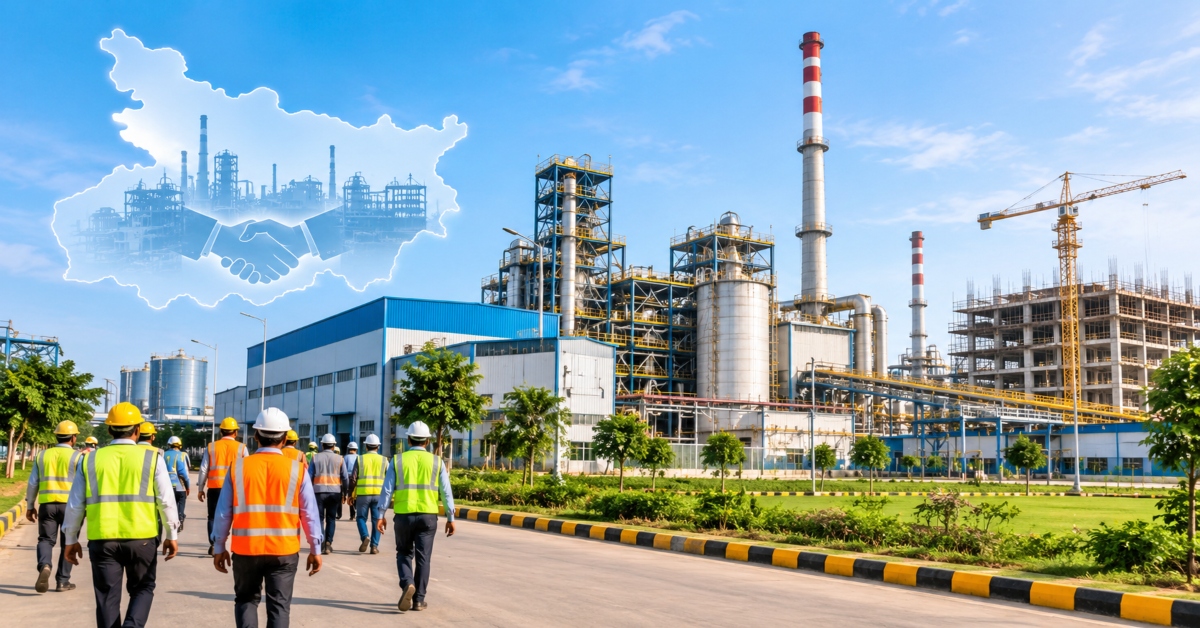
Patna: Bihar is moving beyond its traditional agriculture-based economy to establish a stronger industrial identity, with major investments, established industrial units and projects under development across several districts.

Industrial activity in sectors such as food processing, cement, energy, biofuel, plastics, dairy, information technology, textiles and healthcare is expected to bring significant changes to the state’s economic landscape.
The expansion is also expected to create employment opportunities, encourage skill development and strengthen supply chains connecting industries with local farmers and small entrepreneurs.

According to the available project details, 40 major industrial units have been listed in Bihar Industrial Area Development Authority (BIADA) industrial areas. Another 19 large projects are proposed or operational outside these industrial zones.
The projects involve national-level and major private companies, indicating that industrial investment is spreading across different parts of Bihar rather than remaining concentrated in a few cities.
The Bihar Industrial Investment Promotion Package 2025 includes provisions for land concessions at BIADA rates and other incentives aimed at attracting investment and encouraging industrial development.
Patna And Nearby Areas Expand From Technology To Food Processing
Patna and its surrounding industrial areas are emerging as important locations for projects in technology, manufacturing and food processing.
Fatuha has projects involving Supreme Industries’ plastic products unit and a dairy processing facility. In Bihta-Sikandarpur, Haldiram is associated with a manufacturing unit for namkeen, sweets and snacks.
CtrlS’s data centre is another important addition to the region’s industrial infrastructure.
A particularly notable project is Ampera Life India’s biosensor and electronic products facility, involving an investment of Rs 5,600 crore.
Other projects listed in Patna include rice and pulse mills, maize processing units, a paper mill and a multispeciality hospital.
These developments are expected to diversify industrial activity around the state capital, bringing manufacturing, food processing and technology-related businesses into the region.
Muzaffarpur, Begusarai And Darbhanga Emerge As Industrial Centres
Industrial projects in Muzaffarpur’s Motipur and Bariyarpur areas cover cement grinding, ethanol, compressed biogas, solar modules and construction materials.
Begusarai is seeing activity across food processing, plastics and ethanol, with units associated with Varun Beverages, Prince Pipes, EPIC Agro Products and New Way Home.
In Khagaria, the Pristine Mega Food Park is expected to support maize-based industries and agricultural logistics, strengthening the connection between farming and industrial processing.
Projects in Darbhanga, Madhubani and Samastipur include cement, biofuel, e-waste recycling, textiles and dairy processing. These developments are expected to create a wider industrial base across north Bihar.
Investment Expands From Bhagalpur To Purnia
Bhagalpur’s Pirpainti area is home to one of the state’s largest proposed industrial projects: Adani Power’s thermal power project, valued at Rs 28,225 crore.
A logistics park is also under development in the region, with around 80 per cent construction progress reported in the project details.
Gopalganj has industrial activity linked to sugar, ethanol, dairy, hotels and warehousing.
In Purnia’s Banmankhi, a citric acid manufacturing project has been listed, while a food processing unit in Araria’s Forbesganj is among the projects contributing to industrial expansion in the region.
The spread of projects across these districts highlights the growing geographical reach of investment in Bihar, with opportunities emerging in both established and developing industrial locations.
Investment Expected To Open New Employment Opportunities
Employment generation is one of the key expected outcomes of Bihar’s industrial expansion.
Project documents indicate that several units could create hundreds or thousands of jobs. The growth of cement, food processing, energy, dairy and technology industries is expected to open new employment avenues for local youth.
The expansion could also increase demand for skilled workers, encourage vocational training and strengthen supply chains involving farmers and small businesses.
With projects spread across multiple districts and a mix of established companies and new investments, Bihar’s industrial development is increasingly taking shape across a wider geographical area.
The scale of employment and economic benefits will depend on the progress, commissioning and operational capacity of the projects. As these investments move forward, they are expected to play an important role in diversifying Bihar’s economy and creating new opportunities for its workforce.