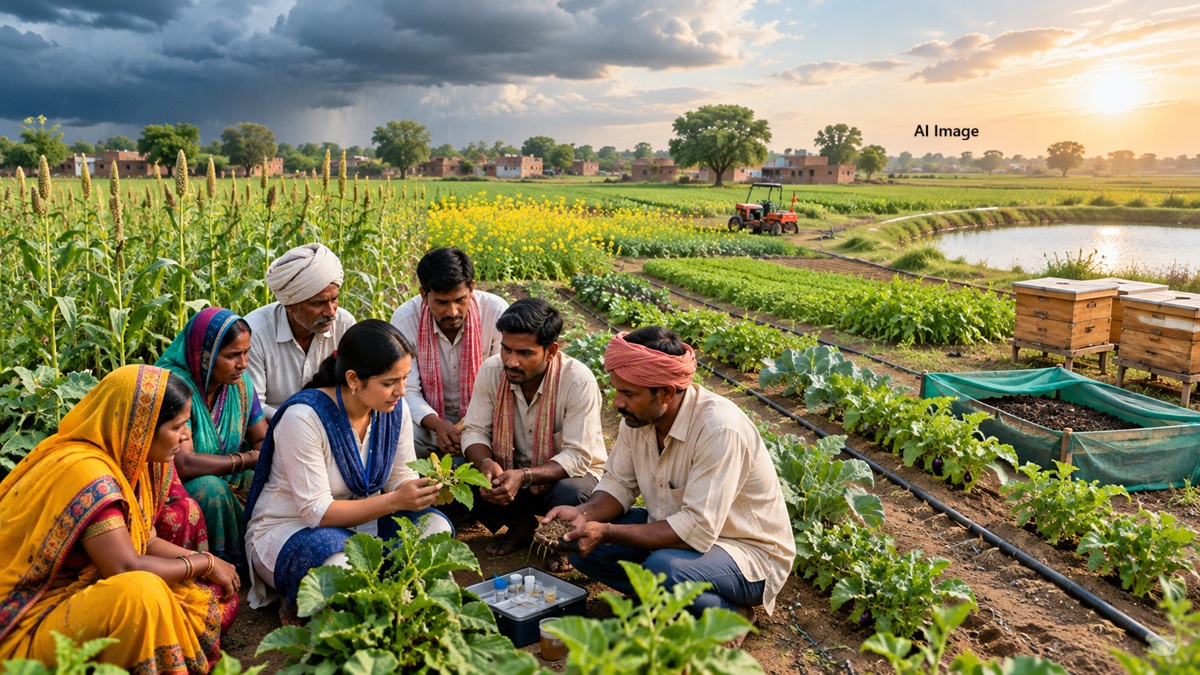
The programme will cover 120 primary villages and 1,080 secondary villages. Five primary villages in each district will be developed as climate-resilient farming centres, with nine surrounding villages linked to each primary village to extend the reach of modern agricultural practices.

Farmers from the secondary villages will be invited to the primary villages for training in modern farming techniques, crop management and climate-resilient agricultural practices. The programme aims to reduce the adverse effects of changing weather patterns, improve agricultural productivity and promote sustainable farming.
Kalpana Kumari, Additional Secretary in the Agriculture Department, has written to the concerned districts regarding the implementation of the programme.

Demonstrations Across 1,150 Acres
Under the programme, crop demonstrations will be conducted across 750 acres during the rabi season and 400 acres during the summer, or garma, season.
Climate-resilient farming initiatives will promote millets and other coarse cereals, oilseeds, pulses, spices and horticultural crops. Each district will also have a 30-acre seed hub to support seed production and availability.
Other planned activities include soil testing, the use of leaf colour charts for better nutrient management, custom hiring centres for agricultural equipment, bee boxes and vermicompost units.
These interventions are intended to improve soil health, encourage balanced fertiliser use, conserve water and promote better management of agricultural resources.
Focus on Floods, Drought and Changing Temperatures
The programme will prepare farmers to manage weather-related challenges, including floods, droughts, deficient rainfall and fluctuations in temperature, which can adversely affect crop yields.
Farmers will receive information on modern agricultural techniques, improved seeds, balanced fertiliser application, water conservation and soil health management. The initiative will also focus on the efficient use of available resources and the wider adoption of sustainable farming practices.
Dr Sumit Saurabh, District Agriculture Officer, Samastipur, said the programme aims to prepare farmers to deal with changing weather conditions and reduce the impact of climate change on agriculture.
24 Districts Selected for the Programme
The programme will be implemented in the following districts:
Samastipur, Patna, Muzaffarpur, Darbhanga, East Champaran, Sheohar, Sitamarhi, West Champaran, Saran, Araria, Arwal, Bhagalpur, Bhojpur, Jehanabad, Kishanganj, Lakhisarai, Madhepura, Rohtas, Saharsa, Supaul, Begusarai, Purnia, Katihar and Vaishali.
The Agriculture Department, Patna, will serve as the nodal office for the programme.
Registered Farmers Eligible for Selection
Farmers will be selected from those registered on the Agriculture Department’s Direct Benefit Transfer (DBT) portal. Under the prescribed eligibility criteria, selected farmers must have a minimum landholding of 0.5 acres and a maximum of three acres.
The programme will focus on spreading climate-resilient agricultural practices across the selected villages through farmer training, field demonstrations and improved access to agricultural resources.
By linking primary villages with surrounding secondary villages, the initiative seeks to extend the adoption of climate-resilient farming techniques to a wider number of farmers across Bihar.