Patna: Winter conditions tightened their grip across Bihar on Sunday, with biting cold and dense fog affecting all 38 districts of the state. The India Meteorological Centre has issued a cold day orange alert for 16 districts, while dense fog warnings are in place for 22 districts, raising concerns over daily life and transport disruptions.

According to the Meteorological Centre, humidity levels in the air have crossed 90 percent, significantly reducing the gap between maximum and minimum temperatures. As a result, residents are experiencing night-like cold conditions even during daytime hours. Although the weather remained dry across the state over the past 24 hours, falling temperatures and persistent fog have added to public discomfort. Officials said there is little chance of relief from cold and fog over the next five to six days.
In districts under the cold day alert, daytime temperatures are expected to remain well below normal. Morning hours are likely to see dense fog, severely impacting road, rail and air traffic. On Saturday, two flights were cancelled and 11 flights were delayed due to poor visibility.

Flight, Train Services Hit by Dense Fog
Air and rail movement continued to suffer as thick fog disrupted schedules. On Saturday, one flight each to Delhi and Kolkata was cancelled, while 11 flights operated behind schedule. More than 15 trains, including the Tejas Rajdhani Express, were delayed.
At Patna airport, the first arrival of the day was an IndiGo flight from Delhi at 10.50 am. The longest delay was reported for an IndiGo flight from Kolkata, which landed at 4.55 pm, nearly one hour and 40 minutes behind schedule.
Due to the cancellation of two flights, around 710 passengers were unable to travel. Officials from Air India and IndiGo said passengers were informed in advance about the cancellations, and those who had already reached the airport were accommodated on alternative flights to Delhi and Kolkata.
Temperature Drops Across State, Patna Sees Narrow Gap
During the last 24 hours, the lowest minimum temperature in the state was recorded at 12 degrees Celsius in Sabour (Bhagalpur) and Dehri (Rohtas). In Patna, the minimum temperature stood at 12.8 degrees Celsius, while the maximum temperature was recorded at 16.6 degrees Celsius on Saturday. This resulted in a narrow temperature difference of just 3.8 degrees, intensifying the cold day conditions in the capital.
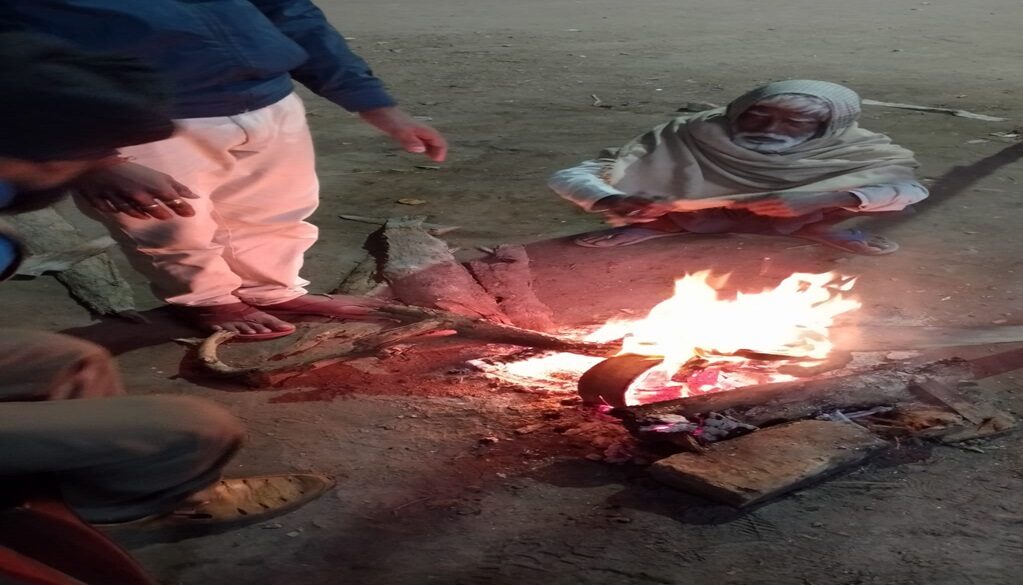
Visuals from different districts showed residents gathering around bonfires in Gopalganj, dense fog blanketing Munger on Saturday morning, and children and youth in Ara using open fires to keep warm.
Why Cold Day Conditions Are Forming
Meteorological experts said the prevailing cold and fog are due to reduced wind speed and high moisture content in the atmosphere. When winds remain calm and humidity stays high, daytime temperatures fail to rise, leading to cold day conditions. Scientists warned that the impact of cold and fog is likely to persist for the next few days.
Air Quality Worsens in Patna
Alongside cold weather, air pollution levels have also risen in Patna. On Saturday evening at 4 pm, the city’s average Air Quality Index was recorded at 170, falling in the poor category. AQI levels crossed 200 near Gandhi Maidan and Veterinary College areas, while Danapur, Secretariat, Patna City and Taramandal areas recorded slightly lower but still concerning levels.
Officials attributed the rise in pollution to the absence of strong morning winds and persistent fog. PM2.5 and PM10 levels were found to be more than double the permissible limits, as moisture in the air caused road dust to remain suspended in the lower atmosphere.
Patna Weather Forecast Today
The cold wave is expected to continue in Patna, with dense fog likely during morning hours. Sunshine may remain weak during the day, keeping temperatures below normal. Residents are likely to feel cold throughout the day.
What Is a Cold Day?
In India, a “cold day” is declared when daytime temperatures remain significantly below normal despite the presence of sunlight. This phenomenon is common in the northern plains during December and January, when dense fog or cloud cover prevents daytime warming. Cold day conditions are often linked to fog, limited sunshine and cold northerly winds, and may pose health risks, especially respiratory problems. Several parts of north India are currently experiencing cold day conditions.