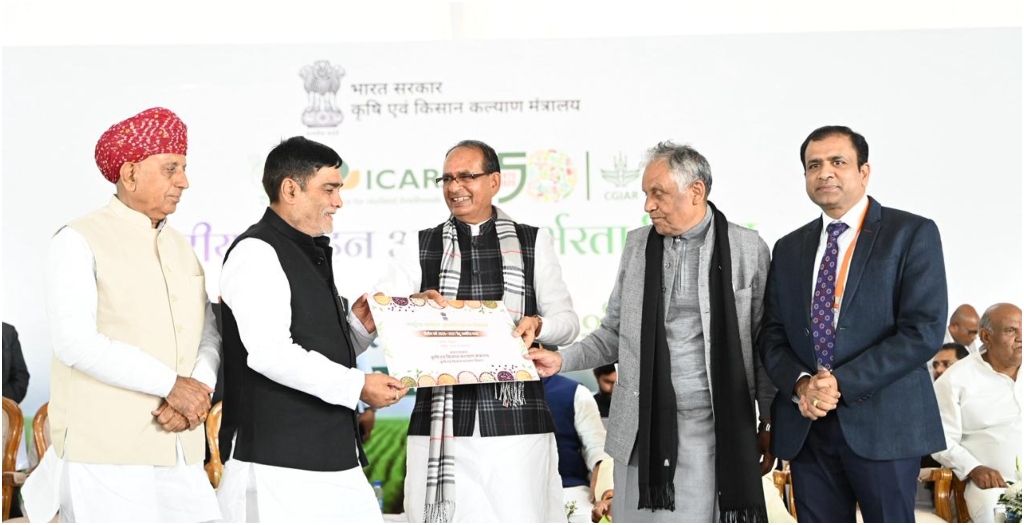
Patna: Bihar agriculture department has started an important journey to become self-reliant in the production of pulses such as lentils, chickpeas and pigeon peas. Speaking at a national agriculture meeting in Sehore, Madhya Pradesh, Bihar’s Agriculture Minister Ram Kripal Yadav said the new National Pulses Self-Reliance Mission will change the future of farmers and improve food security in the country. The programme was launched by Union Agriculture Minister Shivraj Singh Chauhan and marks a new effort to reduce India’s dependence on imported pulses. At the same event, new research buildings, farmer training centres and modern laboratories were opened to help develop better pulse crops.

The minister said Bihar needs special help from the central government because most of the state depends on rain for farming and often faces floods and droughts. He requested a special pulses development package for Bihar so that farmers can get better seeds, irrigation support and modern farming tools. The state government has set a clear goal: Bihar should produce enough pulses for itself within the next five years. This, he said, will not only improve farmers’ income but also make nutritious food easily available to the poor.
To achieve this, the government will focus on five main pulse crops – pigeon pea, chickpea, lentil, black gram and green gram. A national seed hub is planned in Bihar to supply high-quality, fast-growing and disease-resistant seeds to farmers. The minister also said farming will be organised in clusters so that groups of farmers in the same area can get training, irrigation, machinery and advice together. Micro-irrigation systems such as drip and sprinklers will be promoted with up to 90 percent subsidy, especially in rain-fed areas.

The government also wants to improve the buying and selling system for pulses. Farmers will get machines for sowing and harvesting through custom hiring centres. Permanent procurement centres will be set up through agencies like NAFED and FCI so that farmers can sell their crops at Minimum Support Price. To create jobs and increase income, dal mills and processing units will be encouraged with special subsidies. Farmer Producer Organisations will also be supported to run these units.
Pulses are a major source of protein for poor families and are important for children and mothers. They also improve soil health by adding nitrogen naturally and reduce the need for chemical fertilisers. In 2024–25, pulses were grown on 4.48 lakh hectares in Bihar and produced 3.93 lakh metric tonnes, but this is still not enough for the state’s needs. Under the new mission, the government plans to more than double this production.
During the programme, the Union Agriculture Minister gave Rs 93.75 crore to support pulse farming in Bihar. Leaders also suggested holding a national pulses conference in the state. With this mission, Bihar hopes to build a stronger, healthier and more sustainable farming future for its people.