Patna: The ongoing conflict between the United States–Israel alliance and Iran may be thousands of kilometres away, but its ripple effects are being felt in Bihar, particularly in the food and hospitality sector. A shortage of commercial LPG cylinders has forced hotels, restaurants and roadside eateries across several districts to raise prices and alter their cooking methods.

The conflict, now continuing for nearly three weeks, has disrupted global energy supply chains, triggering a gas supply crunch in parts of India. In Bihar, the impact is visible from large hotels in Patna to small tea stalls in districts like Gayaji, Nalanda and Bhagalpur.
As the supply of commercial LPG cylinders shrinks, many food vendors have increased prices. Cutting tea that earlier cost Rs 5 is now being sold for Rs 10 in several places. The price of samosas has risen from Rs 10 to Rs 15, while a basic meal that earlier cost around Rs 80 is now priced between Rs 100 and Rs 120 in many eateries.

Patna: Hotels revise menus amid gas shortage
In the state capital, the gas shortage has forced hotels and restaurants to revise their menus and adopt alternative cooking methods. Many establishments are focusing on dishes that can be prepared using tandoors, induction stoves or coal-based cooking.
Hotels that receive piped natural gas (PNG) through pipelines have largely continued normal operations, while those dependent on commercial LPG cylinders are facing shortages.
At Panache Hotel in Patna, Vice President Operations Allen Christopher said the management has been reducing menu items and experimenting with cooking techniques that require less gas.
“Our kitchen earlier operated round the clock, but now we are closing by 11 pm. We are relying more on tandoors and induction cooking to manage the shortage,” he said.
Christopher added that mutton dishes have been temporarily removed from the menu because they require a longer cooking time and consume more gas. “We are prioritising dishes that need less fuel. Limited gas supply has resumed after a meeting between the district administration and Indian Oil Corporation, which allows us to prepare breakfast and essential meals for guests,” he said.
PNG connections offer relief
Some establishments have been spared the impact due to piped gas supply. Nitin, manager of Bikaner Sweets in Patna, said their operations remain unaffected because the outlet receives PNG through pipelines.
“We have not changed our food prices because the gas supply through PNG is continuing,” he said.
However, restaurants dependent on cylinders are facing difficulties. Vivek Kumar, manager of Take Away Express, said the number of cylinders being supplied has drastically reduced.
“Earlier we used to get around 10 cylinders, but now we are receiving only one. Fortunately, we still have some stock, so the menu has not been changed yet,” he said.
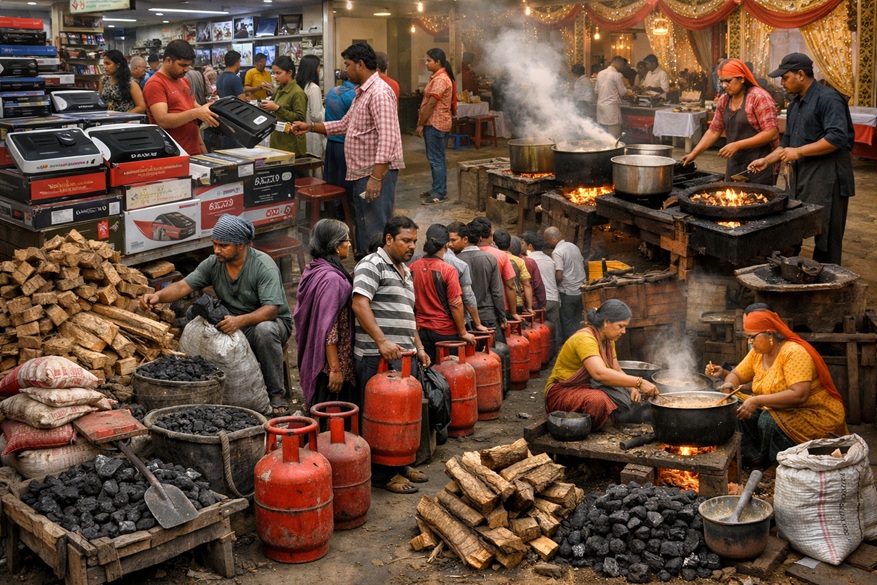
Some hotels have switched to coal-fired stoves. Rohit Kumar, chef at Banjara Hotel in Patna, said the kitchen is currently operating mainly on coal.
“We are receiving only one cylinder per day, so we are cooking on coal stoves. At present we are serving mainly South Indian dishes. Other menu items will resume once the gas supply improves,” he said.
Nalanda: Biryani and snacks now cooked on coal and wood
In Nalanda district, hotel and restaurant operators have shifted to coal and wood-fired stoves to continue operations.
Rajesh Prasad, owner of Kesariya Sweets on Mahatma Gandhi Road in Bihar Sharif, said the supply of commercial cylinders has almost stopped.
“We are now preparing samosas, rasgullas and other items on coal stoves. Coal prices have also increased from around Rs 13–14 per kilogram to Rs 15–20 per kilogram,” he said.
Some businesses, however, still have temporary relief. Rajneesh Ranjan, owner of Biryani House, said his outlet currently has sufficient LPG stock.
“Our operations are normal and we have not increased prices yet. But if the shortage continues, we may have to revise rates in the future,” he said.
Other hotel operators said cooking on wood stoves takes more time, leading to delays in serving customers and a decline in footfall.
Despite the crisis, some street food vendors selling items such as litti, laung-latta and gulab jamun at major intersections have not increased prices yet, saying they want to maintain customer trust.
Gayaji: Rs 5 tea disappears from stalls
In Gayaji, the gas shortage is directly affecting daily expenses of residents. Many tea stalls and small eateries have stopped selling tea for Rs 5. A cup of cutting tea now costs around Rs 10.
Several hotels have shifted to coal stoves, while some have begun using diesel-powered furnaces for cooking.
A hotel operator near Mirza Ghalib College said maintaining stock of commercial cylinders has become a major challenge.
“We are preparing most food items on coal stoves. Only tea, samosa and chole bhature are being cooked using gas,” he said.
Rahul Gupta, owner of Vandana Sweets and Namkeen on Pir Mansoor Road, said his shop still has a limited cylinder stock but has prepared a diesel furnace as a backup.
“If the crisis worsens, we will start using the diesel furnace,” he said.
Bhagalpur: Hotels shift fully to coal
In Bhagalpur, several hotels and restaurants have shifted almost entirely to coal-based cooking due to the LPG shortage.
Hotel operator Abhishek Kumar said the situation has become difficult for restaurant owners.
“Earlier we used commercial LPG cylinders, but now we are not getting gas. We are cooking entirely on coal stoves,” he said, adding that food prices have increased by around Rs 10 per plate.
He also said many cooks are reluctant to work with coal stoves due to the difficulty involved.
Another hotel owner, Rajkamal, said his kitchen earlier used both coal and gas, but now operates only on coal.
“Coal is cheaper than gas, but it is slower and more labor-intensive,” he said.
With the supply of commercial LPG cylinders still uncertain, restaurant owners across Bihar say they may be forced to revise menus and increase prices further if the shortage continues.