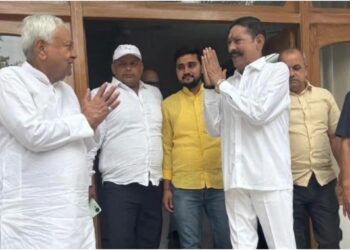
Patna: A quiet meeting held at the residence of Janata Dal (United) National Executive President Sanjay Jha on March 7 has sparked discussions about the emerging political role of Nishant Kumar, son of Bihar Chief Minister Nitish Kumar, within the party.

The meeting took place just hours after the announcement that Nitish Kumar would move to the Rajya Sabha. Around the same time, formalities were underway for Nishant Kumar to join the Janata Dal (United). Before the announcement, Nishant held what party sources described as a closed-door interaction with around 12 to 13 party MLAs.
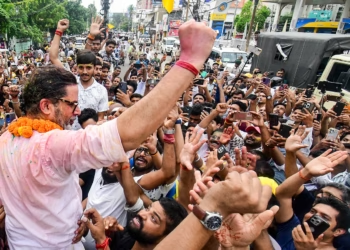
A video of the meeting, released later by the party without audio, showed Nishant Kumar interacting with the legislators. Soon after the meeting, the group was informally referred to as “Team Nishant”. Since then, members of this group have frequently accompanied Nishant Kumar during his public visits, including trips to his native village Kalyanbigha and during events such as the Ganga Aarti in Bakhtiyarpur.

A study of the members of “Team Nishant” suggests that it reflects a generational shift within the party, similar to trends seen in other political parties. The team also appears to follow the model of social engineering that has long been associated with Nitish Kumar’s political strategy.
According to party insiders, the groundwork for Nishant Kumar’s political entry had begun during the Assembly elections. While senior leaders publicly campaigned with the slogan “2025–30 Phir Se Nitish”, the party simultaneously introduced several new faces in the electoral contest.
The Janata Dal (United) contested 101 seats in the elections. While tickets were repeated for all sitting ministers, the party fielded 23 candidates who were contesting Assembly elections for the first time. Many of them went on to win their seats.
Four months after the elections, party observers believe that the move helped create a group of young leaders who could form Nishant Kumar’s core political support base. Sources indicate that Nishant Kumar is expected to play a significant role not only in the government but also in the organisational structure of the party in the coming years.
Party sources say he may be given a major responsibility during the party’s national executive and national council meetings scheduled for March 27.
The composition of the group also reflects an attempt to maintain caste and regional representation. Among the 14 MLAs associated with the team, four belong to the Kurmi community and one to the Koeri community. The group also includes three Rajputs, one Bhumihar and one Kayastha leader. In addition, two members each come from Dalit and Extremely Backward Classes (EBC) backgrounds.
Like Nitish Kumar’s political network, the team includes leaders representing different regions of Bihar. Several members are sons or relatives of established political figures from their respective areas.
For example, Ruhel Ranjan, son of Nitish Kumar’s trusted Nalanda associate Rajiv Ranjan, is part of the group. Similarly, Rituraj has emerged in place of Arun Kumar in Jehanabad, Komal Singh in place of Dinesh Singh in Vaishali, and Chetan Anand has taken forward the political legacy associated with Anand Mohan.
Other members include Manjarik Mrinal from Samastipur, Nachiketa Mandal from Munger, Aditya Kumar from Muzaffarpur and Samriddh Verma from West Champaran. Young leaders such as Shubhanand Mukesh from Bhagalpur, Rahul Kumar Singh from Buxar, Vashishtha Singh from Kargahar, Atirek Kumar from Darbhanga and Vishal from Narkatiya are also part of the team.
Most members of the group belong to a younger generation of politicians. Thirteen of the 14 MLAs associated with the group are between 32 and 36 years old, while Nishant Kumar himself is 44.
The team also includes individuals with professional backgrounds. Manjarik Mrinal previously worked as a scientist in the United States, while Shubhanand Mukesh has served as an Assistant General Manager at Tata Steel. Ruhel Ranjan has also studied and worked in the United States, while Komal Singh manages business interests alongside her political career.
Several members of the group, including Rituraj and Rahul Singh, are trained advocates. Samriddh Verma is linked to a former royal family background. Except for Vashishtha Singh, most members of the team are first-time MLAs.
When contacted, several members of the group said the formation of “Team Nishant” was not formally planned but evolved naturally after interactions among the MLAs.
One legislator said the group often sat close to each other in the Assembly and developed a rapport over time. “We had been interacting regularly. Then we received a call for a meeting with Nishant Kumar. After the meeting, the group began to be referred to as Team Nishant,” the legislator said.
Another member said their priority was to strengthen the party organisation rather than focus on ministerial positions. “Our main aim is to expand and strengthen the party. Nishant’s leadership can help keep the organisation united. Positions and posts are secondary,” the member said.
Apart from political leaders, the team also includes professionals handling organisational and publicity-related work. Anuraj, who previously managed Nitish Kumar’s digital outreach platform ‘Social Sena’, is now working closely with Nishant Kumar and is often seen accompanying him during public engagements.
Party insiders say such organisational support is playing a key role in shaping Nishant Kumar’s public and political profile as he begins to take on a more visible role within the Janata Dal (United).