
Patna: In order to make cities in Bihar clean and pollution-free, new guidelines issued for municipal bodies will come into effect tomorrow, April 1. Under these guidelines, establishments producing more than 100 kg of waste, such as apartments, hotels, and government offices, will be required to install their own waste processing plants. The Urban Development and Housing Department has also issued instructions for on-site composting of wet waste.

According to the Urban Development and Housing Department, this system is being implemented in all municipal bodies under the New Solid Waste Management Rules, 2026. Meanwhile, to make the capital Patna beautiful, clean, and garbage-free, the Patna Municipal Corporation’s new door-to-door waste collection rules will come into effect tomorrow, April 1. Now, during household waste collection, residents will be required to separate their waste into four different categories, not just wet and dry. This was not mandatory previously. Until now, waste collection was conducted using only two categories.
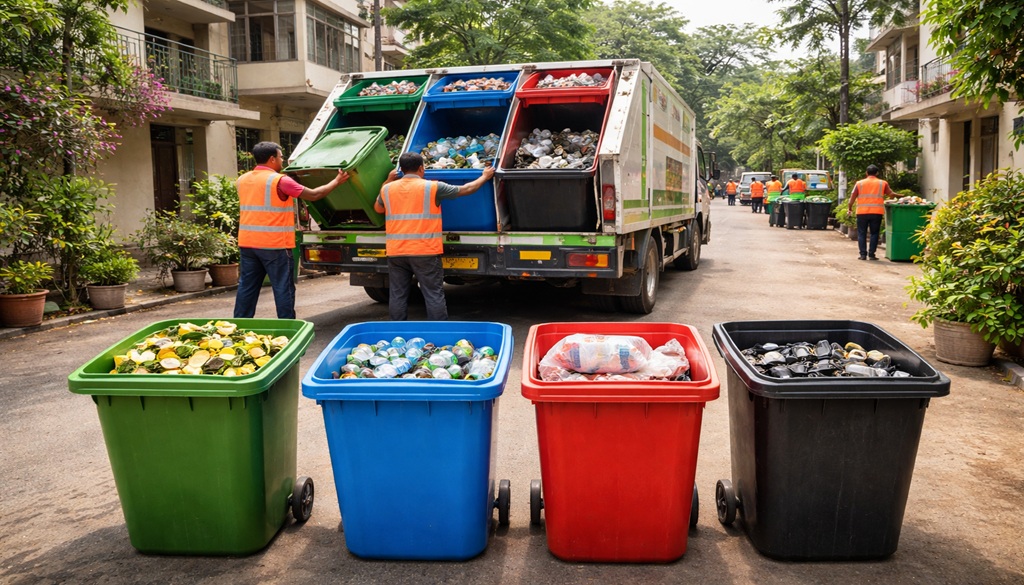
Under this new system, garbage vehicles will now be equipped with four different colored bins.

If household waste is not segregated, sanitation workers will not accept it. The primary objective of this initiative is to ensure 100% scientific waste disposal and prevent environmental pollution. Meanwhile, two new colors are being incorporated into public sanitation practices in the capital. To achieve this, the Patna Municipal Corporation is purchasing a total of 225 new vehicles. This will expand its resources to collect garbage in 375 sectors across all six zones of the city.
Currently, the corporation has 373 closed tippers and 150 CNG tippers, of which approximately 327 vehicles are currently operational. To improve waste collection, the corporation is purchasing 225 new vehicles, including 150 closed tippers and 75 open tippers. All these vehicles are being equipped with new color-coded bins.
The new rules will apply not only to the general public but also to large institutions. Institutions with an area of more than 20,000 square meters or generating more than 100 kg of waste will be considered bulk waste generators. This includes hotels, apartments, and government institutions. They will be required to dispose of wet waste within their premises. If any institution or citizen violates the rules, misreports, or fails to segregate waste, they will be charged heavy environmental compensation under the polluter pays principle. To monitor this, the Central Pollution Control Board has also developed an online portal where the entire waste chain will be tracked.
Identify bins by color
1. Green: Wet waste – kitchen waste, fruit and vegetable peels
2. Blue: Dry waste – plastic, paper, metal, glass
3. Red: Sanitary waste – diapers, sanitary napkins
4. Black: Special care waste – bulbs, paint, medicines, e-waste