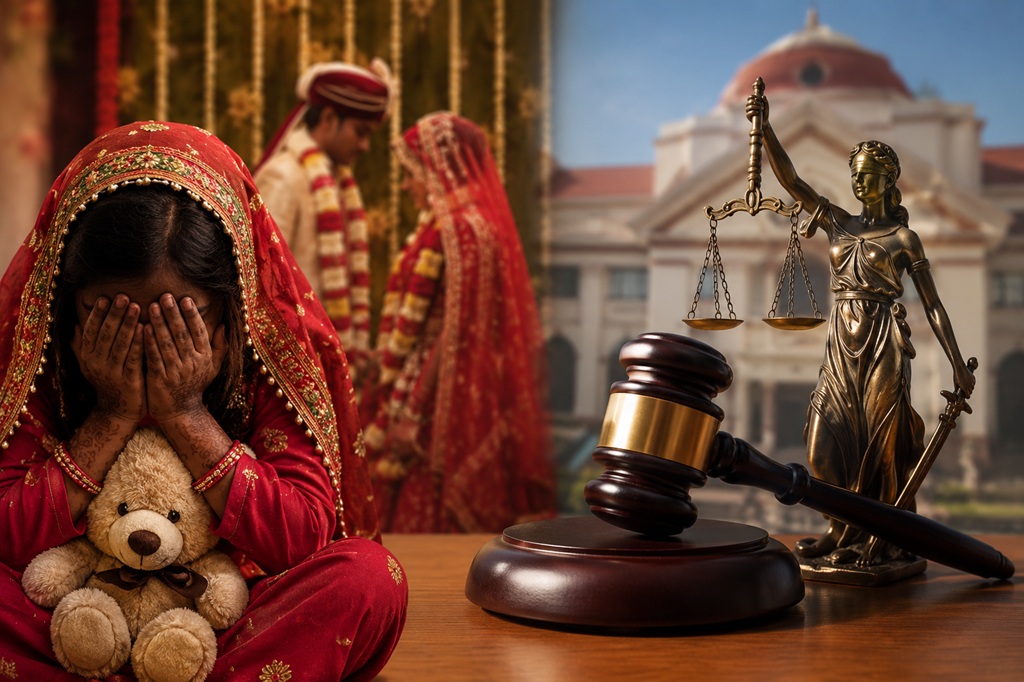
Patna: The Patna High Court has scheduled the next hearing on August 19 in a Public Interest Litigation (PIL) seeking stricter implementation of child marriage laws in Bihar, where 34.6% of women aged 20–24 were married before turning 18, according to the latest National Family Health Survey (NFHS-6).

In a first-of-its-kind legal initiative, the Gender Resource Centre of Chanakya National Law University (CNLU) has joined hands with the Janman People’s Foundation to file the PIL before the Patna High Court, urging authorities to ensure effective implementation of laws prohibiting child marriage across the state.
The petition argues that despite existing legal safeguards, child marriage continues to be prevalent in several districts of Bihar and calls for stronger enforcement at the grassroots level.

A division bench comprising Chief Justice Meenakshi Madan Rai and Justice Soni Srivastava took up the matter. During the hearing, the Advocate General sought additional time to present the state’s response. Accepting the request, the court adjourned the matter to August 19.
Bihar Continues to Rank Among Worst States for Child Marriage
According to NFHS-6 (2023–24), Bihar ranks second in India for child marriage, behind West Bengal.
The survey found that 34.6% of women aged 20–24 in Bihar were married before the age of 18. While this marks an improvement from 40.8% recorded in NFHS-5, the figure remains significantly higher than the national average of 20.1%.
The survey also highlighted that 11.4% of girls aged 15–19 were either pregnant or had already become mothers at the time of the survey, underscoring the continuing health and social consequences of early marriage.
Twelve Districts Record Higher-Than-Average Child Marriage Rates
The survey identified 12 districts where child marriage rates exceed the state average of 34.6%. These include Lakhisarai, Supaul, Araria, Madhepura, Jamui, Purnia, Saharsa, Samastipur, Begusarai, Banka, Katihar, and East Champaran.
The petitioners contend that these figures highlight the urgent need for targeted interventions, particularly in districts where awareness, education, and enforcement remain inadequate.
PIL Highlights Gaps in Enforcement
The PIL argues that although Bihar has stringent laws against child marriage, weak implementation has limited their effectiveness. It seeks stronger coordination among government departments, improved monitoring, and stricter enforcement to curb the practice.
The petition also stresses the need to expand awareness campaigns and improve educational opportunities for girls, particularly in districts with high child marriage rates.
It further notes that adolescent pregnancies resulting from early marriage pose serious public health concerns, contributing to higher risks of maternal mortality, malnutrition, and other health complications among young mothers and their children.
The case is expected to come up for further hearing before the Patna High Court on August 19.