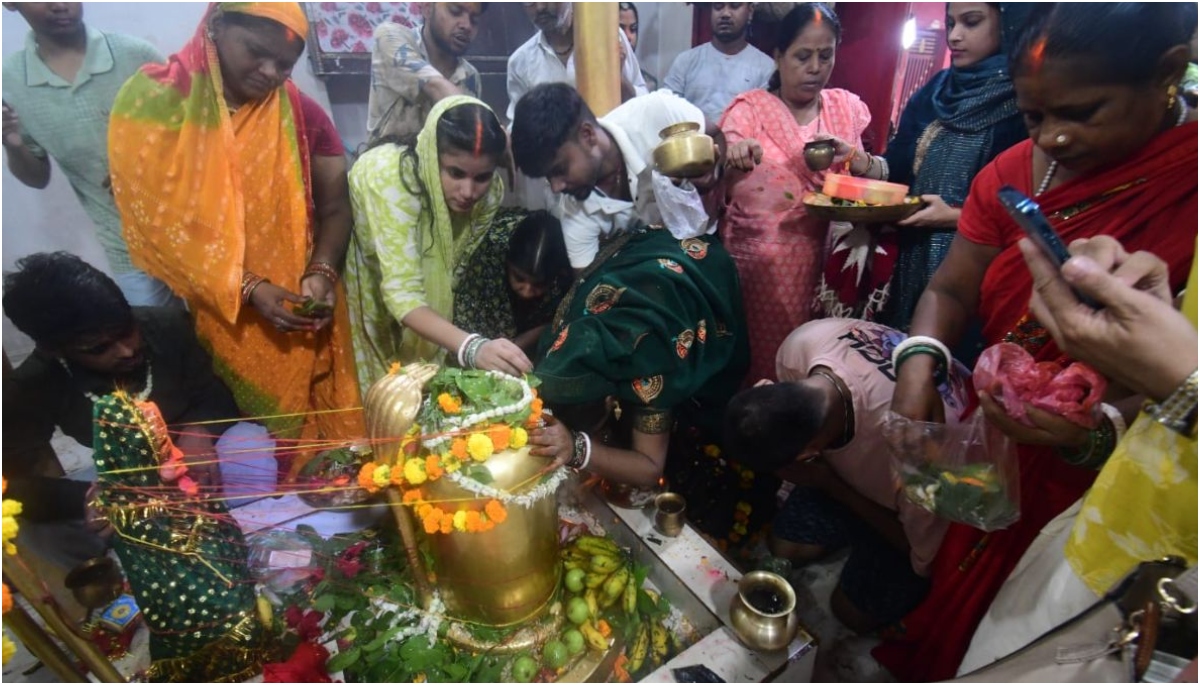
Patna: Long queues of devotees were seen at Shiva temples across Patna on the first Monday of the holy month of Sawan, as intermittent rainfall accompanied religious celebrations across the city. Temples were decorated with flowers and lights while chants of “Har Har Mahadev” and “Bol Bam” echoed throughout the day.

Major temples, including Mahavir Mandir, Gardanibagh Thakurbari, Kadamkuan Chudi Market Shiva Temple, Khajpura Shiva Temple and Panchshiv Mandir in Kankarbagh, witnessed a steady flow of worshippers from the early hours of the morning.
Rare Celestial Alignment Marks This Year’s Observance

According to religious scholars, this year’s first Monday of Sawan is considered especially significant as it coincides with Uttarabhadrapada Nakshatra and Sukarma Yoga, an auspicious combination in the Hindu calendar.
The day also marks the beginning of the 16 Somwari Vrat, a devotional observance in which devotees fast on sixteen consecutive Mondays dedicated to Lord Shiva. Preparations were made in temples and maths for special Shringar, while many households organised Bhajan-Kirtan and Parthiv Pujan.
The Mithila region’s traditional festival, Madhushravani, also commenced on Monday and will continue until August 15.
Devotees Gather at Major Shiva Shrines
Apart from temples within Patna, devotees also visited prominent Shiva shrines in nearby districts. A continuous stream of worshippers was reported at the Shri Gaurishankar Baikunthnath Temple in Baikunthpur near Khusrupur and at Baba Bihateshwarnath Temple in Bihta.
Temple authorities made arrangements to manage the crowds as devotees arrived throughout the day to perform Jalabhishek and offer prayers.
Religious Significance of Worship During Sawan
Religious traditions regard the month of Sawan as one of the most sacred periods for the worship of Lord Shiva. Devotees traditionally perform Abhishek using water, milk and Gangajal, and offer Belpatra as part of their prayers.
Priests also conduct Rudrabhishek accompanied by Vedic chants and the Mahamrityunjaya Mantra, while many devotees recite hymns such as the Shiva Sahasranama, Shiva Panchakshara Stotra, Rudrashtaka and Shiva Tandava Stotra during the holy month.
Traditional Significance of Offerings
According to Hindu religious beliefs, different offerings made to the Shivling symbolise different spiritual aspirations. Water is associated with peace and calmness, milk with good health, curd with relief from difficulties, ghee with strength, honey with sweetness in speech, sandalwood with honour and respect, and saffron with serenity.
Devotees also offer specific flowers and leaves based on traditional beliefs, including Aak flowers for longevity, Harsingar flowers for happiness, Bela flowers for marital blessings, and Shami or Aak leaves for spiritual liberation. Rituals involving milk and sugarcane juice are traditionally associated with prayers for prosperity.
As the holy month progresses, temples across Bihar are expected to witness a continued influx of devotees on the remaining Mondays of Sawan.