Patna: Doctors at the Indira Gandhi Institute of Medical Sciences (IGIMS), Patna, have achieved a significant milestone by successfully placing both biliary and duodenal stents during a single endoscopic procedure in an 82-year-old woman suffering from advanced gallbladder cancer.

The procedure was performed on August 28 in the Department of Gastro-Medicine for a patient with unresectable gallbladder carcinoma, in which surgical removal of the cancer was not possible. The cancer had spread to the duodenum, causing obstruction of both the bile duct and the digestive tract.
According to IGIMS, this is the first time at the institute that an uncovered biliary stent and an uncovered duodenal stent have been successfully placed during the same session.

Complex procedure for bile and food passage
The patient had been experiencing severe and persistent itching because of obstruction to the normal flow of bile. The spread of the cancer to the duodenum had also obstructed the normal passage of food.
The procedure was particularly challenging because doctors found a very small papilla and a large duodenal diverticulum close to it. The papilla is the opening through which the bile and pancreatic ducts empty into the duodenum.
The patient’s advanced age and underlying cancer further increased the complexity of the procedure.
Dr Rahul Kumar, Assistant Professor in the Department of Gastro-Medicine, performed the procedure with support from the endoscopy team.
During ERCP, doctors accessed the bile duct using a guidewire and performed a dye cholangiogram to assess the duct. The examination revealed a long narrowing in the bile duct just below the hilum.
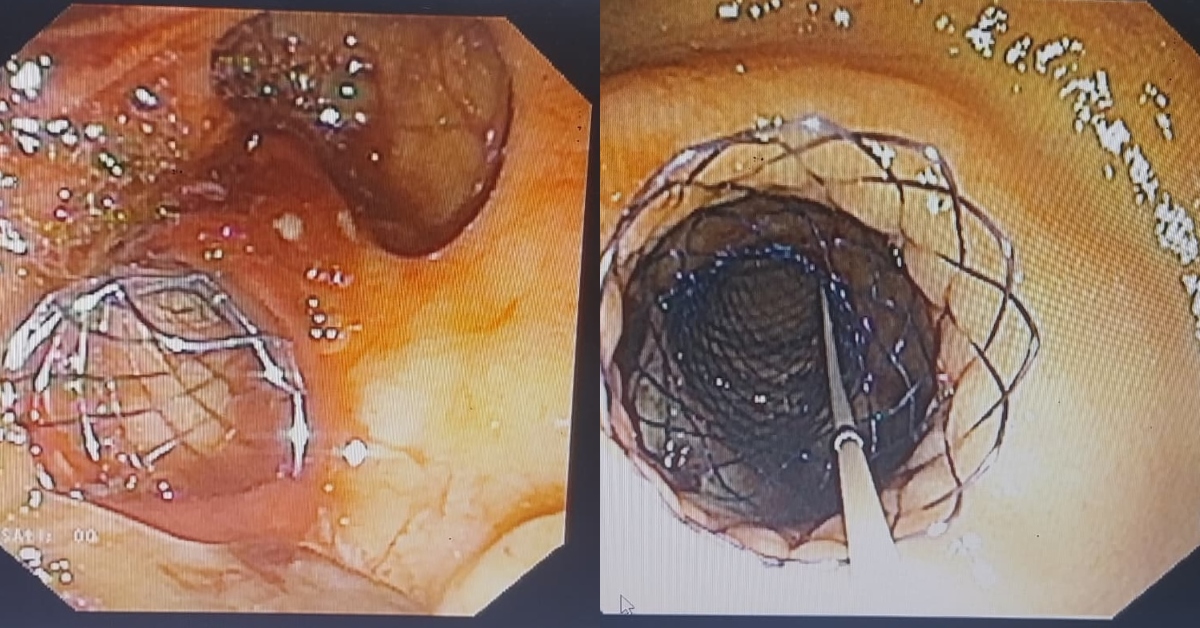
Following the procedure to relieve the obstruction, doctors placed a 10 mm × 8 cm uncovered biliary self-expanding metal stent (SEMS). A free flow of bile was observed after the stent was deployed.
Duodenal stent placed during same session
Since the cancer had also caused an obstruction in the duodenum, restoring bile flow alone was not sufficient.
Doctors therefore proceeded to place a second stent during the same session. Using specialised techniques and equipment, they successfully inserted a 22 mm × 9 cm uncovered duodenal SEMS.
The procedure consequently restored the passages for both bile and food without requiring the patient to undergo two separate complex procedures.
Focus on relief and quality of life
Dr Sanjeev Kumar Jha, Head of the Department of Gastro-Medicine, congratulated the medical team and said IGIMS was continuing to expand advanced endoscopic treatment for patients with serious and complex conditions.
Dr Manish Mandal, Medical Superintendent and Head of the Department of Gastro-Surgery, also provided support and guidance during the procedure.
Mandal explained that when cancer reaches a stage where surgery is no longer feasible, treatment increasingly focuses on relieving symptoms and improving the patient’s quality of life.
In this case, the biliary stent helped restore bile drainage and address the complications associated with bile-flow obstruction. The duodenal stent was intended to relieve the obstruction in the digestive tract, making it easier for food to pass.
Performing both procedures in a single session also meant that the patient did not have to undergo two separate complex interventions.
IGIMS highlights expanding advanced care
Dr Bibhuti Prasanna Sinha, Deputy Director (Administration) of IGIMS, said the institute was continuing efforts to expand advanced medical facilities and make state-of-the-art treatment available.
The successful procedure, he said, could help patients from Bihar and neighbouring regions access complex gastroenterology and cancer-related treatments within the state.
IGIMS Director Dr Binde Kumar congratulated Dr Rahul Kumar and the endoscopy team, describing the procedure as an important milestone for the institute.
He said the institute’s objective was to make modern medical technology available to critically ill patients and provide safe and advanced treatment. The successful procedure, he added, reflected the expertise and coordination of the medical team as well as IGIMS’s capabilities in complex gastroenterology and cancer-related care.