
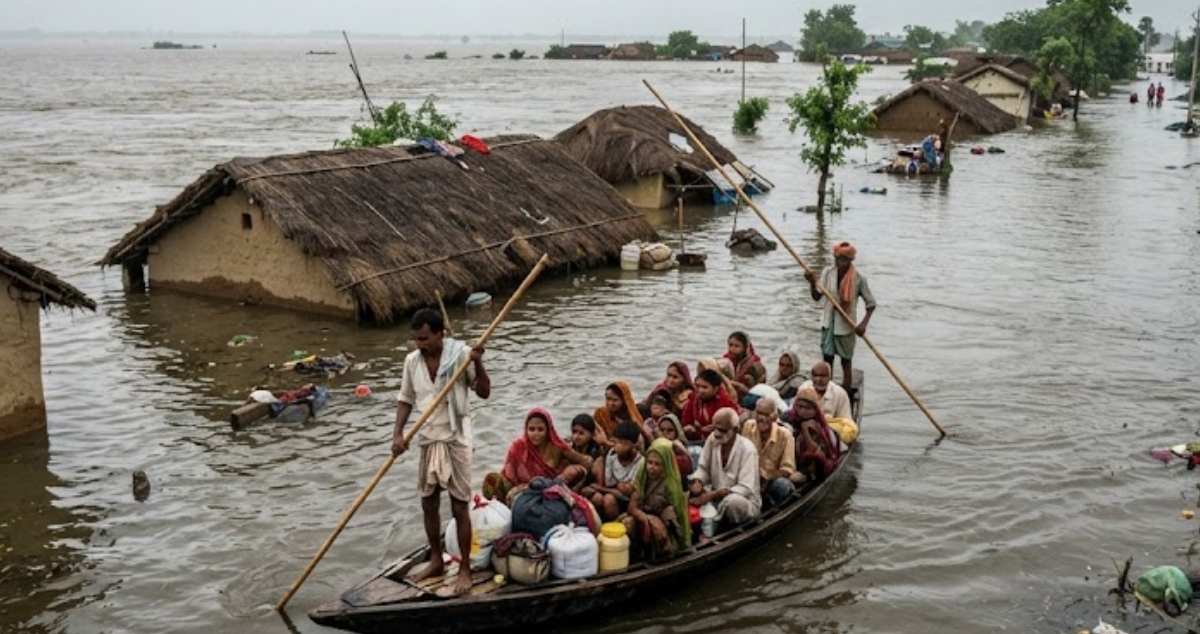
Patna: The Centre has stepped up its response to the flood situation in Bihar, with Union Home Minister Amit Shah speaking to Chief Minister Samrat Chaudhary and informing him that a central team will visit the state to assess the damage.

The team will be led by Union Minister Shivraj Singh Chouhan and is expected to visit flood-affected areas to assess the ground situation and prepare a detailed report on the losses caused by the floods.
The move comes as the Bihar government continues to coordinate with the Centre over the flood situation and seeks measures to address both the immediate damage and the recurring causes of flooding.

Nepal Water Flow Remains Major Challenge for Bihar
Chief Minister Samrat Chaudhary said water flowing into Bihar from Nepal is one of the major factors behind the recurring flood situation in the state.
Heavy rainfall in Nepal can cause water levels in rivers to rise rapidly, affecting several districts along Bihar’s northern and northeastern borders.
According to the Chief Minister, areas such as Supaul are among the first to face the impact before floodwaters spread towards Madhubani and other adjoining districts.
The recurring situation has affected large populations every monsoon, causing damage to homes, crops, roads and other infrastructure.
Bihar Government Had Been in Touch With Centre
The state government had been monitoring the flood situation and coordinating with the Centre for several days.
The Chief Minister said the state administration and officials concerned had been working continuously to monitor the situation and respond to the needs of affected areas.
He said that following directions from Prime Minister Narendra Modi to study the flood situation, the Centre accelerated its intervention.
Amit Shah subsequently called the Chief Minister and informed him that a central team headed by Shivraj Singh Chouhan would be sent to Bihar.
Central Team to Assess Extent of Damage
The primary task of the central team will be to assess the extent of damage caused by the floods.
The assessment is expected to cover several areas, including:
- Damage to roads, bridges and other infrastructure
- Houses damaged or destroyed by floodwaters
- Loss of crops and agricultural land
- Disruption to transport and connectivity
- The condition of embankments and other flood-protection structures
- The impact on affected families, particularly vulnerable and poor households
The findings will help provide a clearer picture of the losses suffered by the state and could form the basis for further assistance from the Centre.
Focus Also on Long-Term Flood Solution
Bihar has faced recurring floods for decades, particularly during the monsoon season. The annual crisis often results in displacement, crop losses, damage to homes and disruption of road connectivity across several districts.
While the immediate focus of the central team’s visit will be damage assessment, attention is also expected to remain on the broader challenge of finding a long-term solution to Bihar’s flood problem.
The state’s dependence on rivers originating or flowing through Nepal makes flood management a complex issue requiring coordination beyond Bihar’s borders.
Central Team’s Report Could Shape Further Relief
The central team’s assessment is expected to provide the government with a detailed account of the flood-related losses across affected areas.
The report could play an important role in determining the extent of additional assistance and flood-management measures required for Bihar.
For communities that face the threat of flooding every year, the central intervention could also renew the focus on long-term measures to reduce the impact of recurring floods.