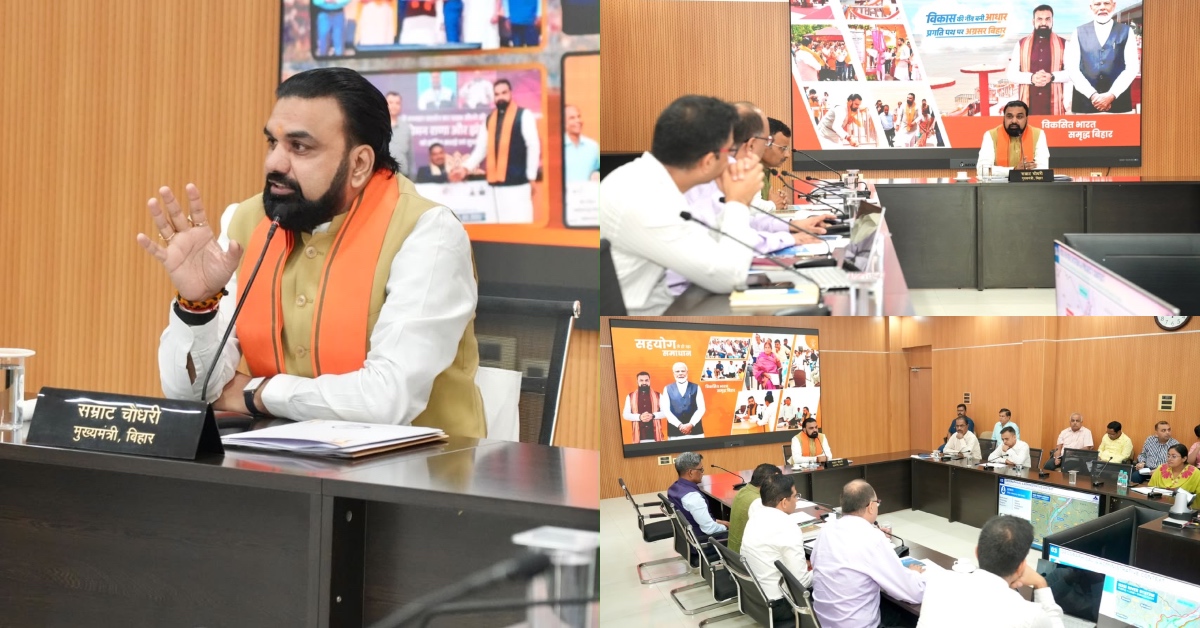
Patna: Bihar Chief Minister Samrat Choudhary on September 24 reviewed major projects related to Kosi flood management, road connectivity and power generation, with officials directed to ensure coordinated and time-bound implementation.

The meeting covered a long-term strategy for reducing flood risks in the Kosi basin, the proposed 348.196-km Buxar-Bhagalpur Greenfield Expressway, the 2,400-MW Pirpainti thermal power project, the Banka power plant and the PM-KUSUM scheme.
The review comes amid the state government’s wider push to accelerate large infrastructure projects. In a separate September 22 review, the chief minister had directed officials to speed up projects, monitor progress regularly and resolve delays through inter-departmental coordination.

Long-Term Kosi Flood Strategy
The Kosi was a major focus of the meeting, with the government discussing a shift from annual flood response towards a long-term flood-risk reduction strategy.
Officials reviewed the need for better sediment management and steps towards a new barrage on the river. The strategy is intended to address the Kosi as a dynamic and interconnected river system rather than relying only on seasonal flood-response measures.
The review also covered the wider river corridor and its impact on people, property, transport links and other infrastructure across multiple districts.
Embankments And Permanent Flood Measures
The meeting also examined proposals for strengthening embankments along the Ganga, Kosi and Gandak.
The government discussed developing four-lane roads along both sides of the rivers as part of a broader approach combining flood protection with regional connectivity.
For the first 100 km of the Kosi, special attention was proposed for double-sheet piling as part of efforts to strengthen vulnerable stretches.
Officials also discussed desilting and sediment control, which can influence the storage capacity and movement of water in river systems.
348-Km Buxar-Bhagalpur Greenfield Expressway
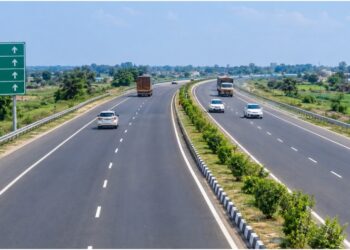
The proposed Buxar-Bhagalpur Greenfield Expressway was another major project reviewed during the meeting.
The planned six-lane corridor has a total length of approximately 348.196 km, including about 336.205 km in Bihar and roughly 12 km in Uttar Pradesh.
The project is intended to improve road connectivity across several parts of Bihar. The proposed corridor has also been described by the state government as Vishwamitra Path.
The review covered the implementation timeline and the need to accelerate work on the expressway along with associated road projects.
Ganga-Ambika, Narayani And Vishwamitra Paths
The chief minister also reviewed three other important road connectivity projects — Ganga-Ambika Path, Narayani Path and Vishwamitra Path.
Ganga-Ambika Path is proposed between Bidupur and Dighwara, while Narayani Path would connect Darihara and Dumariya Ghat.
The Vishwamitra Path proposal covers the Buxar-Ara-Maner corridor in the wider road-connectivity plan. Officials were directed to maintain coordination and work according to defined timelines.
2,400-MW Pirpainti Power Project
The meeting also reviewed the proposed 2,400-MW Pirpainti thermal power project, planned with a capacity configuration of 3×800 MW.
The Banka thermal power project was also included in the energy-sector review.
The focus was on the progress of major power infrastructure and ensuring that implementation-related issues are addressed through coordination between the concerned departments.
Solarisation Of Agricultural Feeders
The chief minister also reviewed the implementation of PM-KUSUM, particularly the solarisation of agricultural feeders.
Officials were asked to speed up work aimed at providing more reliable electricity for agriculture while expanding the use of solar power.
The meeting also discussed the solarisation of government tubewells as part of the wider renewable-energy push in the agricultural sector.
Gandak Embankments And Solar Projects
The meeting included a review of measures for the Gandak river, including the possibility of installing solar plants on embankments.
The approach links flood-management infrastructure with renewable-energy generation and is part of the state’s broader effort to use existing infrastructure for multiple purposes.
Focus On Monitoring And Coordination
The chief minister stressed the need for regular monitoring, inter-departmental coordination and time-bound execution of the projects reviewed.
The meeting brought together senior officials from the water resources, energy and road construction departments, along with other senior officers involved in infrastructure planning and implementation.
The state’s recent project reviews have similarly emphasised faster execution, removal of bottlenecks and adherence to prescribed timelines.
For Bihar, the projects reviewed on September 24 span three major areas — long-term flood-risk management, large-scale road connectivity and additional power capacity — with the government focusing on moving them forward through coordinated implementation.