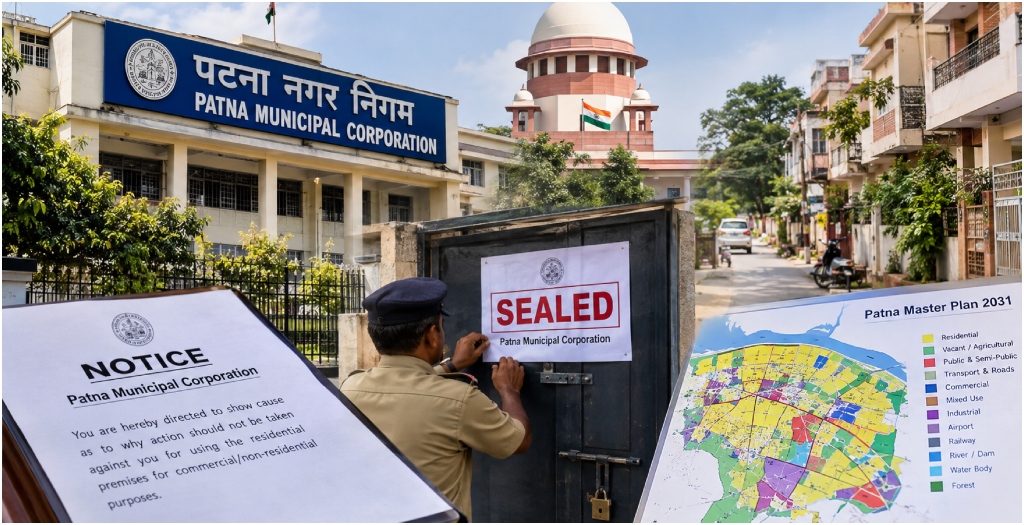
Patna: The Patna Municipal Corporation has begun reviewing cases of non-residential and commercial activity in areas designated for residential use following directions from the Supreme Court. The civic body has conducted a ward-wise survey across its circles and is proceeding with hearings and further action under the court’s directions.

Twenty-four residential colonies listed in the Master Plan 2031 are among the areas being closely examined. They include 11 Bihar government colonies, three Central government colonies and 10 private colonies.
24 Colonies Under Scrutiny

The Bihar government colonies listed are Rajvanshi Nagar, Shastri Nagar, Gardanibagh, Sri Krishna Puri, Pataliputra Colony, Kankarbagh Colony, Bahadurpur Colony, Rajendra Nagar Colony, Hanuman Nagar, Chhajjubagh and CDA Colony.
The Central government colonies include PNT Colony, Revenue Colony and RBI Colony. The private colonies listed are Ashiana Nagar, Krishi Nagar, Police Colony, BM Colony, AG Colony, Rajiv Nagar, Buddha Colony, Sri Krishna Nagar (IAS) Colony, Anandpuri and MMA Flat Colony.
The PMC’s official public notice says its survey covered unauthorised non-residential use in residential areas in compliance with Supreme Court orders dated March 25, May 20, July 9 and August 5, 2026.
Notices Issued To Property Owners
The corporation has issued notices to property owners over the use of residential premises for commercial or other non-residential purposes. Earlier reports put the number at 26,745 properties, while the latest figure provided by the civic administration is 27,395 notices. The PMC has made arrangements for hearings at the concerned zonal offices.
Patna Mayor Sita Sahu has also received a notice in connection with the issue, according to reports.
Municipal Commissioner Yashpal Meena said the identification process had begun in accordance with the Supreme Court’s directions. Officials in all zones have been instructed to examine cases and take action where violations are established.
What The Supreme Court Directions Say
The Supreme Court’s recent directions state that where an area has been specifically designated for residential use and the government has permitted only residential activity, commercial use cannot continue there. Premises found to be used commercially in violation of the sanctioned land use may be sealed in the first instance.
Where the permitted use of a property or area is unclear, authorities have been directed to maintain the existing status quo while administrative processes continue. Pending ownership or other litigation does not, by itself, prevent action where land or buildings are being used contrary to sanctioned permissions.
The directions also cover unauthorised construction. Where construction has been carried out without the required permission, authorities can proceed with sealing or demolition in accordance with applicable law.
Residential Land Accounts For 47.55% Of PMC Area
According to the Master Plan 2031 figures cited by the civic administration, the Patna Municipal Corporation area covers 104.22 sq km. Of this, 49.56 sq km, or 47.55%, is designated for residential use.
Another 18.40 sq km, or 17.66%, is classified as vacant or agricultural land. Public and semi-public use accounts for 10.61 sq km, while transport and roads cover 6.15 sq km.
Commercial land accounts for 4.65 sq km, or 4.46%, while mixed-use areas cover 3.52 sq km. Industrial land accounts for 1.09 sq km, with separate allocations for the airport, railways, river and dam sites, water bodies and forests.
Five-Member Committee To Examine Notices
On August 25, Chief Minister Samrat Choudhary constituted a five-member committee to examine issues arising from the PMC notices and commercial activities in residential premises. The committee is headed by Deputy Chief Minister Vijay Kumar Choudhary.
Urban Development and Housing Minister Nitish Kumar Mishra is the member-secretary. Rural Development Minister Shravan Kumar, Cooperation Minister Ram Kripal Yadav and MLC Sanjay Kumar Singh are the other members. The committee has been tasked with examining the matter and working towards a practical solution.
The PMC’s ongoing hearings and the committee’s review will determine how individual cases are dealt with while the civic body continues implementing the Supreme Court’s directions.