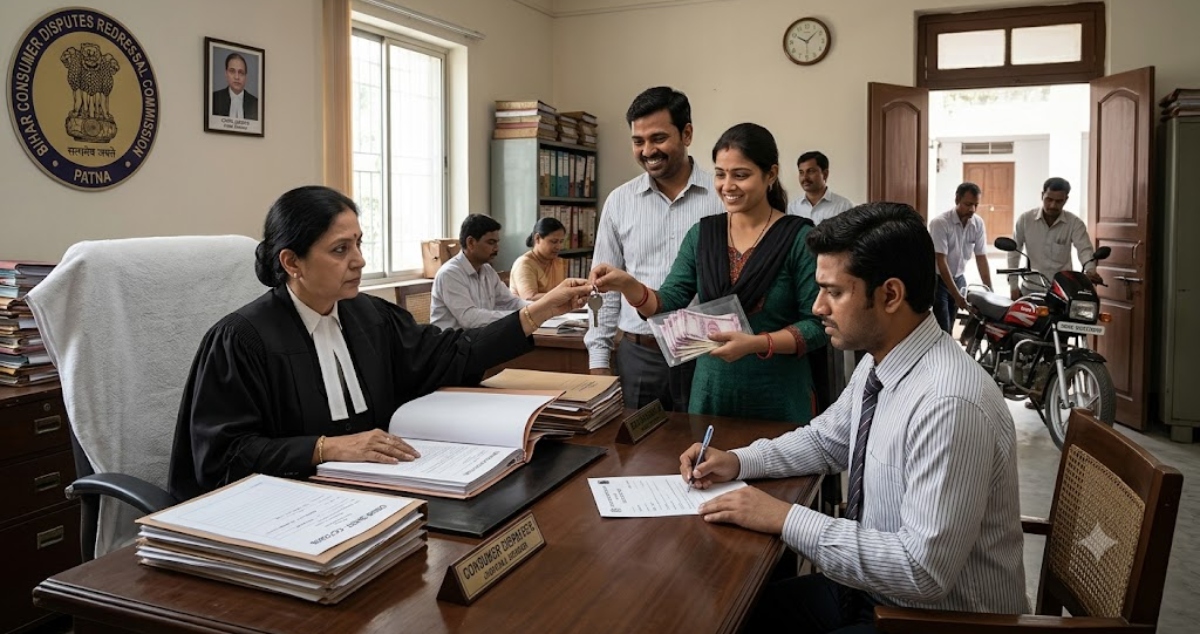
Patna: The District Consumer Disputes Redressal Commission, Patna, has ruled that seizing a two-wheeler without following the prescribed legal procedure constitutes a deficiency in service, even when the borrower has defaulted on loan instalments.

Allowing a consumer complaint filed by Saurabh Raj, the commission directed the concerned financier to return his seized motorcycle after complete servicing and ensure that it is in proper running condition. The financier has also been ordered to pay Rs 10,000 as compensation for mental agony and physical harassment and Rs 10,000 towards litigation costs.
Motorcycle Seized After Loan Repayment Default
According to the case records, Raj purchased a Bajaj Pulsar 130 cc motorcycle on July 31, 2013, using a loan of Rs 65,000 from the concerned financier. The loan was repayable in 20 equal monthly instalments of Rs 3,245 each.

Following a default in repayment, the motorcycle was seized on August 18, 2014. Raj alleged that the vehicle had been taken without following the prescribed notice procedure.
Commission Highlights Mandatory Notice Procedure
During the proceedings, the commission observed that the prescribed process for seizing a vehicle hypothecated against a loan includes a demand notice for outstanding dues, a loan recall notice and a notice informing the borrower of the intention to seize the vehicle.
The financier failed to produce the notice indicating its intention to seize the motorcycle. On this basis, the commission found a deficiency in service and ruled in favour of the complainant.
The decision underscores that a loan repayment default does not exempt a financier from following the applicable legal procedure when repossessing a vehicle.
Financier Given 120 Days to Return Motorcycle
The commission directed the financier to complete the motorcycle’s servicing and return it in proper running condition within 120 days of receiving a copy of the order.
The order also specifies the consequences of non-compliance. If the financier fails to comply, simple interest at 12% per annum will be payable on the amount due after three months, until payment is made or the vehicle is delivered.
If the financier fails to return the motorcycle in running condition after servicing, it must pay Rs 50,000 towards the cost of the vehicle, as directed by the commission.
Commission Members Pass the Order
The decision was delivered by Prem Ranjan Mishra, President, and Rajnish Kumar, Member, of the District Consumer Disputes Redressal Commission, Patna.
The ruling highlights the importance of following due procedure in vehicle repossession and protecting borrowers’ consumer rights.