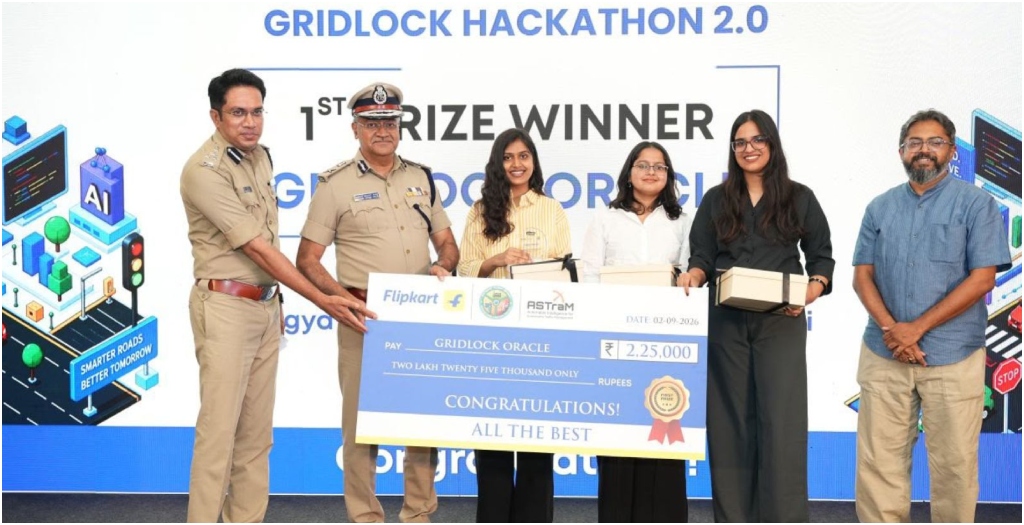
Patna: Three students from the Indian Institute of Technology (IIT) Patna have secured first place in the national-level technology and innovation competition Flipkart GRiD 2.0 with an artificial intelligence-based solution designed to predict traffic congestion arising from road incidents.

The team developed a model called Gridlock Oracle under the competition’s theme, “Event-Driven Traffic Congestion”. The solution aims to help traffic authorities assess whether an incident is likely to cause significant disruption and determine the resources required to manage it.
Third-year students develop AI solution

The winning team comprises Kashish Rai, Bhumi Garg and Pragya Mahajan, all third-year students enrolled in the integrated BTech-MTech programme at IIT Patna.
Rai and Garg are studying Mathematics and Computing, while Mahajan is pursuing Computer Science. Their project uses artificial intelligence to analyse traffic incident data and estimate the likelihood of congestion or road closures.
Model trained on 8,057 traffic incidents
The challenge was conducted in collaboration with the Bengaluru Traffic Police. Participants were provided with data from 8,057 real-world traffic-related incidents and tasked with predicting whether reported incidents would lead to major traffic disruption or require road closures.
The model is intended to help authorities distinguish between incidents that require substantial intervention and those that can be managed with fewer resources.
Traffic police may need to deploy personnel, place barricades or make other arrangements following an incident. However, not every reported incident results in significant congestion. By estimating the potential impact, Gridlock Oracle could help officials decide where to deploy personnel and what level of intervention may be necessary.
Team claims up to 86% reduction in inefficient deployment
According to the information provided about the competition, the team’s solution could reduce inefficient resource deployment by up to 86% during the evaluation phase.
The claimed reduction relates to improving the allocation of traffic management resources through data-based predictions. The figure should be understood in the context of the competition’s evaluation; its performance in operational traffic conditions would require further testing and validation.
AI applications in urban traffic management
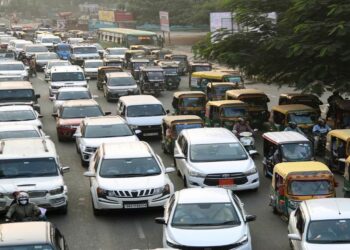
Managing urban traffic has become increasingly complex as cities experience rising vehicle numbers and frequent disruptions caused by accidents, road closures and other unforeseen incidents.
Predictive systems could help traffic authorities identify incidents with a higher likelihood of causing congestion and allocate personnel and equipment accordingly. Such tools may also support quicker decision-making by providing officials with data-based assessments of potential disruptions.
Gridlock Oracle represents an application of AI to urban traffic management. Its practical impact will depend on how effectively the model performs with real-time data and how well its predictions translate into improved traffic operations.