
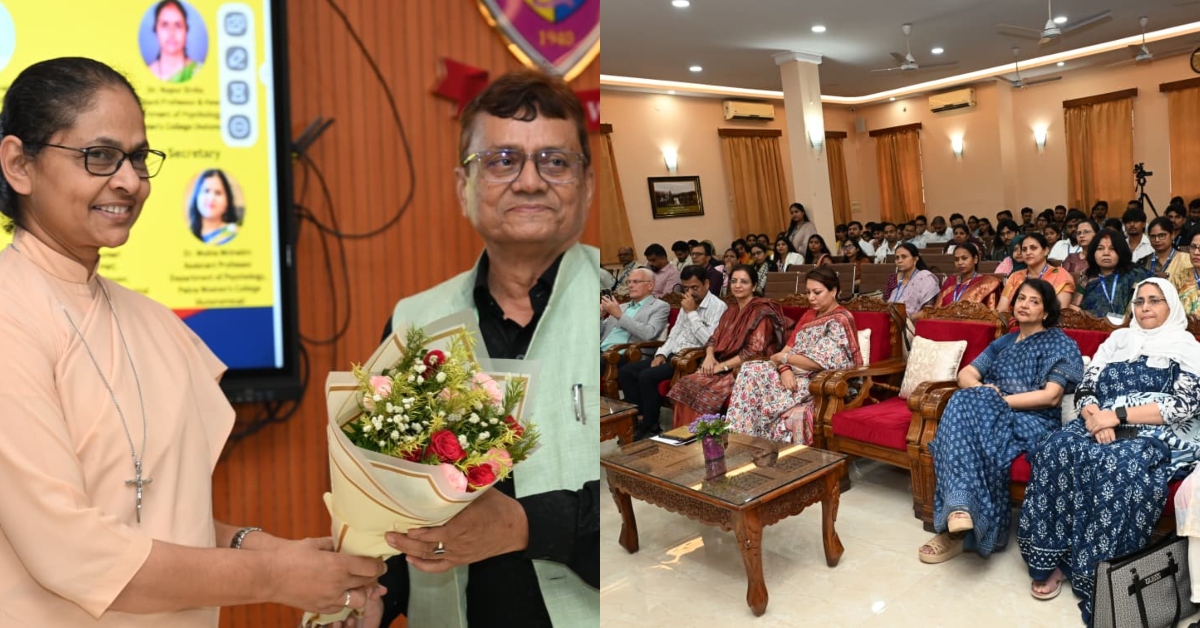
Patna : Patna Women’s College (Autonomous) concluded the three-day NABSCON 2026 conference on Saturday, focusing on the role of artificial intelligence in clinical neuropsychology and the future of patient-centred mental healthcare.

Organised by the college’s Department of Psychology in collaboration with the Neuro and Biofeedback Society (NABS), New Delhi, the conference carried the theme “AI-Enabled Advances in Clinical Neuropsychology.” The concluding day featured plenary sessions, scientific paper presentations and a valedictory ceremony attended by academics, mental health professionals and researchers.
The discussions explored emerging developments in artificial intelligence, mental health in the digital age, neuropsychology, psychological resilience and therapeutic interventions.

Vice-Chancellor Highlights Changing Mental Health Landscape
The valedictory function began with a welcome address and conference report by Dr Aakriti Varshney.
NABS President Dr Anand Pratap Singh and Guest of Honour Professor Dr Rajesh Kumar, Head of the Department of Psychiatry at the Indira Gandhi Institute of Medical Sciences (IGIMS), Patna, addressed the gathering.
Conference Patron and Patna Women’s College Principal Dr Sister M. Tanisha A.C. was also present.
Chief Guest Dr Ajay Kumar Singh, Vice-Chancellor of Patna University, shared his views on the changing mental health landscape and highlighted concerns arising from developments in contemporary society.
The ceremony included the felicitation of dignitaries and the distribution of certificates to participants. Dr Nupur Sinha delivered the vote of thanks, while Dr Farhat Jabin moderated the session. The programme concluded with the National Anthem.
Plenary Sessions Explore AI And Mental Health
The scientific programme on the final day began with Plenary Session I, featuring Professor Roomana N. Siddiqui, who discussed mental health in the digital age, and Dr Priyanka Tiwari, who examined the issue of AI-induced false memories.
The session was chaired by Professor Shilpa Chowdhary. The presentations brought attention to the relationship between emerging technologies and psychological processes, including questions surrounding the effects of digital environments and artificial intelligence on human memory and mental wellbeing.
Plenary Session II featured Professor Braj Bhushan, Dr Ravi Shankar Ravi and Dr Tarun Mishra. The session was chaired by Dr Anand Pratap Singh.
The discussions formed part of the conference’s broader examination of how technological developments and clinical knowledge can contribute to advances in neuropsychology and mental healthcare.
Scientific Paper Sessions Cover Emerging Research
Six parallel scientific paper presentation sessions, numbered 9 to 14, were conducted on the concluding day. The sessions covered topics related to artificial intelligence, mental health, resilience, neuropsychology and therapeutic interventions.
The sessions were chaired by Professor Roomana N. Siddiqui, Dr Feroz Ahmad, Dr Shubham Shree, Dr Aakriti Varshney, Dr Nupur Sinha and Dr Farhat Jabin.
Two additional scientific paper presentation sessions, numbered 15 and 16, were conducted online. Dr Mukta Mrinalini, Dr Medha and Dr Aradhana Kumari chaired these sessions.
The parallel sessions provided a platform for researchers and academics to present their work and exchange perspectives on emerging questions in psychological science and clinical practice.
Conference Emphasises Interdisciplinary Collaboration
The three-day conference concluded with an emphasis on strengthening interdisciplinary collaboration and integrating clinical expertise with intelligent technologies to advance personalised mental healthcare.
The discussions highlighted the importance of examining the opportunities offered by artificial intelligence alongside the clinical knowledge and professional judgement required in mental health practice.
By bringing together academic researchers, clinicians and psychology professionals, NABSCON 2026 sought to encourage dialogue on emerging developments in clinical neuropsychology and their potential applications in patient-centred care.
The conference concluded on October 31, following three days of scientific presentations and discussions on the evolving relationship between artificial intelligence, neuropsychology and mental health.