Patna: Villages and towns across Mithilanchal are resonating with Maithili folk songs as the Sama-Chakeva festival approaches its conclusion on November 24. The festival celebrates sibling affection, nature conservation and the relationship between humans and birds.

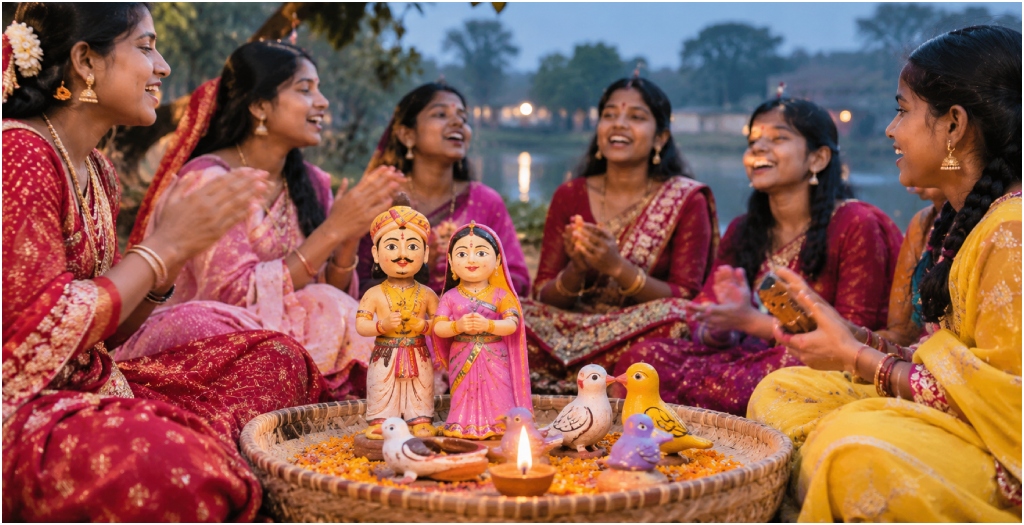
Observed across the Mithila region of Bihar and parts of neighbouring Nepal, Sama-Chakeva begins on Kartik Shukla Saptami and continues until Kartik Purnima. Women and young girls gather at dusk to sing traditional songs, praying for the health, happiness and prosperity of their brothers.
Festival To End With Moonlit Immersion

Acharya Rakesh Jha said the festival began on November 16 and will conclude on November 24, Kartik Purnima, with the immersion of clay figurines under the moonlight.
During the celebrations, women sing Maithili folk songs accompanied by clay figurines of Sama, Chakeva and other symbolic objects. The rituals also include playful exchanges and banter between sisters-in-law.
Sama Bid Farewell Like A Daughter
On Kartik Purnima, sisters feed their brothers chuda (flattened rice) prepared from the new harvest, accompanied by curd, as part of the traditional rituals.
The clay figurines are then immersed in a river or pond. Sama is given a farewell similar to that of a daughter leaving her parental home, while brothers carry mudhi (puffed rice) and batashe (sugar drops) as symbolic provisions for the journey.
Gifts And Promises Strengthen Sibling Bond
Sisters fill their brothers’ bags with laddus, pedas, batashe, mudhi and chuda, wishing prosperity and abundance for their households.
Brothers, in return, give their sisters gifts, money or clothes and reaffirm their commitment to supporting them through life’s joys and hardships.
Festival’s Connection To The Padma Purana
Pandit Rakesh Jha said the Sama-Chakeva tradition is also associated with the Padma Purana.
According to the legend, Lord Krishna’s daughter Shyama was deeply devoted to serving sages. She was transformed into a maina bird after being cursed following malicious gossip by a minister named Churak. The story is associated with the festival’s themes of affection, devotion and the relationship between humans and birds.