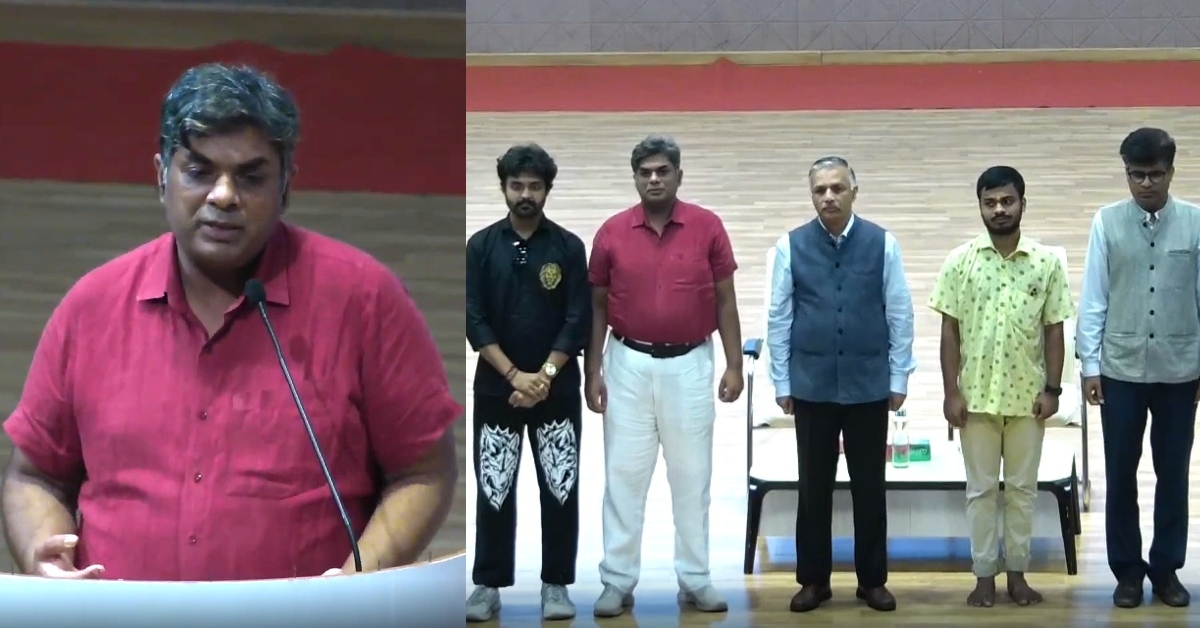
Rajgir : Nalanda University hosted the concluding lecture of its Nalanda Spirit foundational course on Wednesday, with Professor Ashish Gupta tracing India’s mathematical legacy from ancient scholars to modern scientific developments.

Titled “From Bhavana to Infinite”, the lecture examined the contributions of prominent Indian mathematicians and explored how mathematical ideas have evolved across centuries. Professor Gupta also connected historical developments with contemporary research, highlighting the continuing relevance of mathematical structures and concepts.
Brahmagupta, Bhaskar II And Ramanujan’s Contributions

Professor Gupta began by explaining how the principles of universalism, inquiry, exchange and sensitivity are central to the Nalanda Spirit. He then traced significant milestones in India’s mathematical history.
He discussed Brahmagupta’s Composition Law, featured in the mathematician’s treatise Brahmasphutasiddhanta, and highlighted Bhaskar II’s Chakravala method, which is used to solve certain complex equations.
The lecture also explored the work of Srinivasa Ramanujan, particularly the Rogers-Ramanujan identities, which are important in the study of mathematical series and relationships.
Through these examples, Professor Gupta illustrated the range of mathematical ideas developed by Indian scholars and their place in the wider history of the discipline.
Connecting Historical Mathematics With Modern Research
Moving from historical contributions to contemporary developments, Professor Gupta discussed the work of Carl Friedrich Gauss and Manjul Bhargava.
He explained how structural ideas can be reformulated and developed across different mathematical frameworks, demonstrating the continuing evolution of mathematical thought.
Bhargava, a mathematician whose work spans number theory, also serves as an active member of Nalanda University’s Governing Board.
The lecture linked the university’s emphasis on inquiry and knowledge exchange with the continuing development of mathematics across generations.
Nalanda University Designated IIRS-ISRO Distance Learning Nodal Centre
The event also highlighted Nalanda University’s designation as a nodal centre for the Indian Institute of Remote Sensing (IIRS)-ISRO Distance Learning Programme.
Professor Deepak Kumar, the university’s IIRS nodal coordinator, outlined the initiative and invited students to enrol in the courses available under the programme.
The designation provides an opportunity for students to engage with learning resources offered through the IIRS-ISRO initiative.
Vice-Chancellor Calls For Revival Of Regional Mathematical Traditions
In his concluding remarks, Nalanda University Vice-Chancellor Professor Sachin Chaturvedi highlighted the contributions of mathematicians from Ramanujan to Manjul Bhargava in shaping the identity of mathematics.
He also stressed the importance of reviving regional schools of mathematics, including traditions associated with Kerala and Agra, to preserve India’s diverse intellectual heritage and encourage deeper scientific thinking.
The lecture brought the Nalanda Spirit foundational course to a close by connecting India’s mathematical past with modern scholarship and reinforcing the importance of inquiry, exchange and the preservation of regional knowledge traditions.