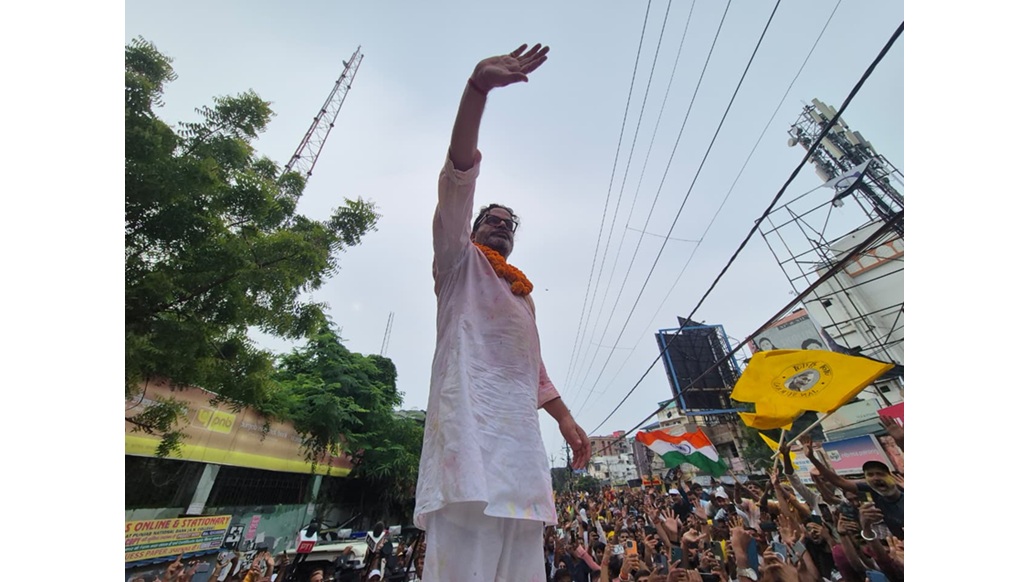
Patna: Jan Suraaj founder Prashant Kishor secured a landmark victory in the Bankipur Assembly by-election, defeating the Bharatiya Janata Party (BJP) candidate Neeraj Kumar by 19,324 votes in what is being seen as one of the biggest political upsets in Bihar in recent years.

Kishor polled 64,117 votes (49.23%), while BJP’s Neeraj Kumar finished second with 44,794 votes (34.40%). Rashtriya Janata Dal (RJD) candidate Rekha Gupta came third with 14,263 votes (10.95%).
The result marks Jan Suraaj’s first-ever seat in the Bihar Legislative Assembly and Kishor’s first electoral victory. More significantly, the BJP lost the Bankipur constituency, considered its traditional bastion for nearly three decades and previously represented by former BJP national president Nitin Navin.

Why Did BJP Lose Bankipur?
Political observers attribute the BJP’s defeat to a combination of anti-incumbency, local issues, strategic campaigning by Prashant Kishor and changing voter preferences.
Anger Over Bharat Tiwari Encounter and NEET Student Murder
One of the factors believed to have influenced the result was public resentment over the alleged police encounter of Bharat Tiwari and the murder of a NEET aspirant in Jehanabad.
Discontent reportedly emerged among sections of Brahmin, Bhumihar and Rajput voters—traditionally regarded as part of the BJP’s core support base. During the campaign, Kishor held multiple small meetings with residents, housing societies, clubs and business groups, highlighting these incidents and questioning the government’s response.
Youth Vote and Student Protests
The bypoll took place amid widespread protests over alleged examination paper leaks and police action against student demonstrators in Bihar.
Campaigners believe police action against protesting students alienated a section of young voters. Bankipur has 53,419 voters aged between 18 and 29, and youth participation was considered relatively high despite constituting around 14% of the electorate.
Prashant Kishor’s Campaign Strategy
Unlike conventional campaigns centred on caste equations, Kishor focused on extensive grassroots outreach.
He conducted door-to-door visits, organised padyatras, held around five “Chai Pe Charcha” interactions daily and addressed two public meetings every day during the campaign.
His campaign repeatedly urged voters to support political change, emphasising governance, education, employment, infrastructure, traffic management, drainage, waterlogging and migration of youth rather than traditional caste-based appeals.
He also projected the election as a referendum on the BJP-led state government.
A Shift Beyond Caste Politics?
While analysts caution against drawing statewide conclusions from a single by-election, Bankipur’s urban electorate appeared to respond more strongly to governance and development issues than conventional caste calculations.
The victory has intensified debate over whether Bihar’s urban voters are increasingly prioritising candidate credibility, governance and public services alongside social identities.
Implications for the BJP and Chief Minister Samrat Choudhary
The defeat is expected to raise questions for the BJP leadership, particularly because Bankipur had remained one of the party’s safest constituencies since 1995.
Political observers believe the result could trigger discussions within the BJP over its urban and upper-caste support base. Kishor had repeatedly described the bypoll as a “public test” of the leadership of Chief Minister Samrat Choudhary, and is likely to use the victory to strengthen that political narrative.
Impact on JD(U) and RJD
The result is also seen as a setback for both the Janata Dal (United) and the Rashtriya Janata Dal.
For JD(U), analysts suggest Jan Suraaj could increasingly appeal to sections of voters who traditionally supported the party for its governance agenda and among segments of the Extremely Backward Classes (EBC).
For the RJD, the outcome may prompt introspection over its performance in urban constituencies. Despite campaigning in Bankipur, the party finished a distant third, while Jan Suraaj reportedly improved its presence in several areas that had previously favoured the RJD.
Third Front Narrative Gains Momentum
The Bankipur verdict has also fuelled discussion about the emergence of Jan Suraaj as a credible third political force in Bihar.
The result has already sparked exchanges between Congress and the RJD over campaign coordination within the Mahagathbandhan, while political observers believe both the NDA and opposition alliance may reassess their electoral strategies ahead of future contests.
Advantage of a Single-Seat Contest
Analysts also point out that contesting a single-seat by-election enabled Jan Suraaj to deploy its entire organisational strength and resources in Bankipur.
Unlike the Assembly elections, where the party had to campaign across Bihar, Kishor concentrated exclusively on one urban constituency, allowing him to maximise voter outreach and campaign visibility.
With its first Assembly seat secured, Jan Suraaj has gained a significant political milestone, while the BJP faces difficult questions after losing one of its strongest urban bastions.