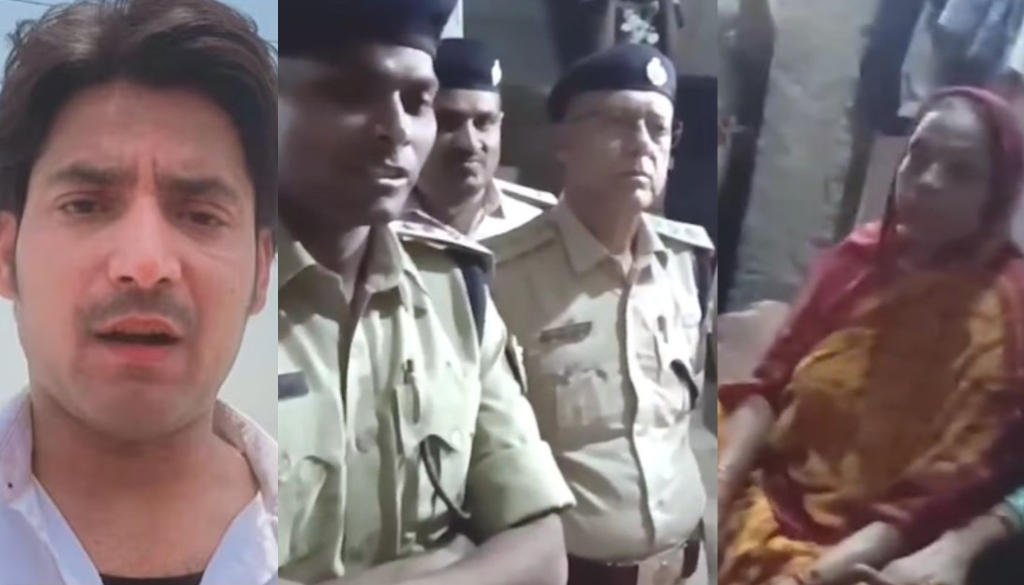
Bhojpur: Rajesh Kumar Sharma, the police officer named in the FIR over the alleged fake encounter of Bharat Bhushan Tiwari in Bihar’s Bhojpur district, has been posted as Deputy Superintendent of Police (DSP) in the Prohibition Department, even as the investigation into the controversial police operation continues. Meanwhile, five police personnel, including the then Station House Officer (SHO) of Shahpur Police Station, remain under suspension.

The transfer has triggered public debate over whether the officer can face arrest and what legal and departmental action may follow in the case.
Murder Case Registered Against Police Officials
The encounter took place on June 17 in Bilauti village under Bhojpur district. On June 22, Shahpur Police Station registered an FIR for murder based on a complaint filed by Bharat Tiwari’s mother, Asha Devi.

The FIR names the then Jagdishpur Sub-Divisional Police Officer (SDPO) Rajesh Kumar Sharma, former Shahpur SHO Rajesh Malakar, and other police personnel who were present during the operation.
According to the complaint, Bharat Tiwari had surrendered after being surrounded by police. His family alleges that despite surrendering and raising his hands, police personnel and members of the Special Task Force (STF) deliberately shot him as part of a pre-planned conspiracy, rather than acting in self-defence as claimed by the police.
Arrest Not Automatic After FIR
Legal experts note that the registration of an FIR does not automatically lead to the immediate arrest of public servants, particularly when the incident occurred during the discharge of official duties.
Under the Supreme Court’s 2014 guidelines in the case of People’s Union for Civil Liberties (PUCL) vs State of Maharashtra, every police encounter must be independently investigated. Investigators are required to examine forensic evidence, post-mortem findings, witness statements and other material before determining whether an encounter was genuine or staged.
Until investigators establish prima facie evidence of a fake encounter or intentional murder, immediate arrest of the accused officers is generally not mandated.
Additionally, constitutional and statutory safeguards apply to public servants. Article 311 of the Constitution provides procedural protection against punitive action without due process, while Section 197 of the Code of Criminal Procedure (CrPC) requires prior government sanction before prosecuting public servants for acts performed in the course of official duty. However, these protections cease to apply if investigations conclude that officers acted outside the scope of their lawful authority.
Judicial Inquiry Underway
Given the sensitivity of the case, the Bihar government has ordered a judicial inquiry headed by retired Justice Vinod Kumar Sinha. The retired judge visited the encounter site on June 25 and has begun examining the circumstances surrounding the incident.
The commission’s findings are expected to play a crucial role in determining whether further criminal proceedings should be initiated against the accused officers.
Five Policemen Suspended
As an initial administrative measure, the state government has suspended five police personnel, including the then Shahpur SHO. Rajesh Kumar Sharma was removed from his post as Jagdishpur SDPO before being reassigned.
Apart from the judicial inquiry, the officers may also face departmental proceedings. If evidence establishes misconduct or dereliction of duty, disciplinary action could range from censure to dismissal from service.
Should the judicial commission conclude that the encounter was staged and recommend prosecution, the investigating agency would be required to obtain sanction from the Bihar Home Department before filing a chargesheet against the serving officers. If sanctioned, the case would proceed to trial, and those found guilty could face penalties ranging from life imprisonment to capital punishment, depending on the court’s findings and applicable law.
Why the New Posting?
On July 1, Rajesh Kumar Sharma was appointed as DSP in the Prohibition Department, a move that has raised questions about its implications.
Administrative experts say such transfers are common during ongoing investigations involving senior officers. Rather than suspending gazetted officers immediately, governments often shift them to non-field or low-impact assignments to ensure they do not influence witnesses or interfere with evidence while inquiries continue.
Officials note that a posting in the Prohibition Department removes the officer from mainstream district policing and active criminal investigations but does not absolve him of legal responsibility.
If the judicial commission finds credible evidence of a fake encounter, the government can still suspend Sharma, sanction his prosecution, and initiate criminal proceedings irrespective of his current posting.
The judicial inquiry and departmental investigations are continuing, and further action will depend on their findings.