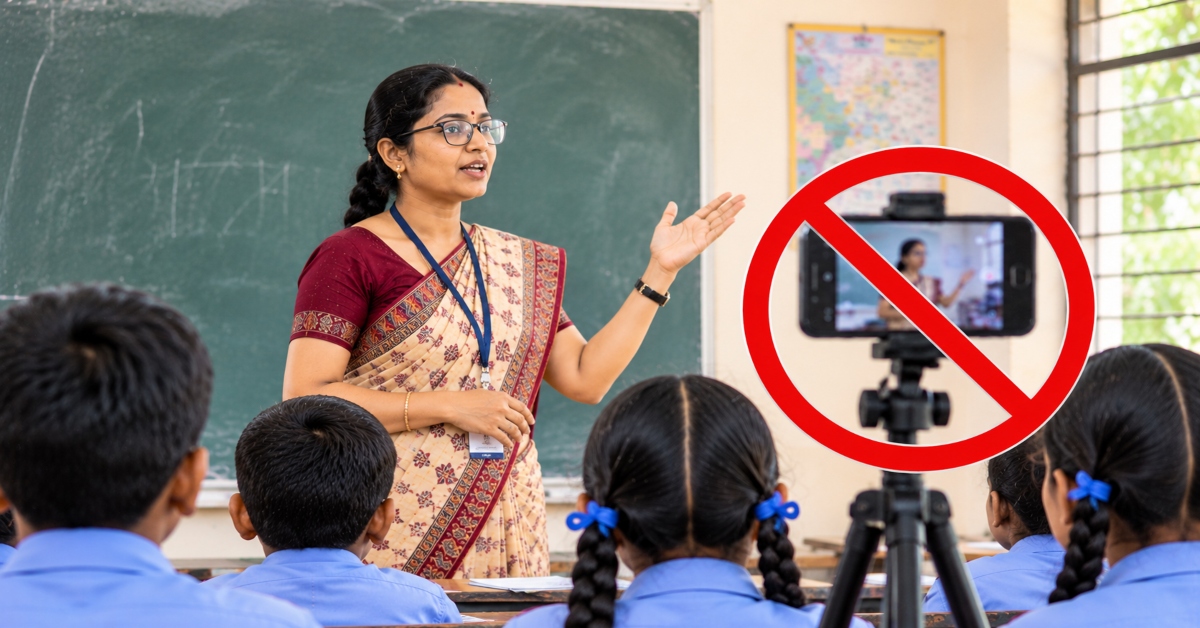
Patna : The Bihar Education Department has tightened restrictions on the use of social media by teachers and other employees of government schools, prohibiting them from making personal reels or videos on school premises and uploading them to platforms such as Instagram and Facebook without prior written permission.

The department said recording videos while teaching could interfere with official duties and raise concerns over students’ privacy. The restrictions apply to government school premises and require staff to obtain approval from their competent controlling officers before recording or sharing content.
Director (Administration) Vijay Kumar Pandey issued a circular on November 4, 2026, addressed to all District Education Officers, District Programme Officers, Regional Deputy Directors of Education and District Magistrates.

The directive refers to the Bihar Government Servants’ Conduct Rules, 1976, and the Bihar Government Servants’ Conduct (Amendment) Rules, 2026.
Department Cites Student Privacy And Disruption Of Teaching
The department has raised concerns about teachers recording themselves while conducting classroom lessons, particularly when students appear in the videos.
According to the circular, such recordings could compromise children’s privacy and their right to life under Article 21 of the Constitution. It also states that making reels during teaching hours is inappropriate and may disrupt government work.
The department has specifically cautioned against recording classroom activities for personal social media content, saying that teachers are expected to prioritise their teaching responsibilities.
The circular also refers to legal provisions concerning obstruction of public servants performing their duties, including Section 186 of the Indian Penal Code and the corresponding provision under the new criminal law framework.
Political, Religious And Objectionable Content Also Restricted
The department has reiterated restrictions on government employees posting or circulating content that violates service conduct rules.
Teachers and other government school staff have been prohibited from using social media to promote political, religious, caste-based or community campaigns.
The circular also cautions against publishing content that is illegal, obscene, defamatory, threatening or indecent, as well as material that violates intellectual property rights or goes against national and internal security interests.
It further states that outsiders cannot enter government school premises during teaching hours without the required permission.
Three Categories Of Activities May Be Recorded With Permission
The department has not imposed a blanket prohibition on recording every activity in government schools. It has identified specific occasions when videos or reels may be permitted, subject to prior written approval from the competent controlling officer.
These include:
- National celebrations: Cultural programmes organised on Independence Day, August 15, and Republic Day, January 26.
- Social initiatives: Activities such as tree plantation, blood donation, food donation and cleanliness campaigns.
- Official inspections: Programmes involving surprise inspections by dignitaries and other authorised officials.
The permission requirement applies to all these categories. Teachers and employees cannot independently record and publish such content without obtaining written approval in advance.
District Education Officials Responsible For Implementation
The Education Department has directed regional and district-level officials to ensure strict implementation of the circular across government schools.
The responsibility for enforcing the instructions has been assigned to Regional Deputy Directors of Education and District Education Officers.
Emphasising the importance of teachers’ professional conduct, the circular also refers to the saying, ‘A Teacher Affects Eternity’, attributed to Henry Brooks Adams. It highlights the long-term influence teachers have on students and the importance of maintaining appropriate conduct.
The latest directive seeks to regulate the personal use of social media on school premises while allowing limited recording of approved educational, cultural and social activities.