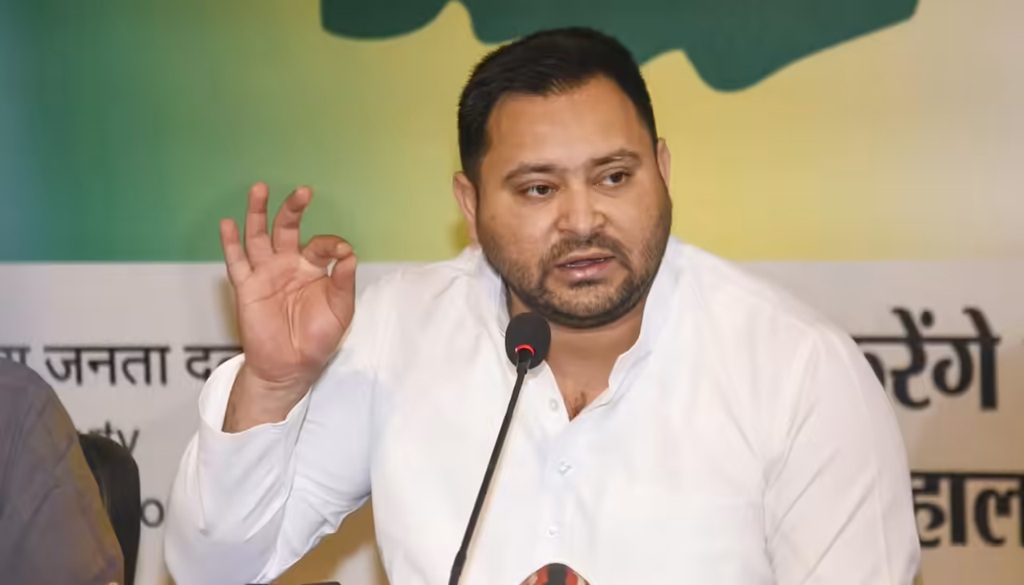
Patna: Rashtriya Janata Dal (RJD) leader Tejashwi Yadav has indicated a major strategic shift within the party, signalling a return to the traditional Muslim-Yadav (MY) social coalition that shaped the political dominance of party founder Lalu Prasad Yadav for nearly three decades.

A day after the expansion of the Samrat Choudhary-led Bihar cabinet, Tejashwi openly hinted at restructuring the party organisation and strengthening its ideological cadre, while also making it clear that RJD may move away from the broader “A to Z” caste outreach experiment attempted in recent elections.
The announcement is being viewed as a significant political recalibration ahead of the next Bihar Assembly election, where Tejashwi is expected to directly face the BJP leadership led by Chief Minister Samrat Choudhary rather than JD(U) veteran Nitish Kumar.

Major Organisational Overhaul Planned
Tejashwi Yadav said RJD is preparing for a complete organisational reform from the district level to various party cells and frontal organisations. Senior party leaders are reportedly engaged in discussions over the restructuring exercise, and a new organisational team could be announced soon.
Responding to a question on the proposed changes, Tejashwi said, “We are going to completely reform our organisation. We will strengthen our cadre. From districts to party cells, only those who believe in the party’s ideology and principles will be given responsibility.”
Political observers believe the move reflects the party’s assessment that its attempt to expand beyond its core social base did not yield the expected electoral gains.
Why Tejashwi Is Returning to the MY Formula
The decision to revisit the MY strategy comes after RJD’s disappointing electoral performance following Tejashwi’s “A to Z” social engineering experiment.
In the 2024 Lok Sabha elections and the 2025 Bihar Assembly elections, Tejashwi reduced dependence on the traditional Muslim-Yadav support base and increased representation for other caste groups, particularly Kushwahas, Bhumihars and non-Yadav OBCs.
However, the strategy reportedly backfired electorally.
From 75 Seats to 25
According to party insiders, RJD’s seat tally dropped sharply from 75 seats to 25 seats after the social balancing experiment failed to consolidate new caste groups while simultaneously weakening its traditional voter base.
During the Assembly elections, RJD reduced the number of Yadav candidates from 58 to 51, while increasing tickets for Kushwaha candidates from 8 to 16 and raising Bhumihar representation from 5 to 6.
Although the experiment showed some success during the Lok Sabha elections, where Mahagathbandhan fielded seven Kushwaha candidates and RJD candidate Abhay Kushwaha emerged victorious, the broader social coalition failed to translate into substantial Assembly gains.
Post-poll surveys reportedly indicated that support among Kushwaha voters for the Mahagathbandhan declined compared to previous elections.
Traditional Vote Bank Drifted Away
Political analysts within the party are also concerned that the broader caste outreach diluted RJD’s traditional MY base.
In Madhepura district, considered a Yadav-dominated region, RJD reportedly won only one of four Assembly seats. Across the larger Kosi belt, the Mahagathbandhan managed to win only three out of 13 seats, with RJD itself securing just two.
Similarly, in the Seemanchal region, considered Bihar’s largest Muslim belt, a section of Muslim voters shifted towards AIMIM. Out of 24 seats in the region, AIMIM reportedly won five seats, while the NDA secured 14. RJD managed to win only one seat there.
The MY formula — combining Muslim and Yadav voters — had been the backbone of Lalu Prasad Yadav’s politics since the 1990s. Under this social coalition, the undivided Janata Dal won 167 seats in the 1995 Bihar Assembly election. Political observers often described the MY formula as the “Mandal response to Mandir politics.”
Challenge from Samrat Choudhary, Not Nitish Kumar
Sources close to the party say Tejashwi now recognises that his principal political challenge in future elections will come from BJP leader and Chief Minister Samrat Choudhary rather than Nitish Kumar.
The BJP-led government’s recent cabinet expansion is also being seen through this political lens. Nearly 70 percent of ministers in the new cabinet reportedly belong to backward classes, extremely backward classes (EBCs), and Dalit communities — social groups traditionally associated with Nitish Kumar’s core support base.
Political analysts believe the NDA is attempting to consolidate Nitish Kumar’s traditional voters under Samrat Choudhary’s leadership. The induction of Nitish Kumar’s son Nishant Kumar into the Bihar government is also being interpreted as an attempt to preserve the JD(U) legacy and retain the support base.
This has reportedly made it more difficult for Tejashwi to make inroads into the EBC and Dalit vote banks.
State Committee Yet to Be Announced
RJD has not announced a full-fledged state committee for nearly three years. The last committee was constituted in April 2023 under then-state president Jagdanand Singh.
Although Mangani Lal Mandal became the state president in June 2025, his team is yet to be formally announced.
Interestingly, the earlier organisational structure had deliberately focused more on EBCs, Dalits and non-Yadav OBCs rather than the traditional MY social combination. Mangani Lal Mandal himself was appointed state president to strengthen outreach among EBC voters.
However, party insiders admit the strategy failed to deliver major political dividends.
Two Recent Signals Towards MY Consolidation
After Nitish Kumar announced his resignation from the Chief Minister’s post on March 5, Tejashwi Yadav reportedly made two symbolic political moves aimed at consolidating Muslim and Yadav voters.
First, RJD initiated contact with AIMIM during the Rajya Sabha election discussions. On March 14, Bihar AIMIM chief Akhtarul Iman met Tejashwi Yadav. The following day, Tejashwi attended Iman’s iftar gathering, sending a political message of Muslim unity within the opposition space.
Second, on April 7, Tejashwi visited Nawada to meet former MLA Rajballabh Yadav after the death of his son. The visit was interpreted as an emotional outreach to Yadav voters. Notably, Tejashwi was accompanied by Kaushal Yadav, considered a political rival of Rajballabh Yadav.
Rajballabh Yadav’s wife Vibha Devi is currently a JD(U) MLA and had shifted allegiance ahead of the Assembly elections.
Tejashwi to Target NDA on Dynastic Politics and Jobs
Tejashwi Yadav has also sharpened his attack on the NDA government over dynastic politics — an issue frequently used by the BJP against opposition parties.
Questioning recent ministerial appointments, Tejashwi said several ministers belong to political families and alleged that BJP no longer has the moral authority to attack RJD on nepotism.
He claimed that sons of prominent political leaders, including Nishant Kumar and Deepak Prakash, were inducted into ministerial positions without being members of either House.
The RJD leader also announced plans to intensify political campaigns on issues such as unemployment, women’s welfare schemes, free electricity promises and unfulfilled government commitments.
Bihar Tour Blueprint Under Preparation
Tejashwi Yadav is expected to launch a statewide political tour in the coming weeks. He said the blueprint for the yatra is being prepared by state president Mangani Lal Mandal.
The campaign is likely to focus on women’s financial issues, employment opportunities for youth, electricity subsidies and alleged failures of the NDA government.
Party leaders say the strategy will combine street-level mobilisation with aggressive opposition inside the Assembly as RJD attempts to revive its political fortunes ahead of the next electoral battle in Bihar.