
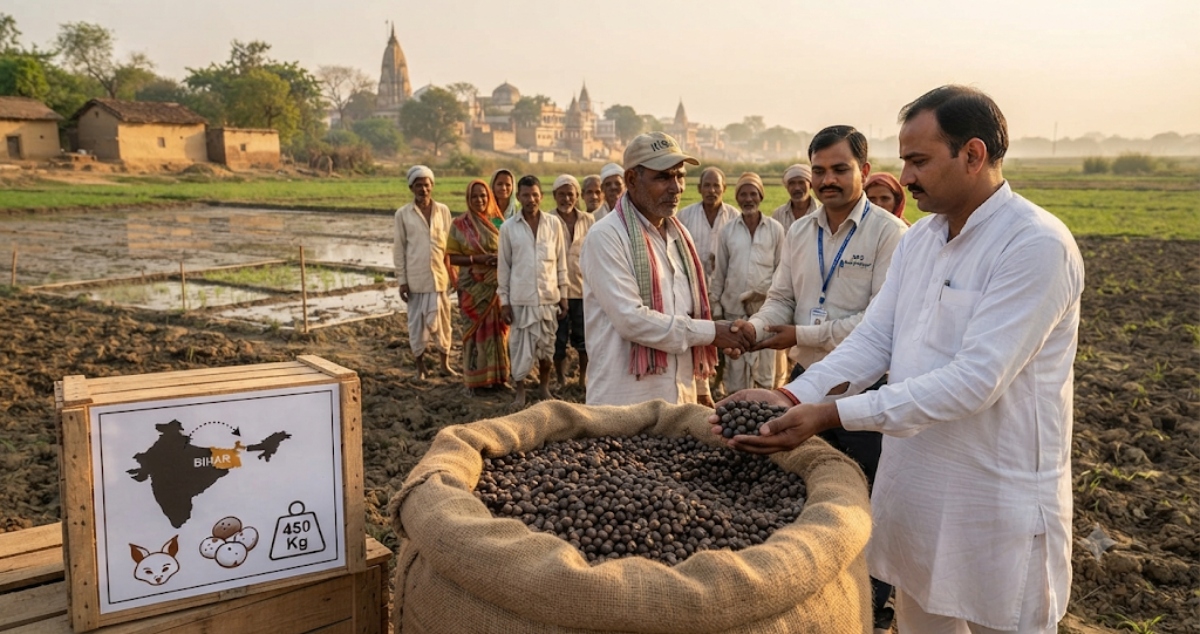
Patna: Bihar’s popular makhana variety is set to make its way into the agricultural fields of Uttar Pradesh, opening up a new farming opportunity for cultivators in Varanasi. Agricultural scientists from Bihar have sent 450 kg of seeds of the improved ‘Swarna Vaidehi’ variety to Uttar Pradesh to promote scientific makhana cultivation.

The initiative aims to familiarise farmers in Varanasi with advanced cultivation techniques, improve crop quality and encourage agricultural diversification. It is being implemented under the Makhana Development Scheme 2026-27.
450 Kg of Swarna Vaidehi Seeds Sent from Bihar

The Regional Research Station (RRS), Jhanjharpur, under Dr Rajendra Prasad Central Agricultural University, Pusa, Samastipur, has supplied 450 kg of makhana seeds to Varanasi.
According to Ashish Rai, Technical Officer and Public Information Officer at the research centre, all the seeds belong to the improved Swarna Vaidehi variety. The seeds have been handed over to the District Horticulture Officer in Varanasi for cultivation and demonstration activities.
The initiative is expected to introduce Bihar’s improved makhana variety to farmers in eastern Uttar Pradesh.
Demonstration Programme to Train Varanasi Farmers
The initiative goes beyond the distribution of seeds. A frontline demonstration programme will be organised in Varanasi to familiarise farmers with scientific methods of makhana cultivation.
Through field-level demonstrations, farmers will receive guidance on:
- Scientific makhana production techniques.
- Crop management practices.
- Selection and use of quality seeds.
- Improved cultivation methods.
- Techniques to enhance production and crop quality.
The programme will allow farmers to understand the cultivation process through practical demonstrations in agricultural fields.
How Makhana Farming Could Benefit UP Farmers
The introduction of an improved makhana variety, combined with scientific farming practices, could create an additional income opportunity for farmers in Varanasi.
Better cultivation techniques may help improve both production and product quality. The initiative also aims to encourage farmers to diversify beyond conventional crops and explore makhana cultivation as a commercial agricultural option.
However, the actual economic benefits will depend on crop yields, cultivation costs and market conditions.
Bihar’s Jhanjharpur Centre Working to Improve Makhana Cultivation
The Regional Research Station in Jhanjharpur has been working on improved makhana varieties, seed production, scientific cultivation, processing and the transfer of agricultural technology to farmers.
The supply of 450 kg of Swarna Vaidehi seeds to Varanasi is part of these efforts to expand improved makhana cultivation beyond Bihar.
Officials present during the initiative included Centre In-charge Dr Sanjay Kumar, Dr SK Mandal, Dhirendra Kumar, Ashish Rai, Satish Kumar, Subodh Kumar and Jitendra Jha, along with other officials and staff members.
The initiative marks a step towards expanding Bihar’s expertise in makhana cultivation to other states and creating new agricultural opportunities for farmers.