Patna: When Arpit Kumar travelled to a village in Bihar in 2018 to study groundwater contamination, he expected to find a problem that scientists and government agencies were already addressing. Instead, he encountered broken water-treatment plants, children drinking water from handpumps and families who knew their drinking water was contaminated but could not afford to buy an alternative.

One encounter left a lasting impression on him. A young boy had developed unusual marks on his skin, while the child’s father showed similar marks on his own hands and feet. The family told Arpit that doctors had linked their condition to contaminated groundwater, but they had no affordable source of safe drinking water.
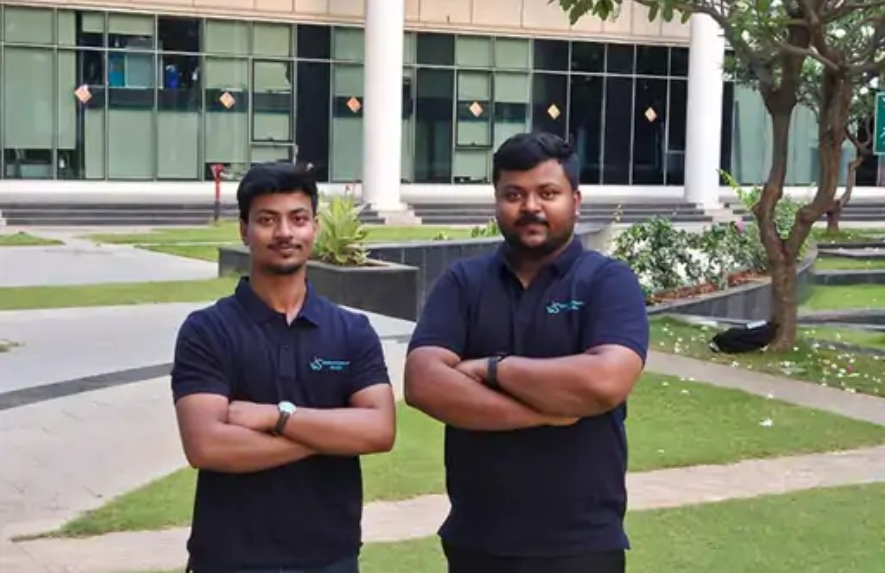
For Arpit and his younger brother, Abhijeet Kumar, the experience turned a school-level research assignment into a mission to address arsenic contamination in drinking water.

The brothers, originally from Barhiya village in Bihar’s Lakhisarai district, began developing a water-treatment system that they say can remove arsenic without electricity or chemical treatment. Their innovation uses what they describe as magnetic separation technology and has since evolved into a startup, Navmarg Research and Innovation Private Limited.
The brothers say their system has treated approximately 29 lakh litres of water so far. A plant installed in Udwantnagar in Bihar’s Bhojpur district can process 4,500 litres per hour, while larger systems are being explored for community-level water treatment.
Their journey began not in a laboratory or a university, but at Bihar Bal Bhavan Kilkari, an institution in Patna where school students work on science projects.
A school assignment that changed their direction
In June 2018, Arpit was studying in Class 9 at Holy Mission Secondary School in Patna, while Abhijeet was in Class 7. Both were part of the 2017–18 batch at Kilkari, where students were assigned research projects alongside their regular schooling.
Their science instructor gave them a topic: the extent of arsenic pollution in Bihar and the reasons behind its spread.
The brothers began surveying affected areas and reading scientific research papers. During this process, they came across a paper by Professor Yamaguchi of the University of Tokyo on the magnetic properties of metals.
That research prompted a question: Could magnetic technology be used to separate arsenic from contaminated water?
Their initial experiments involved electromagnets and magnets of different shapes, but the results did not meet their requirements. They subsequently began experimenting with neodymium-iron-boron (NdFeB) permanent magnets, which can retain their magnetic strength for many years.
According to Arpit, the challenge was not simply choosing a powerful magnet. It was designing a system that could treat water flowing under pressure while reducing arsenic concentrations.
The brothers continued working on the prototype, gradually moving from an experimental setup towards a system intended for practical use in communities affected by contaminated groundwater.
The encounter that made the problem personal
Arpit said the seriousness of the problem became clear when he visited Dulhpur village in Buxar district in 2018 to examine existing arsenic-removal facilities.
Although treatment plants had been installed, he found some of them broken or non-functional. At a government school, he observed that teachers were buying drinking water, while children were consuming water from handpumps.
He also noticed unusual marks on the skin of several children.
Arpit visited the home of a young boy whose body had developed visible discolouration. The family lived in a modest, makeshift house and depended on handpump water for daily use.
According to Arpit, the boy’s father showed him similar marks on his own hands and feet and explained that the family could not afford to buy drinking water regularly.
The encounter prompted Arpit to discuss the symptoms with Dr Arun Kumar of Mahavir Cancer Sansthan in Patna, whose team studies the links between arsenic exposure and cancer. Dr Kumar subsequently became a mentor to the brothers.
Long-term exposure to arsenic through contaminated drinking water can cause serious health problems. According to the World Health Organization (WHO), chronic exposure can lead to skin lesions and an increased risk of cancers, including skin, lung and bladder cancer.
Arsenic exposure during pregnancy and childhood is also associated with adverse developmental outcomes. However, skin changes alone cannot establish arsenic poisoning, and medical assessment and water testing are necessary to determine the cause.
For affected families, the central challenge remains access to safe water. Simply advising people to stop consuming contaminated water is not enough when alternative sources are unavailable or unaffordable.
How the brothers developed their water-treatment system
The project initially faced a credibility problem. Arpit said that persuading officials and researchers to take a school student’s claim of developing an arsenic-removal technology seriously was difficult.
A breakthrough came in December 2018, when their project was selected for the 26th National Children’s Science Congress in Bhubaneswar, where it received an A+ grade. The Department of Science and Technology also acknowledged the project’s potential for further development.
Following an initiative by Kilkari’s director, the brothers approached Bihar’s Department of Science and Technology. They received Rs 3 lakh to support patent filing and further research.
Their laboratory prototype was subsequently tested at a laboratory associated with the Public Health Engineering Department (PHED). Arpit said the system was able to treat water containing arsenic at concentrations as high as 1,000 micrograms per litre.
In 2019, he emailed the then director of the Council of Scientific and Industrial Research’s Indian Institute of Chemical Technology (CSIR-IICT), Hyderabad, without relying on personal introductions. He received a response the following day and was invited to present the technology for scientific evaluation.
Dr S. Sridhar of CSIR-IICT became another mentor to the brothers.
In December 2020, the first 3D-printed unit was installed on a handpump in Maner, near Patna, in collaboration with PHED.
According to Arpit, the unit treated approximately 29,000 litres of water in one month. The arsenic concentration in the untreated water was 141 micrograms per litre, which fell to below 5 micrograms per litre after treatment.
The project subsequently received Rs 4.36 lakh through PHED for pilot installations in schools. In 2023, UNICEF Bihar provided Rs 13 lakh to support further research into the technology at the molecular level.
Navmarg Research and Innovation Private Limited was established the same year to take the innovation beyond the prototype stage.
The brothers also say their technology has been included in the Ministry of Jal Shakti’s National Jal Jeevan Mission innovation technology panel.
How does the magnetic water filter work?
The brothers’ system, called the Navmarg magnetic filter, is designed for use in arsenic-affected households, schools, community water points and public institutions.
According to Arpit, the system has three stages:
- Pre-filtration: Water passes through a carbon filter to remove dust and suspended particles.
- Magnetic treatment: Water passes through the system’s magnetic treatment unit, which is intended to separate arsenic from the water.
- Post-filtration: An additional filtration stage can be used where water contains high levels of soil or other suspended material.
The founders say the system does not require electricity or chemical treatment and does not involve frequent replacement of the main filter. They estimate that the magnetic component can last more than 10 years.
The underlying mechanism and its performance are important considerations. Arsenic dissolved in water is not ordinarily removed simply by passing water near a conventional permanent magnet. A magnetic treatment system must have a scientifically demonstrated mechanism for capturing or separating the arsenic, and its performance needs to be validated through independent testing under real-world conditions.
The brothers say their system has undergone laboratory testing and pilot deployment. Detailed, independently verifiable results on its operating mechanism, performance across different water compositions, long-term reliability and safe disposal of the separated arsenic would help establish its effectiveness at a larger scale.
Can 1,000 litres of water be treated for Rs 8?
Cost is one of the key claims behind the innovation.
Arpit estimates that the system can treat 1,000 litres of water for approximately Rs 8. The founders say the technology could provide an affordable option for communities where access to treated drinking water remains a challenge.
They have developed two models, according to Arpit.
The community-level unit costs approximately Rs 50,000, while a ward-level system costs around Rs 5 lakh to Rs 6 lakh. The larger model is designed to process up to 1.5 lakh litres of water per hour, he said.
These figures are estimates provided by the founders. Actual costs would depend on installation, maintenance, testing, operating conditions and the safe handling of arsenic-bearing waste.
Arsenic removal must also be accompanied by proper disposal of the separated contaminant. Otherwise, the arsenic could re-enter the environment and contaminate soil or water.
From Bihar villages to Karnataka
The technology has progressed from a student project to installations intended to serve communities.
A larger plant in Udwantnagar, Bhojpur district, currently has a reported capacity of 4,500 litres per hour. Arpit said approximately 29 lakh litres of arsenic-free water had been supplied through the initiative so far.
The startup is also working with Karnataka’s rural drinking water department on installations in Raichur and Yadgir districts.
Beyond treatment equipment, the brothers are developing two additional initiatives.
One is µSENSE, an Internet of Things-based sensor intended to detect arsenic and bacteria in water. The other, JalJyoti, is a geographic information system-based database designed to map water quality and identify areas where contamination may be a concern.
The tools are intended to help communities and authorities understand local water conditions and make more informed decisions about drinking-water safety.
Why arsenic contamination remains a concern in Bihar
Arsenic is a naturally occurring element found in the Earth’s crust. Under certain geological conditions, it can dissolve into groundwater and enter drinking-water supplies.
The WHO guideline value for arsenic in drinking water is 10 micrograms per litre. Water exceeding this level requires appropriate assessment and, where necessary, treatment or replacement with a safe source.
Bihar is among the states affected by groundwater arsenic contamination, particularly in areas of the Gangetic plains.
According to figures cited by Arpit from Bihar’s PHED, a 2025 report identified arsenic concentrations above the prescribed limit in groundwater across 4,709 rural wards. He also cited 54 blocks along the Ganga as areas of concern.
Government figures cited by the brothers refer to contamination across multiple districts, although the number of affected districts varies between the datasets and reporting periods. The exact number of people currently exposed to unsafe arsenic concentrations cannot be established from district-level figures alone.
The claim that around five crore people in Bihar face a risk from arsenic-contaminated water should therefore be treated as an estimate unless supported by a clearly identified assessment of population exposure.
The extent of exposure can vary significantly between neighbouring locations, making regular testing of individual water sources important.
What can people do to reduce arsenic exposure?
The most effective immediate step is to establish whether a drinking-water source is contaminated through appropriate laboratory testing.
Households should not assume that water is safe simply because it looks clear or tastes normal. Arsenic cannot reliably be detected through appearance, smell or taste.
Where contamination is confirmed, residents should use a verified safe source or a treatment system specifically demonstrated to remove arsenic. Ordinary water filters and purifiers should not be assumed to remove it unless their performance has been established for that purpose.
Authorities and treatment providers must also ensure that arsenic removed from water is handled and disposed of safely.
For communities that rely on handpumps and groundwater, affordable treatment is only one part of the solution. Reliable maintenance, regular water-quality testing and access to alternative safe sources are equally important.
From two school students to startup founders
The brothers’ work has evolved alongside their education and professional careers.
Arpit completed a BSc in Physics (Honours) at Manipal Academy of Higher Education and is now the founder and chief executive officer of Navmarg Research and Innovation. Abhijeet, the younger brother, is the company’s co-founder and chief technology officer and is studying computer science at IIT Patna.
Their family moved from Barhiya in Lakhisarai district to Patna in 2010. Their father, Upendra Kumar, worked as an operating theatre assistant at a private hospital, while their mother, Rita Kumari, had a science background but could not continue her education because of financial constraints.
Arpit has said his mother’s priority was ensuring that her children received a good education despite the family’s limited means.
The startup has also received mentorship through the Adani Group’s Vande Wings programme. According to Arpit, the initiative selected 54 participants from approximately 26,000 applications, and the brothers are working towards expanding the production and reach of their water-treatment technology.
Their journey illustrates how a research assignment can lead to an attempt to solve a pressing public-health problem. Whether the technology can deliver reliable, affordable arsenic removal at scale will depend on continued scientific validation, field performance, maintenance and safe waste disposal.
For communities that have lived with contaminated groundwater for years, the ultimate measure of success will be straightforward: consistent access to drinking water that is demonstrably safe.