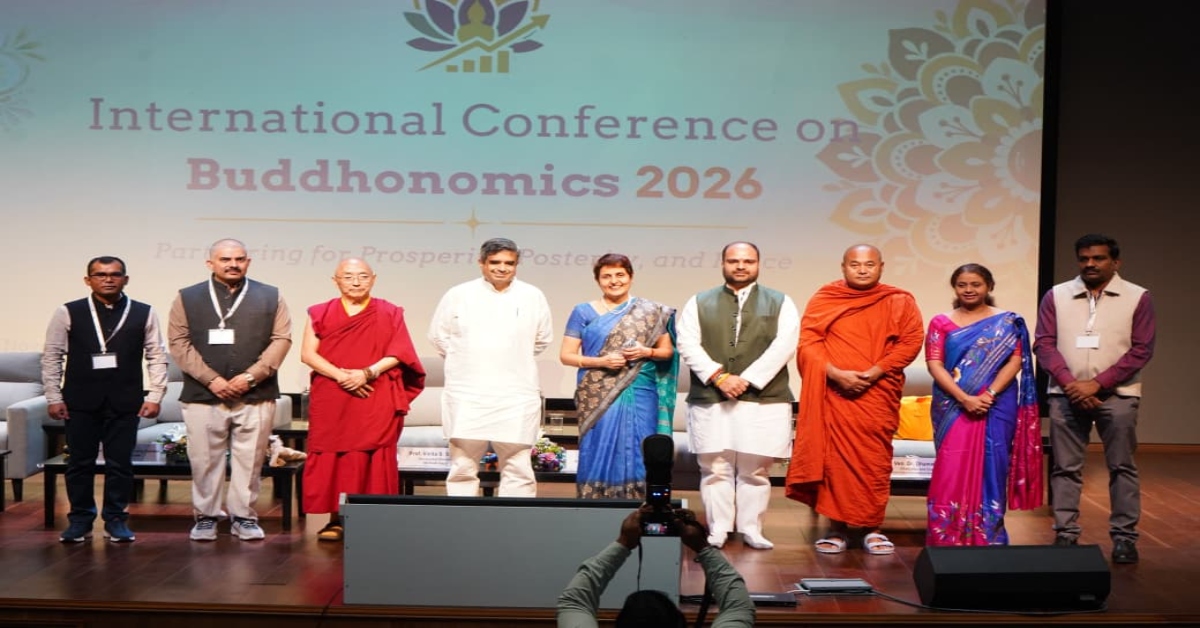
Bodh Gaya: The Indian Institute of Management (IIM) Bodh Gaya organised the international conference Buddhonomics 2026 on November 21, bringing together academics, policymakers, researchers and industry experts from India and abroad to discuss the role of Buddhist philosophy in contemporary economic systems.

Held under the theme Partnerships for Prosperity, Better Futures for Future Generations and Peace, the conference focused on the relationship between economic growth, ethical conduct, mindfulness and sustainable development.
The event aimed to explore how principles of Buddhist philosophy, including compassion and responsible use of resources, could contribute to a more inclusive and sustainable economic framework.

IIM Bodh Gaya Director Highlights Local Development And Mindfulness
The conference began with a ceremonial lamp-lighting. IIM Bodh Gaya Director Professor Vinita S. Sahay highlighted the institute’s connection with its surrounding region and local culture.
Describing the land as special, she emphasised the importance of improving opportunities for local communities through education and skill development. She said these initiatives could help strengthen people’s capabilities and promote inclusive growth.
She also identified mindfulness and sustainability as key institutional values and underlined the importance of academic platforms that encourage knowledge-sharing, collaboration and the exchange of ideas.
Saket Mishra Emphasises Ethics In Economic Growth
Uttar Pradesh Legislative Council member and former IPS officer Saket Mishra attended the conference as the chief guest.
In his address, Mishra highlighted the importance of ethical values in economic development. He said Buddhist philosophy does not oppose wealth creation but encourages people to pursue prosperity through responsible and ethical means.
He also stressed the need to ensure that the benefits of artificial intelligence (AI) reach all sections of society. He called for maintaining human involvement and accountability in decisions involving AI.
Speakers Discuss Responsible Wealth Creation And Human Welfare
IIM Bodh Gaya Dean of Research and Planning Professor Aviral Kumar Tiwari discussed the relationship between economic progress and ethical values. Referring to the traditional concept of Shubh-Labh, he said wealth creation should go hand in hand with responsibility and positive values.
He emphasised that the benefits of economic progress should extend beyond individuals and contribute to the welfare of society as a whole.
Padma Shri awardee and noted Tibetan scholar Professor Geshe Ngawang Samten spoke about India’s intellectual and philosophical traditions, highlighting the legacy of Nalanda and India’s contribution to global knowledge.
He observed that happiness is not limited to material comforts but is also connected with positive thinking and mental peace. He further stressed that equality begins with individual transformation, compassion and love.
He called for an economic system built on ethical values, human welfare and sustainable development.
Dr Dhammapiya, Chancellor and Chairman of DDI BU, said Buddhist teachings extend beyond the proper use of wealth and resources to offer guidance on improving the quality of life.
Using the example of a honeybee, he explained the importance of utilising resources wisely and maintaining a balance between individuals, society and the environment. He also proposed the establishment of an International Buddhonomics Forum to promote these principles globally.
207 Research Papers Selected From 272 Submissions
The conference received 272 research paper submissions, of which 207 were selected after review. A total of 140 papers were presented across 25 technical sessions.
Of these presentations, 59 were conducted offline, while the remaining presentations took place online.
The sessions covered a wide range of subjects, including the global economy, sustainable development, good governance, responsible business practices, artificial intelligence and cultural heritage.
The conference saw participation from 96 institutions across 11 countries.
India was represented by 12 IIMs, IITs and national institutions, along with 45 universities and 26 business schools and colleges. Seven industry and social organisations, including Tata Steel and Bank of Baroda, also participated.
Connecting Ancient Wisdom With Modern Economic Challenges
Through Buddhonomics 2026, IIM Bodh Gaya sought to highlight the relevance of ethical conduct, compassion and sustainability in today’s economic framework.
The initiative aims to connect India’s ancient knowledge traditions with contemporary economic challenges while encouraging collaboration and the exchange of ideas for a more balanced and sustainable future.