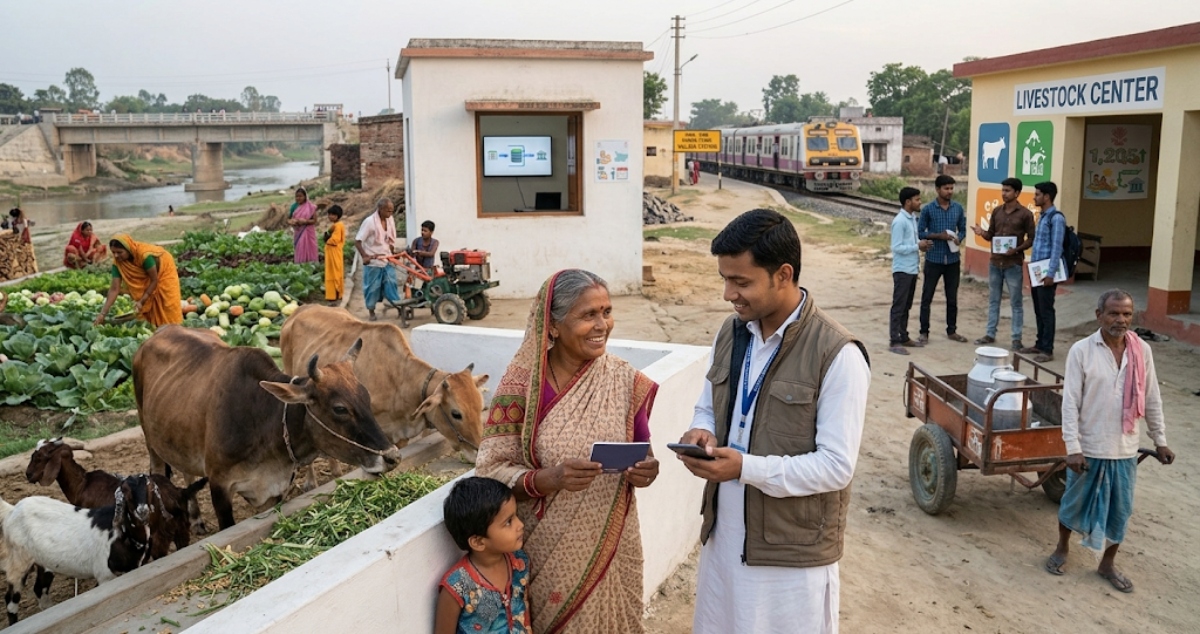
Livestock farming is emerging as an important pillar of rural livelihoods in Bihar and Jharkhand, creating employment opportunities beyond traditional agriculture. Dairy farming, goat rearing, poultry and fisheries are helping rural households generate additional income and explore self-employment opportunities.

According to government figures, more than 14 lakh families in Bihar are receiving employment through livestock-related activities. In Jharkhand, around 1.56 lakh families are directly benefiting from the state’s cattle-rearing scheme.
The figures raise an important question: Can livestock farming become a sustainable alternative to migration and strengthen the rural economies of both states?

Bihar and Jharkhand’s Livestock Population: Where Do They Stand?
According to the Ministry of Fisheries, Animal Husbandry and Dairying’s Annual Report 2025-26, India’s 20th Livestock Census, conducted in 2019, recorded approximately 53.67 crore livestock across the country.
The fieldwork for the 21st Livestock Census has been completed, but its final report has not yet been released.
According to the 2019 census, Bihar had approximately 3.65 crore livestock, while Jharkhand recorded around 2.36 crore. Bihar ranked fifth nationally, while Jharkhand stood at 12th position in terms of total livestock population.
| State | Total livestock population |
|---|---|
| Uttar Pradesh | 6.80 crore |
| Rajasthan | 5.68 crore |
| Madhya Pradesh | 4.06 crore |
| West Bengal | 3.75 crore |
| Bihar | 3.65 crore |
| Andhra Pradesh | 3.41 crore |
| Maharashtra | 3.31 crore |
| Telangana | 3.26 crore |
| Karnataka | 2.90 crore |
| Jharkhand | 2.36 crore |
Bihar accounts for approximately 6.8% of India’s total livestock population, while Jharkhand contributes around 4.4%.
Cattle, Goats and Poultry: A Comparison
The 20th Livestock Census figures reveal differences between the two states across various livestock categories. Bihar has a larger population of cattle, buffaloes and goats, while Jharkhand has a higher number of poultry birds.
| Livestock category | Bihar | Jharkhand |
|---|---|---|
| Cattle | 1,53,97,980 | 1,12,23,052 |
| Buffaloes | 77,19,794 | 13,50,313 |
| Goats | 1,28,21,216 | 91,21,173 |
| Poultry birds | 1,65,25,349 | 2,48,32,906 |
These figures indicate the significant potential of both states in dairy farming, goat rearing and poultry-based businesses.
Milk Production: Bihar Ahead of Jharkhand
Milk production is another important indicator of the strength of a state’s dairy sector.
According to the Department of Animal Husbandry and Dairying, Bihar produced 133.98 lakh tonnes of milk during 2024-25, accounting for 5.41% of India’s total milk production. The state ranked ninth nationally.
Jharkhand recorded milk production of 31.15 lakh tonnes during the same period, contributing approximately 1.26% to national production and ranking 14th.
| Indicator | Bihar | Jharkhand |
|---|---|---|
| Milk production | 133.98 lakh tonnes | 31.15 lakh tonnes |
| National share | 5.41% | 1.26% |
| National ranking | 9th | 14th |
Uttar Pradesh, Rajasthan and Madhya Pradesh are the country’s three largest milk-producing states.
However, higher total milk production does not necessarily translate into higher per capita availability.
Per Capita Milk Availability Below National Average
According to government figures for 2024-25, India’s average per capita milk availability was 485 grams per day.
In comparison, Bihar recorded 285 grams per person per day, while Jharkhand reported 214 grams.
| State | Per capita milk availability |
|---|---|
| Punjab | 1,318 grams |
| Rajasthan | 1,229 grams |
| Haryana | 1,128 grams |
| Madhya Pradesh | 707 grams |
| Uttar Pradesh | 447 grams |
| Bihar | 285 grams |
| West Bengal | 219 grams |
| Jharkhand | 214 grams |
| National average | 485 grams |
Both Bihar and Jharkhand remain below the national average, highlighting the need to improve animal productivity, breeding facilities, veterinary healthcare and milk collection infrastructure.
Large Livestock Population, but Several Challenges Remain
Despite their substantial livestock populations, both states face challenges in transforming animal husbandry into a stronger source of rural income.
Some key areas requiring attention include:
-
Animal productivity: Improving milk production per animal through better breeds, scientific breeding practices and balanced nutrition.
-
Veterinary healthcare: Expanding veterinary hospitals, vaccination facilities and access to timely treatment in rural areas.
-
Fodder availability: Ensuring an adequate supply of green fodder, dry fodder and nutritious animal feed.
-
Dairy infrastructure: Strengthening milk collection, chilling, processing and marketing networks.
-
Poultry and goat farming: Providing small livestock farmers with training, financial assistance, insurance and reliable market access.
Addressing these gaps will be essential to making livestock farming more profitable and sustainable.
How Much Does Animal Husbandry Contribute to Bihar and Jharkhand’s Economy?
Animal husbandry has an important place in the economic structure of both states.
According to state-wise Gross Value Added (GVA) figures for 2024-25, the livestock sector contributed approximately 7.81% to Bihar’s economy. Its contribution to Jharkhand’s economy stood at around 5.88%.
Both states have substantial rural populations that depend on agriculture and allied activities for their livelihoods.
According to the 2011 Census, approximately 88.7% of Bihar’s population and 75.9% of Jharkhand’s population lived in rural areas.
The Jharkhand government estimates that nearly 80% of its rural population depends on agriculture and allied activities for livelihood.
Meanwhile, Bihar’s Economic Survey 2024-25 reported that agriculture, forestry and fishing accounted for 19.5% of the state’s GSVA in 2023-24.
These figures underline the importance of agriculture and livestock-based activities in supporting rural households.
Can Livestock Farming Create Jobs and Reduce Migration from Bihar?
Migration has remained a major economic and livelihood challenge for Bihar. A large number of people move to other states in search of employment and better income opportunities.
In this context, livestock farming can provide an alternative source of local employment, particularly through dairy farming, goat rearing, poultry and fisheries.
According to figures released by Bihar’s Rural Development Department, livestock-related activities are providing employment opportunities to families across the state.
The reported figures are:
| Livestock-based activity | Families receiving employment |
|---|---|
| Goat rearing | 8.12 lakh |
| Dairy farming | 1.75 lakh |
| Poultry farming | 2.24 lakh |
| Fisheries | 751 |
In Jharkhand, government figures indicate that around 1.56 lakh families are directly benefiting from the state’s cattle-rearing scheme.
The state government also claims that approximately 50,000 families, particularly women, are being connected with livestock-based livelihood opportunities every year.
These initiatives indicate how animal husbandry can help create income opportunities within villages rather than forcing households to depend entirely on migration.
Milk and Egg Production Have Increased in Bihar
Bihar’s livestock sector has also recorded growth over the years.
According to the Bihar Economic Survey 2024-25, the state’s livestock population increased by 35.5% between 2003 and 2019.
Between 2018-19 and 2023-24, milk production increased by 30.9%, while egg production registered a growth of 95.1%.
These figures indicate the expansion of livestock-related economic activities in the state.
Government Schemes Supporting Dairy Farming in Bihar
The Bihar government has introduced several schemes to promote animal husbandry and encourage rural entrepreneurship.
According to the Economic Survey 2024-25, the government approved Rs 48.48 crore under the Samagra Gavya Vikas Yojana during the financial year 2024-25 to establish dairy units.
Under the scheme:
-
Beneficiaries belonging to Extremely Backward Classes, Scheduled Castes and Scheduled Tribes can receive subsidies of up to 75%.
-
Beneficiaries from other categories are eligible for subsidies of up to 50%.
The initiative aims to encourage more people to establish dairy businesses and generate sustainable income.
Sudha’s Role in Strengthening Bihar’s Dairy Sector
The Bihar State Milk Cooperative Federation (COMFED), which operates under the Sudha brand, plays an important role in the state’s dairy industry.
Through its milk collection, processing and marketing network, COMFED connects rural milk producers with organised markets.
Such cooperative networks can help farmers access better marketing facilities and create a more stable income source.
What Is Needed to Make Livestock Farming an Alternative to Migration?
While livestock farming has considerable potential, it cannot become a sustainable alternative to migration without addressing several practical challenges.
Small farmers and landless households need access to initial capital, animal insurance, improved breeds, affordable animal feed, veterinary services and assured markets for their products.
Dairy, poultry and goat-rearing activities also need to move beyond small household operations and develop into organised rural enterprises.
Better training, financial support, cold-chain infrastructure and market connectivity will be equally important.
Livestock farming has the potential to generate local employment, increase household incomes and reduce migration pressures in Bihar and Jharkhand. However, there is currently no official data establishing the extent to which the expansion of livestock-based livelihoods has reduced migration from either state.