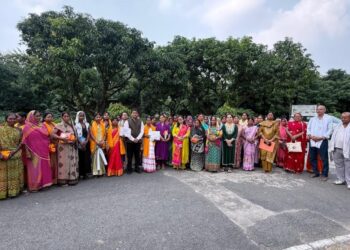

Rajgir: Nalanda University’s Department of Archaeology, in collaboration with the Anthropological Survey of India (AnSI) and Banaras Hindu University (BHU), organised a national workshop on Tuesday exploring how modern science, genetics and bioarchaeology can be used to better understand the ancient human past.

The workshop was inaugurated by Nalanda University Vice Chancellor Professor Sachin Chaturvedi, who stressed the importance of strengthening scientific and interdisciplinary approaches to archaeological research.
Focus on genomics and laboratory-based archaeology

In his inaugural address, Chaturvedi highlighted the growing importance of genomic history and advanced scientific methodologies in archaeology.
He emphasised the need to develop archaeological laboratory facilities capable of supporting areas such as DNA extraction and purification, isotopic analysis, chronological reconstruction and statistical analysis to strengthen archaeological interpretations.
Chaturvedi also referred to ongoing collaboration with an Australian research team through which human genomic data have been collected and studied. He said Nalanda University could build on such collaborations to develop a broader understanding of human biological diversity, population histories, mobility and demographic processes.
He also highlighted partnerships with institutions such as AnSI as important for combining archaeological, genomic, isotopic and anthropological evidence to reconstruct the past using scientific methods.

Experts discuss ancient DNA and population history
The workshop was attended by Jaideep Mazumdar, former Secretary, Ministry of External Affairs, along with researchers and experts from several institutions.
The key plenary session featured Professor Chaturvedi and organising chair Professor Vasant Shinde, Nalanda University and CSIR Bhatnagar Fellow at the Centre for Cellular and Molecular Biology (CCMB), Hyderabad.
Professor B.V. Sharma, Director of the Anthropological Survey of India, spoke about the role of biological anthropology and health studies in understanding how historical communities adapted to their environments.
Professor Gyaneshwer Chaubey of the Department of Zoology at Banaras Hindu University discussed the importance of advanced genomic research and ancient DNA studies in reconstructing South Asian population history.

Further technical presentations were delivered by Dr Abhishikta Ghosh Roy of Visva-Bharati, Santiniketan; Dr Prajjval Pratap Singh, M.K. Bhan Fellow at BRIC-CDFD, Hyderabad; and physical anthropologists Dr Manjulika Gautam and Dr Ningombam Somorjit Singh of AnSI.
The workshop also featured academic contributions from Professor Godabarish Mishra, Dean I/C, School of Historical Studies at Nalanda University, and Dr Elora Tribedy, Convener from the Department of Archaeology, Nalanda University.

Integrated archaeology programme announced
During the workshop, Professor Chaturvedi also announced the launch of an Integrated M.A. and Doctoral Programme in Archaeology at Nalanda University.
The programme is intended to promote advanced interdisciplinary research and develop expertise at the intersection of archaeology, anthropology and scientific approaches to understanding the human past.