Patna: Sharadiya Navratri, the nine-day festival dedicated to Goddess Durga and the worship of Shakti, has begun today bringing with it rituals, fasting, prayers and the worship of the Goddess’s nine forms.

From Ghatsthapana, the installation of the sacred pot, to the recitation of mantras and the worship of different manifestations of the divine feminine, each day holds religious significance for devotees.
According to Patna-based astrologer Pandit Narayan Pandey, chanting the Navarna Mantra alongside the worship of Goddess Durga is considered particularly auspicious during Navratri. He also explained the traditional astrological interpretations associated with the Goddess’s arrival on an elephant and departure on a rooster this year.

Goddess Durga’s Arrival On An Elephant Considered Auspicious
According to Pandey, Goddess Durga will arrive on an elephant and depart on a rooster this year. Traditional religious beliefs attach significance to the Goddess’s vahana, or divine vehicle, based on the days on which Navratri begins and concludes.
The Goddess’s arrival on an elephant is traditionally considered a favourable sign associated with prosperity, happiness, good rainfall, abundant food and general well-being.
Her departure on a rooster, however, is interpreted in traditional astrology as a possible indication of anxiety, restlessness, instability and suffering.
These interpretations form part of religious and astrological traditions and are understood within the context of faith.
Ghatsthapana Muhurat On October 11
Sharadiya Navratri begins on the Pratipada, or first day, of the Shukla Paksha in the Hindu month of Ashwin. The first day is dedicated to Goddess Shailaputri, the first of the nine forms of Goddess Durga.
Pandey said the primary auspicious time for Ghatsthapana on October 11 is from 6.19am to 10.12am. Within this period, a standard auspicious muhurat is available from 7.33am to 9am.
Other timings mentioned for the ritual include:
- Labh Muhurat: 9am to 10.28am
- Abhijit Muhurat: 11.44am to 12.31pm
- Rahu Kaal: 4.34pm to 6.01pm
According to traditional astrological beliefs, Rahu Kaal is generally avoided for auspicious rituals such as Ghatsthapana.
How Ghatsthapana Is Performed
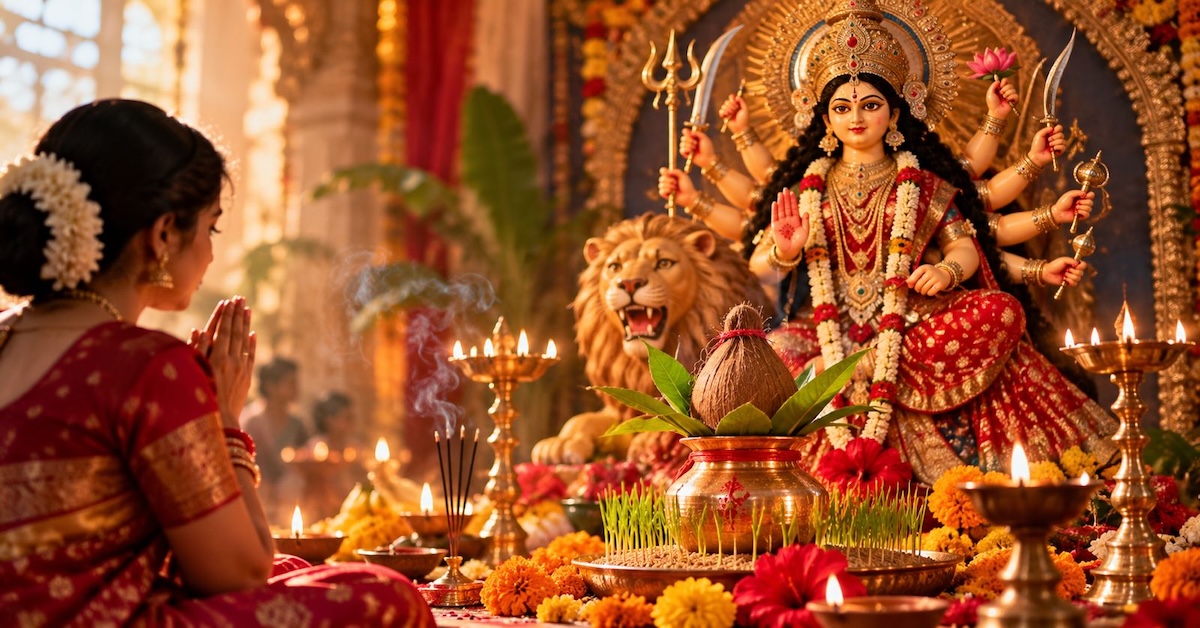
Ghatsthapana marks the formal beginning of Navratri worship. The place of worship is first cleaned, after which sacred soil is placed in an earthen vessel and barley seeds are sown.
A water-filled kalash is then installed beside the vessel, traditionally topped with mango leaves and a coconut. Devotees invoke Goddess Durga and perform the prescribed worship, light a lamp and take a solemn vow, known as Sankalp.
Many households maintain an Akhand Jyot, or continuously burning flame, and recite the Durga Saptashati throughout the nine days.
The rituals symbolise devotion and the beginning of a period of prayer, discipline and spiritual reflection.
Nine Days, Nine Forms Of Goddess Durga
Each day of Navratri is dedicated to a different manifestation of Goddess Durga, with each form associated with distinct spiritual qualities.
Day 1 — Goddess Shailaputri: Worshipped as a symbol of strength, determination and firm resolve.
Day 2 — Goddess Brahmacharini: Represents penance, devotion and spiritual discipline.
Day 3 — Goddess Chandraghanta: Associated with courage and the strength to confront challenges.
Day 4 — Goddess Kushmanda: Revered as the creative force behind the universe.
Day 5 — Goddess Skandamata: Represents motherhood and nurturing power.
Day 6 — Goddess Katyayani: Associated with the destruction of evil.
Day 7 — Goddess Kalaratri: Worshipped as the form that frees devotees from fear.
Day 8 — Goddess Mahagauri: Symbolises peace, purity and serenity.
Day 9 — Goddess Siddhidatri: Revered as the bestower of spiritual accomplishments, or Siddhis.
Many families observe Kanya Pujan on Ashtami or Navami, worshipping young girls as manifestations of the divine feminine. The nine-day festival is followed by Vijayadashami.
View this post on Instagram
Navarna Mantra: The Significance Of ‘Om Aim Hreem Kleem Chamundayai Vicche’
Pandey said chanting the Navarna Mantra is considered an important spiritual practice during Navratri.
The mantra is:
“Om Aim Hreem Kleem Chamundayai Vicche.”
According to traditional religious beliefs, devotees chant the mantra to seek Goddess Durga’s blessings, cultivate mental stability, overcome fear and gain strength to face life’s challenges.
The syllables Aim, Hreem and Kleem are regarded as seed syllables, or Beej Aksharas, associated with divine energies.
In the interpretation described by Pandey, Aim is associated with Goddess Saraswati, Hreem with Mahalakshmi and Kleem with Mahakali. Together, the three syllables represent knowledge, prosperity and power.
The mantra is therefore regarded in this tradition as a means of invoking the combined energies of these three goddesses through the worship of Goddess Durga.
Mantra Chanting And Meditation During Navratri
Traditional beliefs associate the chanting of the Navarna Mantra with spiritual benefits, self-confidence and mental peace. The practice is also believed to help devotees seek protection from negativity, overcome obstacles and appease the nine planets, known as the Navagraha.
Pandey recommends chanting at least one mala, or a rosary of 108 repetitions, daily during Navratri. He said that chanting 16 malas is considered even more beneficial within this spiritual practice.
Regular chanting and meditation are also traditionally encouraged as ways to concentrate the mind and maintain composure during periods of stress.
A Festival Of Devotion, Discipline And Positive Resolve
Beyond its rituals, Sharadiya Navratri offers devotees an opportunity to practise self-restraint, prayer, charity and spiritual reflection. Fasting, mantra chanting and worship are observed as ways of seeking the Goddess’s blessings over the nine days.
The traditional beliefs surrounding Goddess Durga’s arrival on an elephant and departure on a rooster add another dimension to this year’s observances.
At its heart, the festival carries a message of devotion, courage and righteous action, encouraging devotees to face challenges with faith and a commitment to positive change.