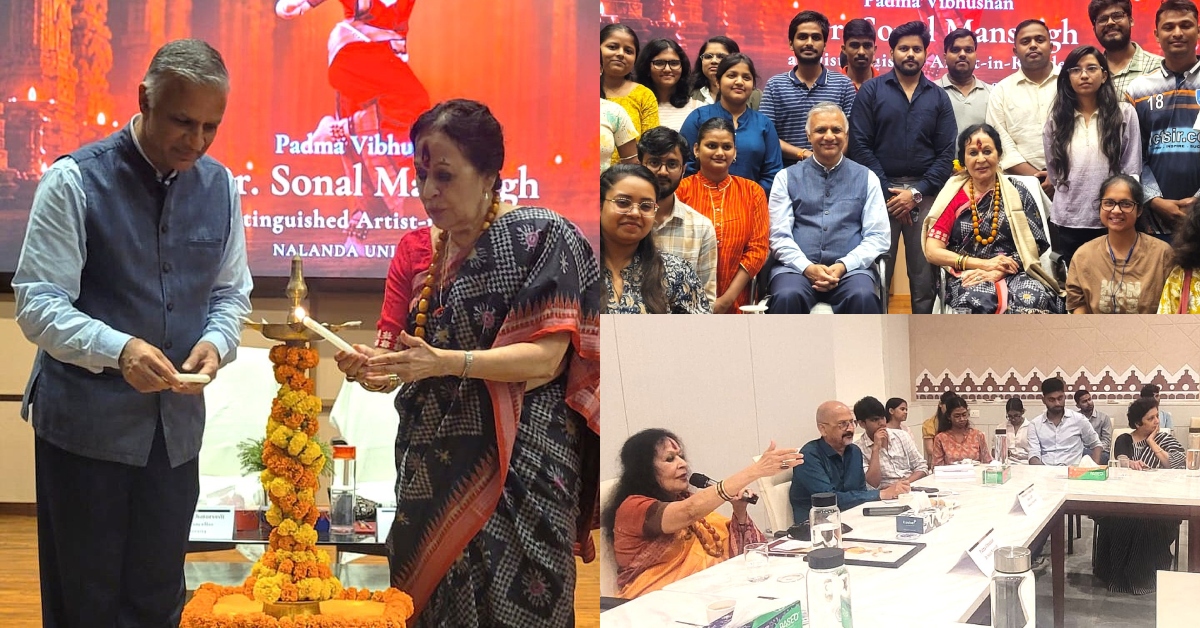
Rajgir, Nalanda: Padma Vibhushan Dr Sonal Mansingh, one of India’s leading classical dancers and a former Rajya Sabha member, has joined Nalanda University as its Distinguished Artist-in-Residence for a series of academic and cultural engagements.

Her residency formally began on the evening of September 7, when Nalanda University Vice-Chancellor Professor Sachin Chaturvedi inaugurated the Artist-in-Residence Programme.
Chaturvedi said Mansingh’s association with the university would give students an opportunity to learn the nuances of classical dance from an accomplished practitioner. He also linked the programme to the wider need to encourage students to engage with India’s own intellectual and cultural traditions.

In her inaugural remarks, Mansingh emphasised the importance of the Guru-Shishya Parampara, under which the teacher plays a role in stimulating and developing the student’s mind.
Ramayana And India’s Living Traditions
During the second day of her engagement with the university community, Mansingh interacted with students and faculty members, discussing the diversity and continuing evolution of India’s artistic and cultural traditions.
The Ramayana was central to the discussion. Mansingh explained how the narrative travelled across different regions, languages and communities, taking varied forms in folk, tribal, classical, Shastric and literary traditions.
Despite these variations, she highlighted the continuity of the epic’s essential identity and described the Ramayana as a “living tradition” that continues to evolve through cultural exchange.
She also reflected on Sita’s character, particularly her strength and agency, while discussing the philosophical idea of līlā and its relationship with individual purpose, dharma and the wider civilisational narrative.
Kathak And Bharatanatyam: Traditions That Evolve
The discussion also turned to India’s classical dance traditions and their historical connections.
Responding to questions about Kathak and Bharatanatyam, Mansingh emphasised that artistic traditions did not develop entirely in isolation. The movement of artists, teachers and ideas helped create exchanges in areas including abhinaya, rhythm, storytelling, gesture and musical expression.
She stressed that tradition survives not by remaining frozen in its original form but by continuing to find new forms of expression.
The discussion offered students an opportunity to examine classical dance not simply as a performance tradition but also as a form of cultural knowledge shaped by centuries of interaction.
Women Performers And The Colonial Period
Mansingh also discussed the historical experiences of women performers and the changes in public perceptions of performance traditions during the colonial period.
She encouraged students to approach these histories through their wider social and cultural contexts, highlighting the need for a nuanced understanding of how India’s artistic traditions developed and were perceived over time.
The conversation brought together disciplines including art, history, philosophy, literature and cultural studies, aligning with Nalanda University’s emphasis on interdisciplinary and reflective learning.
Nalanda Spirit Lecture On Art And Ancient Knowledge
On September 9, Mansingh delivered the Nalanda Spirit Lecture at the Viswamitralaya Auditorium.
The lecture, titled “Art, Classical Traditions and the Spirit of Ancient Nalanda”, explored the relationship between artistic expression, classical traditions and India’s knowledge heritage.
Mansingh discussed the continuing importance of art and performance as vehicles for cultural memory, knowledge transmission and civilisational dialogue.
Her engagement at Nalanda University combines artistic practice with academic discussion, giving students and faculty an opportunity to explore India’s classical traditions through multiple perspectives.
The Artist-in-Residence Programme is intended to create a space where practitioners from the arts can contribute directly to the university’s academic and cultural environment, strengthening connections between creative expression, knowledge traditions and contemporary learning.