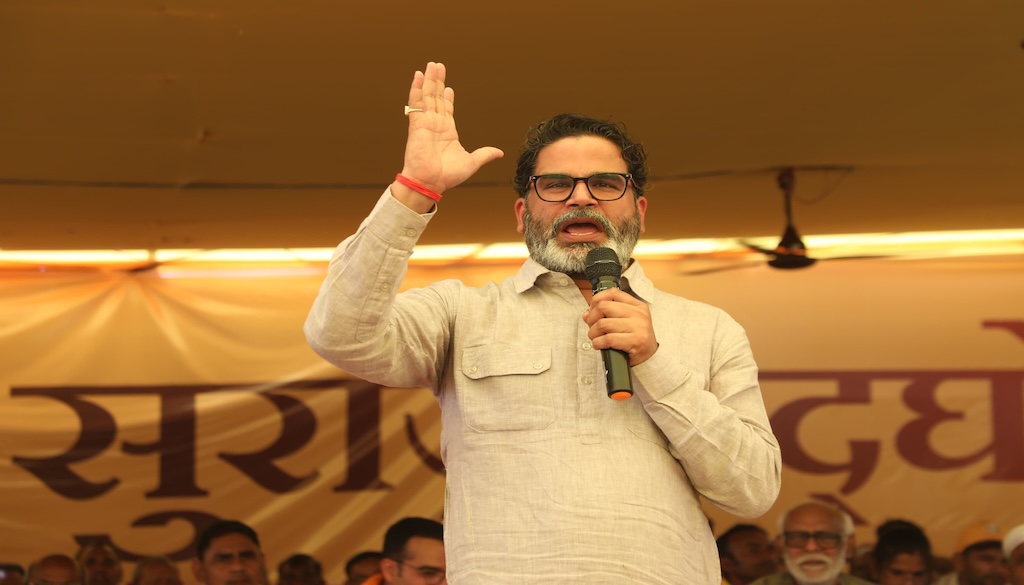
Patna, October 16: Political strategist-turned-activist Prashant Kishor has decided not to contest the upcoming Bihar Assembly elections, a move that has surprised many after his recent challenge to Rashtriya Janata Dal (RJD) leader Tejashwi Yadav in Raghopur. Kishor announced on October 15 that the Jan Suraaj Party had collectively decided he would not enter the fray this time.

Kishor Explains His Decision
“The party has decided that I won’t contest the election. If I complete the work I already have, it will be enough,” Kishor said. He argued that contesting could divert the organization’s resources and harm other candidates. “This decision was not made as part of any political strategy, but in public interest. Our goal is to win 150 seats; if we fall short, we will accept defeat,” he said, emphasizing that his focus would remain on strengthening the organization and supporting candidates across constituencies.
Weak Argument or Strategic Move?
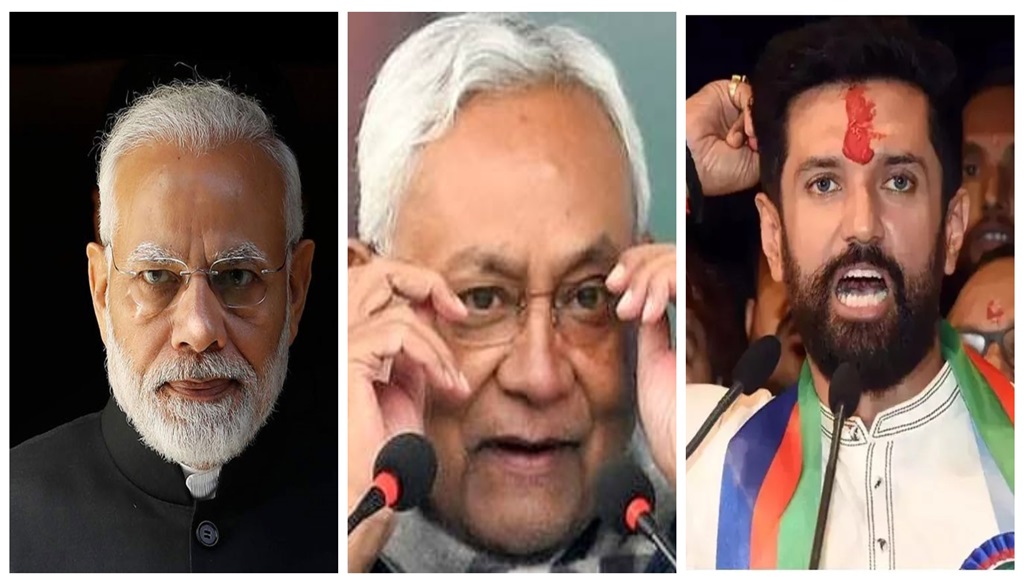
However, Kishor’s reasoning has not convinced many observers. Analysts point out that several top leaders—including Prime Minister Narendra Modi, Congress MP Rahul Gandhi, and RJD’s Tejashwi Yadav—have managed to contest elections while leading extensive campaigns.

According to NDTV, PM Modi addressed 206 rallies and roadshows during the 2024 Lok Sabha polls and still contested successfully from Varanasi. Rahul Gandhi, who held around 75 rallies, won from both Rae Bareli and Wayanad. Similarly, The Hindu reported that Tejashwi Yadav addressed 247 rallies and four roadshows during the 2020 Bihar Assembly elections while contesting and winning from Raghopur.
Why Kishor May Have Stayed Away
Political experts say Kishor’s decision may have deeper strategic and image-related reasons.
1. Avoiding a Risky Debut
Patna University Professor of Political Science Rakesh Ranjan says Kishor’s decision could be a tactical move to avoid potential embarrassment. “The Jan Suraaj Party is contesting for the first time. If Kishor contests and loses, it could severely damage the party’s credibility,” he explained.
He cited examples of leaders whose parties collapsed after their own defeats. In 2019, Pappu Yadav’s Jan Adhikar Party (Democratic) failed to win any seats, leading to its eventual merger with Congress in 2024. Similarly, Pushpam Priya Chaudhary’s Plurals Party contested 102 seats in 2020 but failed to win even one; she herself lost from both constituencies she contested.
2. Avoiding the ‘CM Face’ Trap
Political analyst Sanjay Singh believes Kishor wanted to steer clear of being projected as a chief ministerial candidate. “If Kishor had contested, he would automatically be seen as the CM face. Coming from the Brahmin community, his candidacy could have reignited the ‘forward vs backward’ divide in Bihar’s Mandal-dominated politics,” Singh said.
Kishor appears aware of this risk, evident in his balanced ticket distribution. Jan Suraaj’s first and second lists—released on October 9 and 13—reflect careful social engineering, with significant representation for Scheduled Castes, Scheduled Tribes, EBCs, OBCs, and Muslims.
3. Building an Image as a Political Reformer
Kishor has often said he does not aspire to hold positions but aims to “change politics itself.” Professor Ranjan adds, “He is trying to establish his identity as a reformer rather than a politician. He may want to test his party’s base before taking the electoral plunge himself.”
Comparing Kishor’s approach to that of Nitish Kumar, Ranjan said, “Even Nitish Kumar prefers to stay away from contesting elections directly, focusing instead on building his party’s organizational strength.”
The Road Ahead
Kishor’s decision has sparked speculation about the Jan Suraaj Party’s long-term strategy. While some see it as a cautious but wise move for a debutant party, others interpret it as a sign of hesitation after his bold challenge to Tejashwi Yadav in Raghopur.
As the Bihar elections approach, political observers will be watching whether Kishor’s “non-contesting” stance strengthens his image as a reformer—or exposes a lack of confidence in his new political venture.