Patna: Each year, Bihar’s festive season turns railway stations into rivers of movement — and this year, the convergence of Diwali, Chhath Puja, and the state assembly elections has magnified the migration wave. While trains are packed with workers returning home to celebrate, officials now fear that millions of these migrants will leave the state before the second phase of voting on November 11, potentially affecting voter turnout.

According to the Indian Railways, nearly four thousand additional trains have been scheduled to handle the seasonal rush. The first phase of polling will take place on November 6, and the second on November 11, but by then, the exodus of workers is expected to peak.
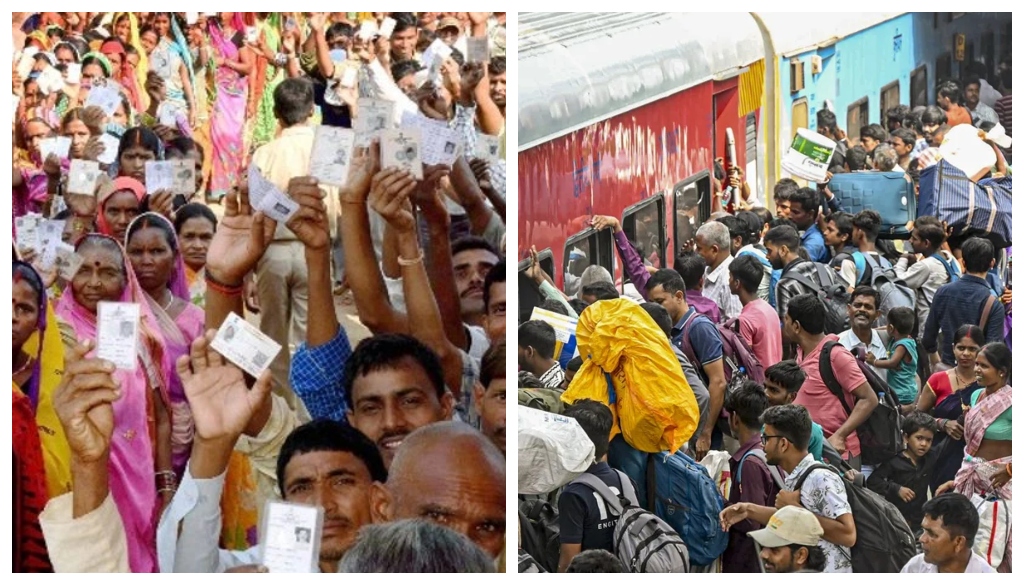
Data from railway authorities show that 1.4 million passengers have booked tickets to leave Bihar between October 28 and November 5, with another 6,00,000 confirmed to travel between November 6 and 10. In addition, around one million passengers are expected to travel without reservations in general coaches.

This trend, officials say, is similar to previous years. In 2024, an estimated 4.2 million passengers departed Bihar between November 8 and 14, immediately after Chhath Puja. While the number may be slightly lower this year, the overall scale remains vast. The Railways has prepared to run around 12,000 train trips across the network to accommodate the surge.
At major hubs like Patna Junction, Rajendra Nagar, and Danapur, crowds have already swelled. For many, returning home during Chhath — a festival deeply rooted in identity and family — takes precedence over voting. “We come home once a year; Chhath with family is non-negotiable,” said a worker waiting for his train at Patna Junction.
While some migrant workers said they planned to cast their votes before leaving, employees and contractual workers were less certain, citing limited leave and travel constraints. This disparity could lead to differential turnout between constituencies with high outmigration and those where voters remain locally anchored.
Political observers suggest that the timing of Chhath Puja — a festival that mobilises nearly every household in Bihar — may inadvertently reshape the electoral landscape. Constituencies with high migration, particularly in central and north Bihar, could see lower turnout during the second phase.
Despite appeals from political parties urging migrants to vote before returning to work, the socioeconomic pull of migration remains stronger. For many, the cycle of temporary return and rapid departure defines life between survival and belonging.
The Election Commission has acknowledged the overlap of festival migration and polling but maintains that adequate arrangements are in place. Yet, as trains fill and platforms overflow, the challenge remains — whether faith and festivity will overshadow the ballot box in one of India’s most politically significant states.