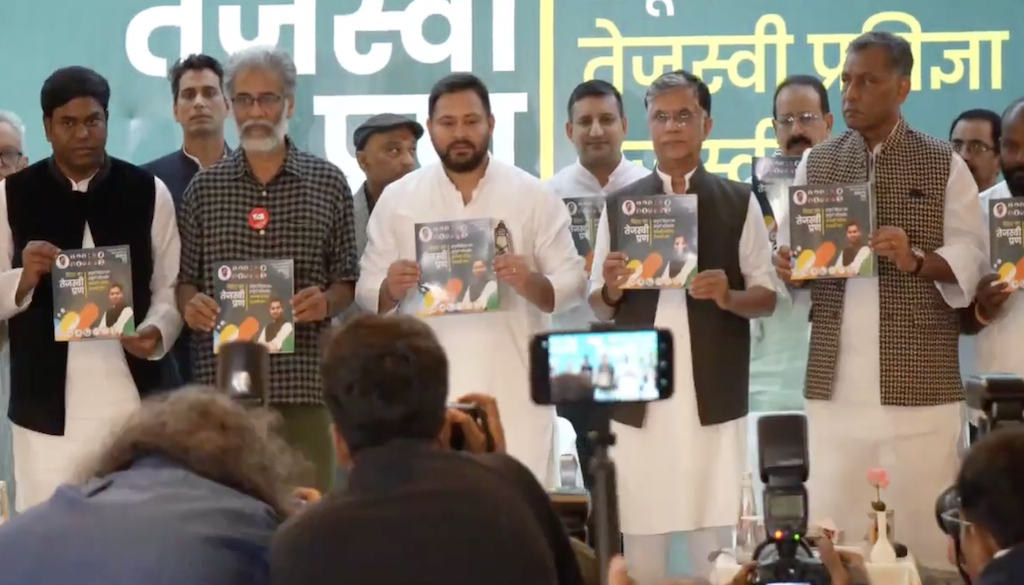
Patna: The Grand Alliance (Mahagathbandhan) on Tuesday released its election manifesto titled ‘Tejashwi’s Pledge’, with Rashtriya Janata Dal (RJD) leader Tejashwi Yadav promising sweeping welfare measures ahead of the Bihar Assembly elections. Focusing heavily on employment and women empowerment, Tejashwi announced that one member of every household would get a government job within 20 months if the alliance comes to power — a promise that would mean nearly 2.8 crore jobs in less than two years.

Tejashwi, who had earlier promised 10 lakh government jobs in the previous election, said his new pledge is aimed at harnessing the energy of Bihar’s youth. There are about 1.63 crore voters aged between 18 and 35 years in the state, making youth a decisive factor in the upcoming polls.
1. Women-Centric Welfare Push
In a clear bid to woo women voters, traditionally considered Chief Minister Nitish Kumar’s strong base, Tejashwi announced the ‘Mai Behen Maan’ scheme, under which women will receive a monthly grant of ₹2,500 and annual assistance of ₹30,000. He also promised to set up a women’s college in every subdivision and degree colleges in 136 blocks.

The manifesto appears to follow a national trend: in nine states that announced direct cash transfer schemes for women between 2023 and 2024, eight ruling parties returned to power — a success rate of 89 percent.
2. Focus on Government Employees
The Grand Alliance has also sought to attract nearly four lakh contract employees by promising to regularize their services. Regularized employees would receive higher pay, annual increments, and twice-yearly Dearness Allowance (DA) revisions. The manifesto further promises to reinstate the Old Pension Scheme, already implemented in several Congress-ruled states like Rajasthan, Chhattisgarh, and Himachal Pradesh.
3. Addressing Teachers’ Discontent
To address long-standing resentment among teachers, Tejashwi has proposed a transfer policy allowing teachers and other government workers to be posted within a 70-km radius of their home district. The Nitish government has faced repeated protests and criticism over its transfer policy, particularly from women teachers.
4. Focus on Extremely Backward Classes
Tejashwi has also attempted to consolidate support among Bihar’s Extremely Backward Classes (EBCs), who make up 36 percent of the state’s population. He pledged to pass the Extremely Backward Classes (Prevention of Atrocities) Act and reiterated his demand for population-based reservation.
5. Promises for Farmers
The manifesto includes a promise to implement Minimum Support Price (MSP) on all crops and to revive the Mandi system, which was dismantled years ago. The alliance also pledged greater support for sharecroppers and reforms to improve agricultural marketing infrastructure.
Experts Question Feasibility of Promises
Senior journalist Amarnath Tiwari described the manifesto as “a repetition of old promises,” adding, “Tejashwi has been talking about jobs for years, but there is no clear blueprint. Manifestos rarely influence voters, and after elections, they are often forgotten.”
Another senior journalist, Praveen Bagi, said the promises are financially unrealistic. “Implementing these schemes without a clear revenue model will bankrupt Bihar. Removing the 50% reservation limit is constitutionally impossible. The Old Pension Scheme hasn’t succeeded elsewhere. This manifesto raises hopes but lacks a roadmap,” he said.
Despite criticism, analysts agree that the focus on jobs and women’s welfare may resonate strongly with Bihar’s young and female voters — two key demographics that could shape the 2025 election outcome.