By Karuna Kumari
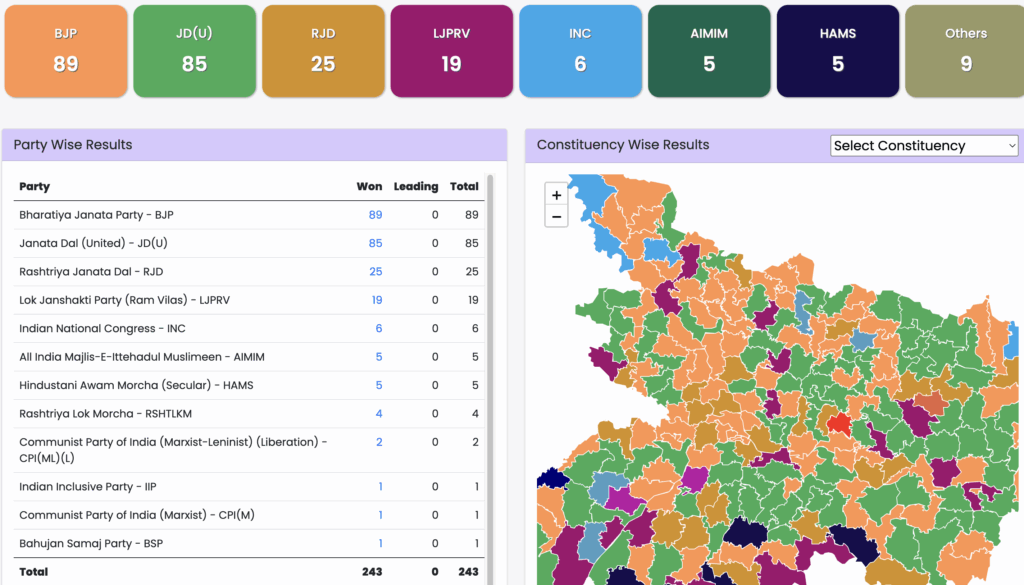
Patna: The Election Commission of India on Thursday night declared the final results for all 243 seats in the Bihar Assembly elections, confirming a sweeping victory for the National Democratic Alliance and positioning the BJP as the single largest party in the state.

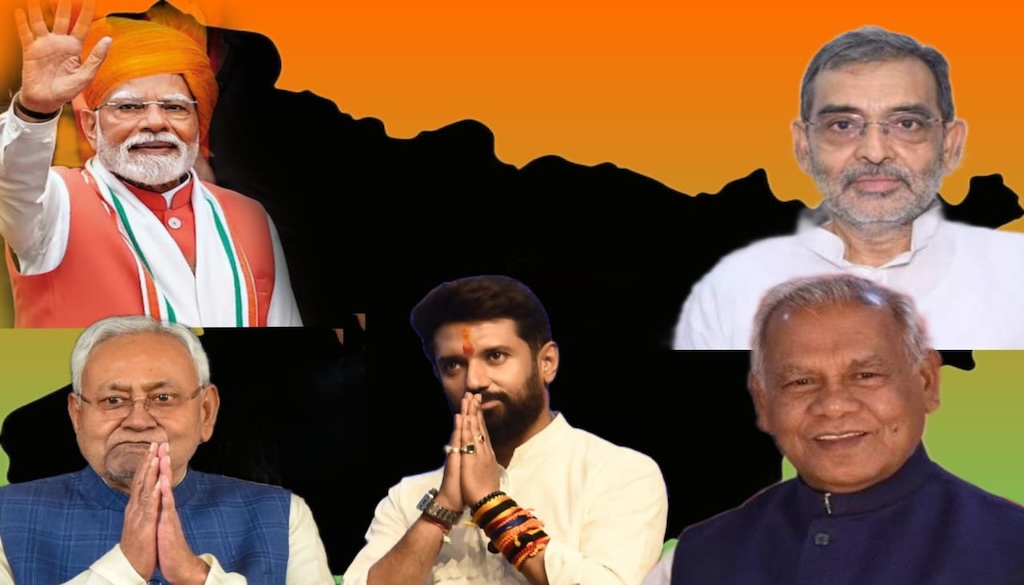
According to the ECI’s website, the BJP won 89 of the 101 seats it contested, closely followed by Nitish Kumar’s JD (U), which secured 85 seats from an identical seat share. The NDA’s smaller allies also delivered strong performances: Chirag Paswan’s LJP (Ram Vilas) won 19 of 28 seats, Jitan Ram Manjhi’s HAM(S) won five out of six, and Upendra Kushwaha’s Rashtriya Lok Morcha clinched all four seats it contested.
Opposition collapses as Mahagathbandhan falters

The Grand Alliance suffered a near-complete collapse. The RJD, once Bihar’s dominant force, won only 25 of the 143 seats it fielded candidates in. The Congress fared worse, securing just six seats out of 61. Mukesh Sahni’s VIP, contesting 14 seats, failed to open its account.
Among the Left parties, CPI(ML) won two seats and the CPM one. In contrast, Asaduddin Owaisi’s AIMIM emerged as a surprise contender in the Seemanchal region, winning five of 24 seats. The BSP also registered a solitary win in Ramgarh on the Bihar–Uttar Pradesh border.
Why the NDA surged
The results ensure the NDA will form the government in Bihar once again, breaking a 20-year anti-incumbency cycle with a decisive and region-wide mandate. Analysts point to Nitish Kumar’s Women’s Employment Scheme, popularly known as “Das Hazari”, as a key force behind the alliance’s surge. The programme transferred Rs 10,000 to 12.1 million women, strengthening the JD (U)’s long-standing support among women voters.
Equally significant was the opposition’s lack of preparedness. While the NDA finalised its seat-sharing agreement within six days of the election announcement, the Grand Alliance failed to release its formula even weeks into the campaign. Internal discord was apparent: in eight constituencies, alliance partners ended up contesting against each other.
Modi frames verdict as rejection of “Jungle Raj”
Responding to the results, prime minister Narendra Modi hailed the verdict as a “reaffirmation” of the NDA’s governance model. “Phir ek baar NDA sarkar,” he declared. Modi revived his campaign rhetoric targeting the RJD-era “Jungle Raj” and the katta (pistol) culture, arguing that Bihar had once again rejected a return to those days. “That kind of government will never come back to Bihar,” he told party workers.
With the NDA’s strong showing across regions and its allies united behind Nitish Kumar, the coalition is set for another term in power—while the opposition faces the task of rebuilding from one of its most bruising defeats in recent memory.