Patna: The Bihar government has signed memorandums of understanding worth Rs 13,000 crore for the construction of two pumped storage power plants, in what officials described as the state’s largest renewable energy initiative so far.

The agreements were signed on Tuesday between Bihar State Power Generation Company Limited (BSPGCL) and two private energy firms in the presence of Chief Minister Nitish Kumar and Energy Minister Bijendra Prasad Yadav at Vidyut Bhawan in Patna.
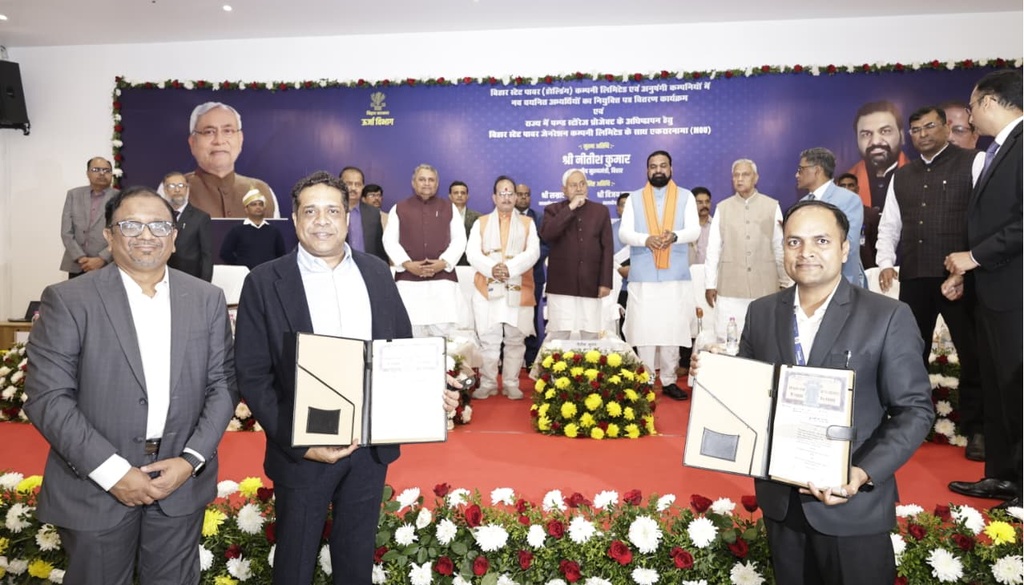

The projects, with a combined capacity of 2,120 megawatts, will be developed in Nawada district by Greenko Energies Private Limited and Sun Petrochemicals Private Limited. Officials said the plants would use off-stream and closed-loop pumped storage systems, allowing water to be stored during the monsoon and used to generate electricity without disrupting the natural flow of rivers.
Speaking at the signing ceremony, Yadav said the projects reflected the state’s commitment to providing reliable and clean power while supporting India’s goal of achieving net zero emissions by 2070. He described the initiative as the largest renewable energy project undertaken in Bihar to date and appealed to investors to explore opportunities in the state’s growing energy and industrial sectors.
Under the agreements, Greenko Energies will invest Rs 7,800 crore in a 1,200MW project at Ekamba, while Sun Petrochemicals will invest Rs 5,200 crore in a 920MW facility at Gosaitari. Both projects will be executed entirely with private investment and are scheduled for completion within six years.
The projects are being implemented under the state’s Pump Storage Project Promotion Policy, 2025, which was notified earlier this year. Officials said all procedural steps, including the selection of developers, were completed within five months of the policy’s introduction.
The state government said the projects would create employment for around 8,000 people during the construction phase and significantly enhance Bihar’s capacity for renewable energy integration, peak demand management and grid stability. Authorities added that improved storage capacity could also help lower electricity costs for consumers in the long term.