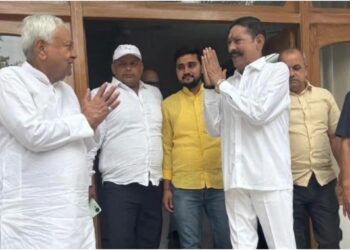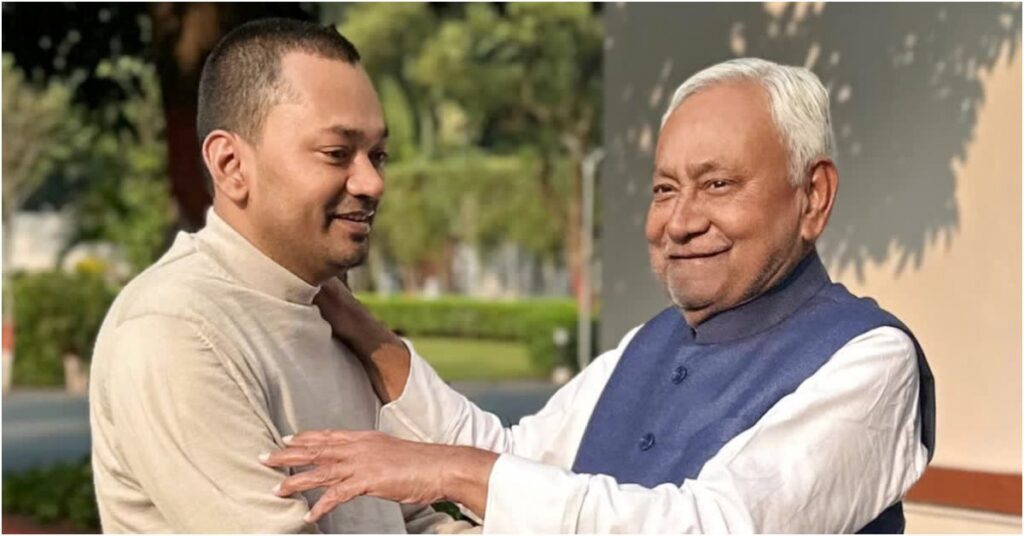
Patna: Bihar Chief Minister Nitish Kumar’s son Nishant Kumar formally entered politics on Sunday by joining the Janata Dal (United) (JD(U)). With his political debut, Nitish Kumar has become the ninth Chief Minister of Bihar whose son has stepped into active politics.

The development also highlights a broader trend in Bihar where the leadership of major regional parties is increasingly moving to the second generation. Currently, the three key political parties in the state—the Rashtriya Janata Dal (RJD), Janata Dal (United) and Lok Janshakti Party (Ram Vilas)—are associated with leaders from political families. While JD(U) has not formally handed over the party leadership to Nishant Kumar, his entry has sparked speculation about a future role in the party’s organisational structure.
RJD is currently led by former Deputy Chief Minister Tejashwi Yadav, while Chirag Paswan heads the Lok Janshakti Party (Ram Vilas). Both represent the next generation of leadership in Bihar politics.

Nishant Kumar has largely stayed away from public life so far. Like his father, he studied engineering and has maintained a low public profile. Unmarried and known to have an inclination toward spirituality, Nishant is now expected to gradually take on political responsibilities linked to his father’s legacy. Nitish Kumar has often criticised dynastic politics and frequently targeted RJD chief Lalu Prasad Yadav over the issue.
The family of Lalu Prasad Yadav has long been active in politics. His elder son Tej Pratap Yadav and younger son Tejashwi Yadav have both been involved in public life. Tejashwi currently leads the RJD, while Tej Pratap later formed his own outfit, the Jan Shakti Janata Dal. In the 2025 Bihar Assembly elections, Tej Pratap contested from the Mahua seat but failed to win.
Tejashwi Yadav also led the Mahagathbandhan alliance in the 2025 Assembly elections, which ended in defeat. Earlier, he had served as Deputy Chief Minister in the coalition government with Nitish Kumar. Tej Pratap had also served as a minister in the state government. However, both leaders are yet to achieve the same political stature as their father. Lalu Prasad Yadav’s daughter Misa Bharti is currently a Member of Parliament.
Another former Bihar Chief Minister, Jitan Ram Manjhi, has his son Santosh Kumar Suman active in politics. Santosh Suman currently serves as a minister in the Bihar government. Manjhi, who once served as Chief Minister after Nitish Kumar resigned following the 2014 Lok Sabha election setback, later founded the Hindustani Awam Morcha (Secular) and is currently part of the National Democratic Alliance (NDA).
Several former chief ministers of Bihar have also seen their sons enter politics. Daroga Prasad Rai, who served as Chief Minister in 1967, had a son Chandrika Rai who became an MLA but did not achieve the same political stature as his father. Chandrika Rai’s daughter Aishwarya Rai was married to Tej Pratap Yadav, though their divorce case is currently pending in court.
Dalit leader and former Chief Minister Ram Sundar Das also had his son Sanjay Kumar Das enter politics and become an MLA, though he did not leave a major political impact.
The political legacy of former Chief Minister Karpoori Thakur is being carried forward by his son Ramnath Thakur, a senior JD(U) leader and Rajya Sabha member who currently serves as Minister of State in the Union Ministry of Agriculture and Farmers Welfare. He has previously served in the Bihar government as a cabinet minister.
Similarly, the son of former Chief Minister Satyendra Narayan Sinha, Nikhil Kumar, also entered public life and held several key positions, including that of a Governor.
The political legacy of former Chief Minister Jagannath Mishra is being continued by his son Nitish Mishra, who has served as a minister in the Bihar government and is currently a BJP MLA.
Another former Chief Minister, Bhagwat Jha Azad, saw his son Kirti Azad enter politics after gaining fame as an international cricketer. Kirti Azad has served as a Member of Parliament for several terms and has been associated with multiple political parties during his career.
With Nishant Kumar’s entry into the JD(U), the role of political families in Bihar’s politics has once again come into focus, reflecting how leadership in several parties has gradually transitioned to the next generation.