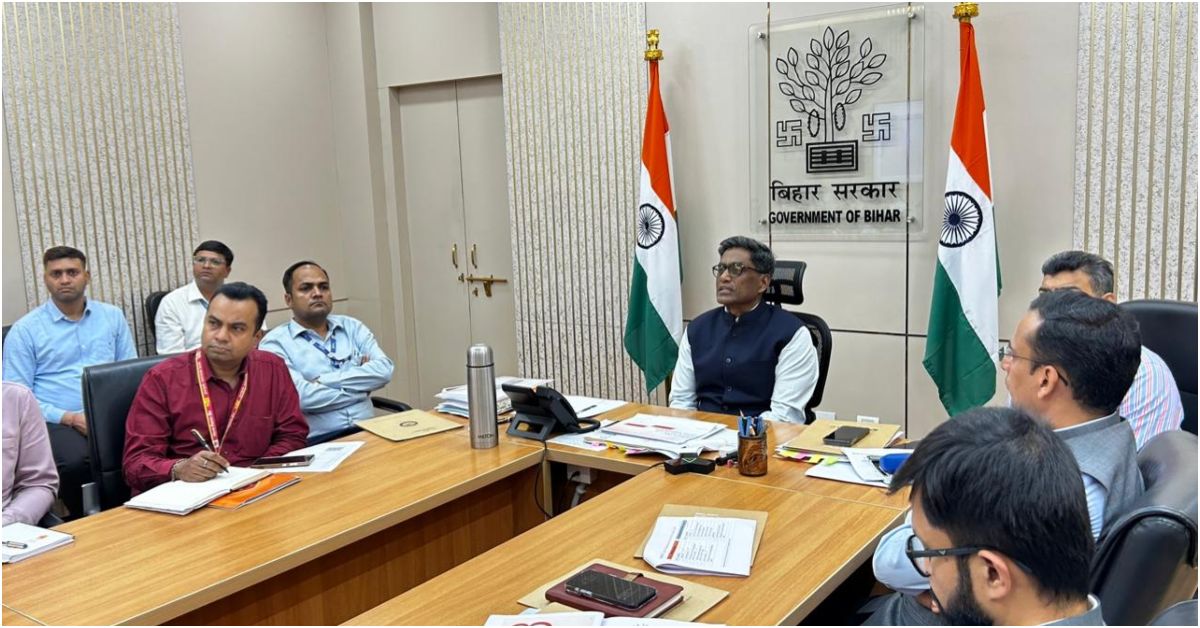
Patna: The Bihar government has set out an ambitious plan to expand solar rooftop coverage under the PM Surya Ghar Yojana, aiming to connect over 4.8 lakh households by the 2026–27 financial year. The initiative was outlined during a high-level review chaired by the state’s Chief Secretary, Pratyaya Amrit, via video conference on Tuesday.

The meeting brought together all District Magistrates and Superintendents of Police, along with senior officials including Manoj Kumar Singh, Secretary of the Energy Department, and Himanshu, CEO of JEEViKA, and representatives from major banks. Discussions focused on the scheme’s current progress, the coverage of ‘Kutir Jyoti’ consumers, bank loan procedures, and the creation of ‘Model Solar Villages’.
Officials emphasised the role of central subsidies in making the scheme accessible: Rs 30,000 for a 1 kW plant, Rs 60,000 for a 2 kW system, and up to Rs 78,000 for units of 3 kW or more. Affordable bank loans at an interest rate of 6% are also being offered, though authorities have noted difficulties in loan disbursal due to unnecessary document demands. The Chief Secretary instructed District Magistrates to organise special camps to simplify the application process, stressing that banks must not request non-essential documents for smaller systems.

Under the Utility Led Aggregator (ULA) model, Bihar plans to connect 5.8 million ‘Kutir Jyoti’ consumers to solar systems over the next four years. Currently, approval has been granted for 2.5 lakh rooftop installations by October 2026. JEEViKA workers, referred to as ‘Jeevika Didis’, will assist consumers in the application process, with an initial focus on five Panchayats from each block to ensure swift coverage.
A ‘Model Solar Village’ will be developed in every district, receiving Central Financial Assistance of Rs 10 million. District officials have been tasked with selecting eligible villages in the remaining 28 districts and nominating Nodal Officers to monitor and accelerate implementation. The scheme is slated for completion by March 2027.
The review signals Bihar’s push toward sustainable energy adoption at the household level, integrating government support, bank facilitation, and community involvement to achieve its solar targets.