Patna: The Bihar government has approved a large-scale township development policy that will see greenfield satellite townships built around 11 cities, including the state capital, under a land pooling model that returns 55% of developed land to original landowners.

Officials say the initiative is designed to accelerate planned urban expansion while significantly increasing land value in the participating regions.
Under the policy, undeveloped land will be pooled by the government, developed with full infrastructure, and then redistributed. Landowners will receive 55% of their original holdings back as developed plots, while the remaining land will be used to finance and execute the township projects.

Structured Redistribution of Land
According to the framework, the remaining 45% of pooled land will be divided for multiple purposes: 22% will be used for the construction of roads and transport infrastructure; 15% will be retained by the government to recover development costs; 5% will be allocated for public amenities including parks, drainage systems, hospitals and civic infrastructure; and 3% will be reserved for housing for economically weaker sections.
Officials describe the model as a “self-financing urban development mechanism” intended to reduce direct fiscal burden while ensuring comprehensive infrastructure development.
Promise of Rising Land Value
The government argues that the primary benefit for landowners will not be immediate compensation, but the appreciation in value of returned land once infrastructure is in place.
Basic services such as roads, electricity, water supply and street lighting will be developed before redistribution. Authorities claim that once these facilities are established, land values in the designated zones are expected to rise substantially, turning ownership into a long-term financial asset.
The state has also indicated that private developers may be involved in constructing residential colonies and commercial spaces within the new townships to further stimulate investment and economic activity.
Implementation and Timeline
According to officials, the land pooling process will begin within two months of formal notification of each township project. During this phase, landowners will be invited to submit objections and suggestions, which will be reviewed before finalisation.
A designated development authority will oversee demarcation and infrastructure construction. Public assets such as roads, parks and civic facilities will remain under government control.
Once development is completed, allotment certificates will be issued and land will be returned either in the same location or in nearby areas within the township zone.
If exact location matching is not possible, alternative plots will be allocated in adjacent areas. In cases of high demand or limited availability, allotments may be finalised through a lottery system.
Safeguards, Penalties and Transparency Measures
The policy includes provisions for penalties in case of delays in execution, aimed at ensuring timely completion of projects.
To maintain transparency, project maps will be held jointly by the Urban Development and Housing Department and the Revenue Department. Land distribution will be determined based on project-specific financial viability and planning requirements.
Officials say the governance structure is intended to reduce disputes and ensure clarity in ownership and allocation.
Restrictions on Land Transactions
Alongside the policy rollout, the state has imposed restrictions on the purchase, sale and transfer of land within designated township areas.
In the Patna region, the restriction will remain in place until 2031, in line with the city’s master plan. In other notified cities, including Sonepur, Gaya, Darbhanga, Saharsa, Purnia and Munger, the moratorium will remain effective until March 2027.
Authorities say the restrictions are intended to prevent speculative trading and ensure that land remains available for structured development under the new framework.
‘Greenfield’ Model of Urban Expansion
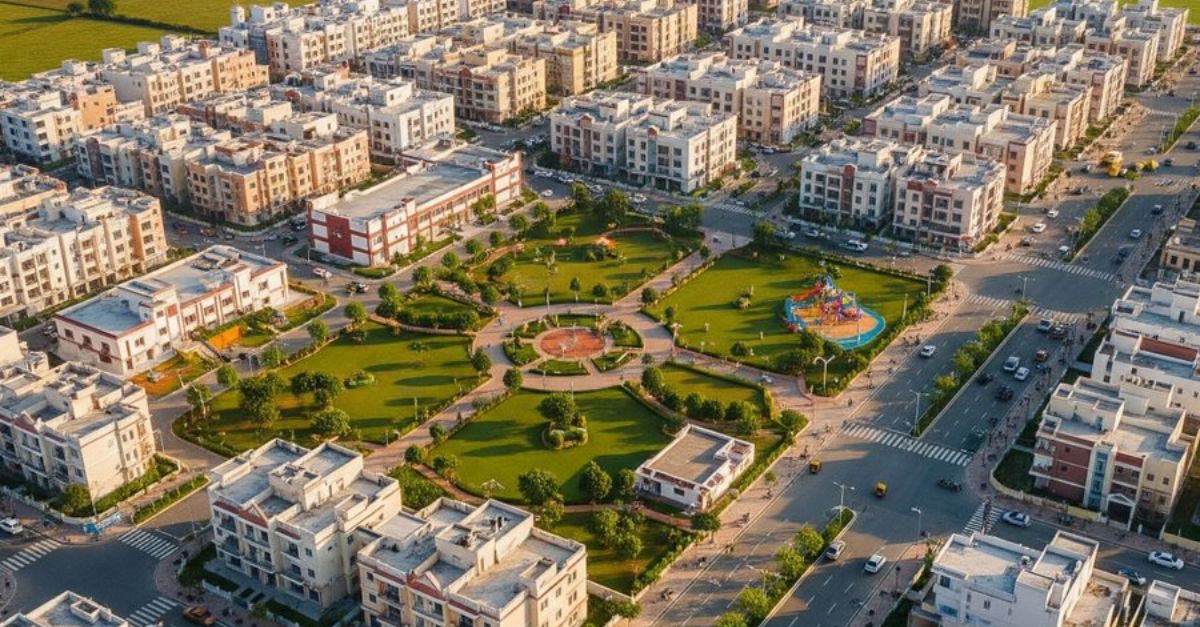
The proposed developments fall under the category of greenfield townships, which are built on previously undeveloped land on the outskirts of urban centres. These projects typically involve the creation of entirely new urban infrastructure, including transport networks, residential zones and public facilities.
Under the land pooling approach, rather than outright acquisition, landowners become stakeholders in the development process by receiving a portion of the upgraded land.