
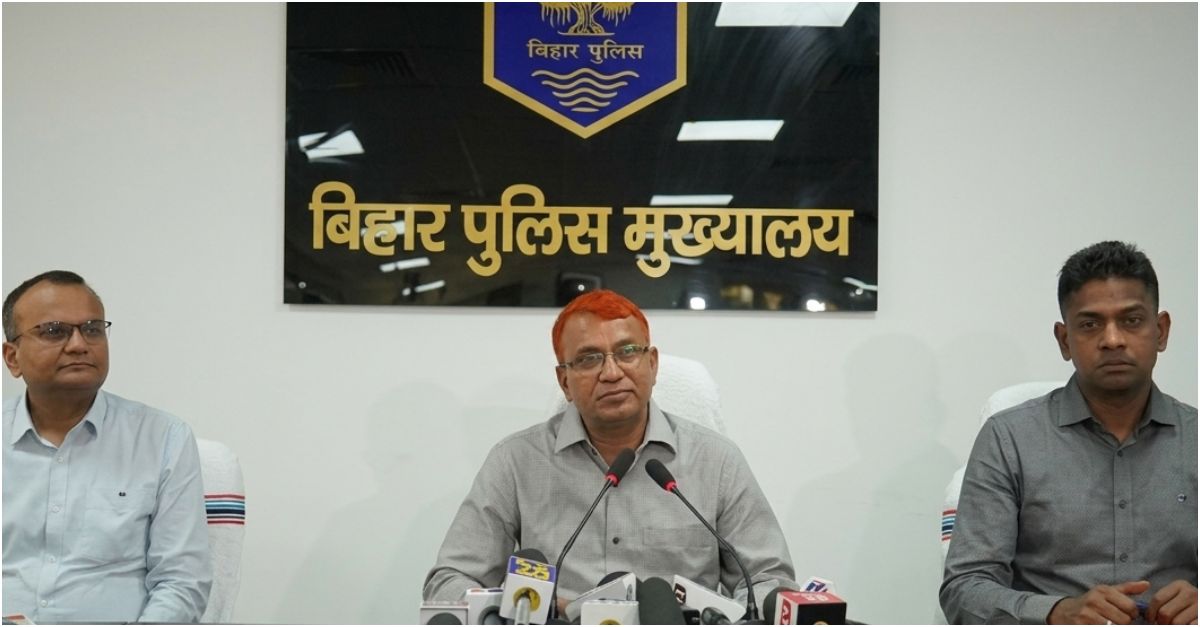
Patna: Bihar Police has initiated a major technological overhaul aimed at making criminal investigations fully digital within the next six months. Under the new criminal laws implemented in 2024, the state police has intensified efforts to modernise investigation procedures through advanced technology, forensic science, and digital platforms.

Police Headquarters has directed officers and personnel across the state to undergo specialised in-service training in modern investigation techniques, forensic science, and digital policing tools. Officials said the initiative is intended to improve the efficiency of investigations and strengthen the rule of law through evidence-based policing.
Push for Scientific and Evidence-Based Investigations

As part of the modernisation drive, the State Forensic Science Laboratory (CID, Bihar), in collaboration with the Directorate of Forensic Science Services (DFSS), organised a two-day satellite conference on biological sciences at the Bihar Police Headquarters auditorium.
The conference was attended by 40 forensic experts along with representatives from four international equipment manufacturers — Thermo Fisher, Syntol, Qiagen, and Hi-Media.
Discussions during the conference focused on the development and demonstration of indigenous and low-cost DNA analysis tools, particularly microsatellite DNA technology. Officials said these tools are expected to strengthen scientific evidence collection in murder, kidnapping, and property-related crime investigations.
Greater Use of CCTNS and E-Sakshya App
The Bihar Police has also directed regional police units to make extensive use of digital policing platforms to improve transparency and speed in investigations.
Between January and April 2026, a total of 353,949 case diaries and 112,520 FIRs were recorded through the Crime and Criminal Tracking Network and Systems (CCTNS), according to official figures.
The Government of India-developed ‘e-Sakshya App’ is also being used for audio-video documentation of crime scenes, searches, seizures, and victim statements. During the same period, 68,844 Unique IDs (SIDs) were generated through the application.
Officials said the app is aimed at ensuring transparency and maintaining the integrity of evidence collection during investigations.
Integrated Systems for Criminal Tracking and Child Safety
Bihar Police is simultaneously expanding the use of integrated digital systems for criminal tracking and victim protection.
Police stations have been instructed to upload complete details and photographs of missing and victimised minors on the Mission Vatsalya Portal to support faster recovery efforts.
The ‘e-Prisons’ system is being used to verify criminal antecedents of accused persons, while the Inter-Operable Criminal Justice System (ICJS) is facilitating quicker information exchange between police, prisons, courts, and prosecution departments.
Authorities are also using the ‘e-RAD’ application for scientific road accident analysis and the National Automated Fingerprint Identification System (NAFIS) portal for fingerprint matching of criminals. Official data shows that 40,416 new enrollments were recorded on these platforms during the first four months of 2026.
Paper-Based Investigation Process to End
The Crime Investigation Department (CID) has fixed a six-month deadline for the complete implementation of technology-based investigation systems across Bihar.
After this transition period, physical copies of charge sheets and final reports linked to FIRs will no longer be accepted. All such documents will have to be submitted exclusively through online platforms.
To support the transition, police personnel across districts are undergoing regular physical and technical training programmes through the Higher Training School and the Centre for Development of Advanced Computing (C-DAC).
Officials said the move is expected to reduce delays, improve record management, and strengthen accountability within the criminal justice system.