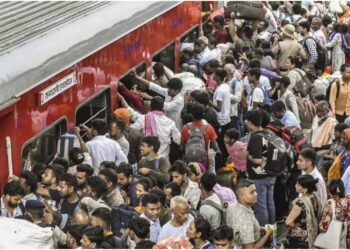
Patna: Bihar is witnessing intense heatwave conditions with temperatures soaring above 40 degrees Celsius across several districts. Weather experts have warned that there is little possibility of relief from the scorching heat over the next eight days, while prolonged heatwave conditions may continue for nearly 30 days this season.

Adding to the concern, meteorologists have warned of a possible drought-like situation in Bihar this year due to the anticipated impact of El Niño and a potential “Super El Niño” event in the Pacific Ocean. Experts say rising sea surface temperatures near the equatorial Pacific could influence weather patterns from mid-May until winter.
According to meteorologists, the warming Pacific Ocean could block the flow of cool and moisture-laden winds from the Indian Ocean and Arabian Sea toward India. These winds are crucial for monsoon rainfall. A disruption in their movement may result in below-normal rainfall during the monsoon season.

Monsoon Likely To Arrive Early In Bihar
Weather scientists have predicted that the southwest monsoon may reach Bihar between June 8 and 10, slightly earlier than its usual arrival around June 15. The monsoon is expected to hit Kerala by May 26.
Meteorologist Ashish Kumar said Bihar is likely to receive below-normal rainfall during the 2026 monsoon season. The state’s average monsoon rainfall is around 992.2 mm, but this year rainfall may remain nearly 20% below normal.
Experts warned that if El Niño strengthens into a Super El Niño phase, the rainfall deficit could become even more severe.
Severe Heatwave May Continue Throughout May
According to weather forecasting platform AccuWeather, Bihar may continue to experience extreme heat throughout May. In Patna, the maximum temperature is expected to remain above 40°C until May 29, while temperatures may touch 45°C on May 27.
Districts such as Gaya and Rohtas could also witness temperatures crossing 45°C, intensifying heatwave conditions across the state.
What Is El Niño And Super El Niño?
El Niño is a naturally recurring climate phenomenon that affects global weather patterns. It generally lasts for 9 to 12 months and originates in the tropical Pacific Ocean near the equator.
Normally, winds move warm ocean water from east to west, pushing it toward Indonesia. However, when these winds weaken, warm water shifts eastward toward South America. This increases sea surface temperatures in the Pacific Ocean and alters atmospheric circulation worldwide.
Meteorologists say the stronger the ocean warming, the stronger the El Niño effect becomes.
“Super El Niño” is not an official scientific term, but it is used when Pacific Ocean temperatures rise at least 2°C above average, creating an exceptionally strong El Niño event. Such events are rare and were last observed nearly a decade ago.
How El Niño Impacts India’s Monsoon
During an El Niño event, warm winds from the Pacific Ocean interfere with the cool, moisture-bearing winds coming from the Indian Ocean and Arabian Sea toward India. This weakens monsoon rainfall across the country.
In Bihar, monsoon rainfall largely depends on moisture-laden winds from the Bay of Bengal. Meteorologists said that under strong El Niño conditions, these winds may weaken, resulting in reduced rainfall over the state.
82% Chance Of Super El Niño Development
According to the US-based National Oceanic and Atmospheric Administration (NOAA), there is an 82% probability of a Super El Niño developing between May and July this year.
The agency has also projected a 96% likelihood that El Niño conditions may continue from December 2026 to February 2027. There is around a 67% chance that the event could remain “strong” or “very strong,” raising fears of weak monsoon rains, drought, and severe heatwaves.
Could Bihar Face A Situation Like The 1966-67 Drought?
Agriculture in Bihar is heavily dependent on monsoon rainfall. Farmers have already suffered losses due to low winter rainfall and unseasonal rain between February and April, which damaged crops including wheat.
Experts said the success of paddy cultivation and winter crops will depend largely on this year’s monsoon performance. If rainfall remains significantly below normal, drought conditions could emerge in several parts of the state.
Concerns have also resurfaced over whether Bihar could face a crisis similar to the 1966-67 drought, when food grain production reportedly dropped from 7.5 million tonnes in 1965-66 to 4.3 million tonnes in 1966-67, leading to a severe grain shortage.
However, experts noted that Bihar’s current agricultural and food storage capacity is significantly stronger than it was in the 1960s. Bihar is now among India’s top wheat and rice producing states and ranks third in maize production. Adequate food grain reserves at both state and national levels are expected to prevent any large-scale famine-like situation.