| BEFORE YOU READ
A lingua franca is a shared language that lets people with different mother tongues trade and work together. Science and industry have never had one for numbers. Physics counts in metres and joules, medicine in blood pressure and heart rate, logistics in tonnes and delays, robotics in torque, and AI in probabilities. Each field is an island, so a flood warning, a hospital’s readiness and a fleet’s capacity cannot be read together. The 0→1 Doctrine is designed as a digital lingua franca: every measure is placed on its own scale from 0 to 1, keeping its meaning and its limits, so different fields, and the AI systems that serve them, can check them side by side. It replaces no science; it lets them work together. |

THE DATA SCIENCE LEAVES BEHIND
A study ends, an instrument is retired, and its data stays on drives and tapes. Together with the world’s other archives, stored data now runs to zettabytes, held in data centres that draw gigawatts. Much of science’s share becomes dark data, never opened again, not because it holds nothing, but because no one can safely judge what it still holds.

ATOMS · COLLIDER RUNS WORTH A SECOND LOOK
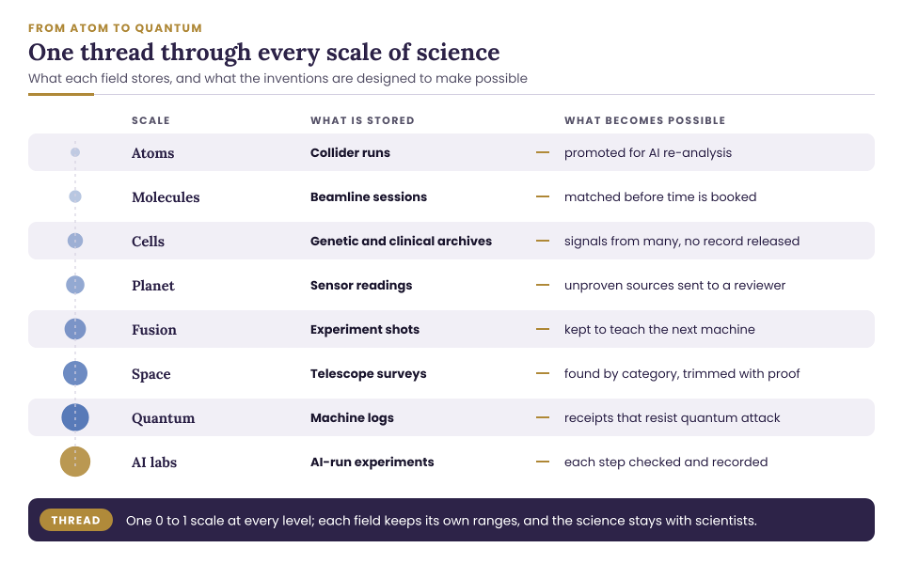
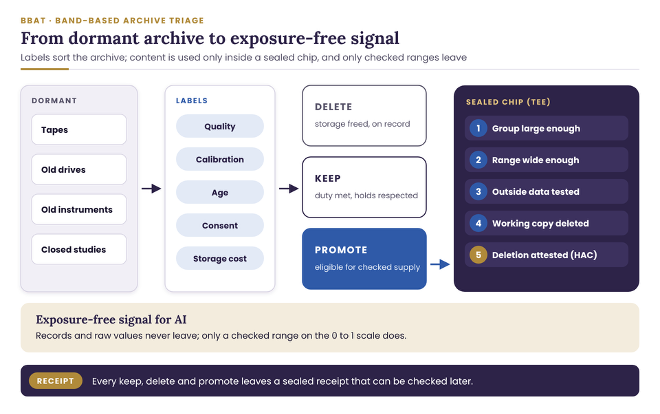
Particle physicists sometimes return to data from closed experiments when a new idea or AI method arrives. BBAT is designed to sort such runs by the labels they already carry, such as data quality, calibration version, detector conditions and age, without opening the events themselves.
What it makes possible: old runs promoted for re-analysis by AI, each choice on record.
MOLECULES · BEAM TIME, MATCHED
Synchrotron and neutron facilities serve chemists, biologists and materials scientists, and beam time is scarce. In the 0→1 Doctrine, what an experiment needs and what a beamline can deliver are placed as ranges on the same scale, so a request is matched before time is booked.
What it makes possible: fewer wasted sessions, and a record of why each slot was given.
CELLS · SEQUENCES THAT BELONG TO PEOPLE
Genetic and clinical archives hold some of science’s most valuable data and its strictest duties. Here BBAT works inside a Trusted Execution Environment (TEE), a protected area of a chip. Groups too small are refused, narrow ranges are widened and each range is tested against outside data, and a Hardware Attestation Certificate (HAC) attests that the working copy was deleted before anything leaves.
What it makes possible: research signals from many people through Band-Derived Training Signals (BDTS), with no record released.
THE PLANET · READINGS THAT MUST PROVE THEIR SOURCE
Climate and Earth-observation records come from thousands of sensors of different ages. BBAT is designed to send a reading whose source cannot be proven to a reviewer through the Human Override Pathway (HOP).
What it makes possible: cleaner inputs for AI that learns how the planet behaves.
FUSION · SHOTS THAT TEACH THE NEXT MACHINE
Fusion experiments run in short shots, each leaving diagnostic records. BBAT can sort shot archives by machine settings, diagnostic quality and age, so researchers can promote the shots most worth keeping. The 0→1 Doctrine can hold high-level operating changes for a researcher, while millisecond control stays with the machine.
What it makes possible: decades of shots that stay useful to AI helping design the next machine.
SPACE · ARCHIVES FOUND BY CATEGORY
Observatories and space missions keep telescope surveys that others could use, if they knew what exists. SCAN (Systemic Category-level Availability Notice) shows, by category, what kind of data is available across holders, without naming a holder or record.
What it makes possible: survey data that can be found, shared and trimmed with proof.
QUANTUM · NEW MACHINES, LONG RECORDS
Quantum computers produce calibration and run logs that matter for years, and future large ones could break much of today’s encryption. BBAT’s receipts can be signed with methods built to resist future quantum computers.
What it makes possible: quantum-era records that can still be checked as computing changes.
AI LABS · A CHECK BEFORE AI RUNS THE EXPERIMENT
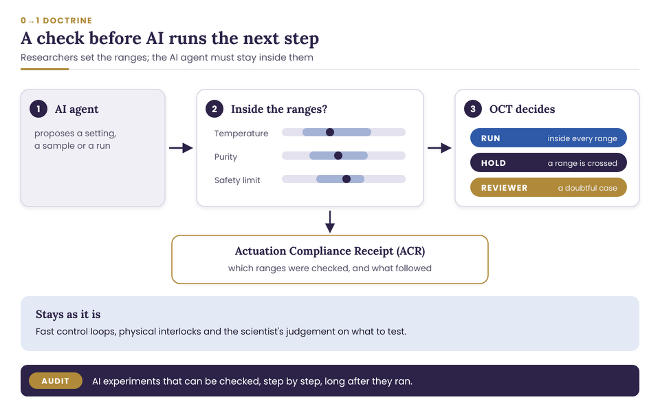
AI agents are beginning to plan and run experiments. Under the 0→1 Doctrine, an agent’s next step, such as a setting, a sample or a run, is checked against ranges that researchers set. The Orchestration and Compliance Token (OCT) holds a step that fails, and the Actuation Compliance Receipt (ACR) records why. Fast control loops and physical interlocks stay as they are.
What it makes possible: AI experiments that can be audited.
WHAT FUNDERS AND INVESTORS GAIN
Funders pay for each measurement once. With BBAT, an archive can show what it holds, what was deleted under which rule and what was promoted for reuse, each with a receipt. With the holder’s permission, a funder or investor can check this first.
What it makes possible: research money that keeps working after a study ends.
WHEN SUPER INTELLIGENCE ARRIVES
Artificial general intelligence (AGI) and super intelligence may one day design experiments of their own, and may want every measurement science has made. Where these inventions are in use, that history reaches them as checked signals, under rules people set, with a record of each step.
HONEST LIMITS
Neither invention discovers a law of nature; both make existing data and decisions easier to trust and reuse. Labels must be accurate, so doubtful ones go to a reviewer.
QUESTIONS SCIENTISTS ASK
| 01 Does it change how data is analysed?
Analysis stays with scientists; BBAT governs what is kept, deleted or promoted. |
02 Can open data stay open?
Yes. The privacy steps apply where records concern people. |
| 03 Who sets the ranges?
Researchers and the bodies that govern each field. |
04 Does it work on old tapes and drives?
It works on stored data, new or old, wherever labels can be read. |
| 05 Can a deletion be checked later?
Yes. Its sealed receipt shows what was deleted, when and why. |
06 Does it need new instruments?
Existing ones work; proof of source is strongest with newer sensors. |
CLOSING NOTE
Science has spent centuries measuring the world, from atoms to galaxies. Before the singularity, if it comes, those measurements can teach AI again, with every record kept where it belongs.
This can be tested, live, via API, governed against ungoverned, side by side.
THE INVENTOR
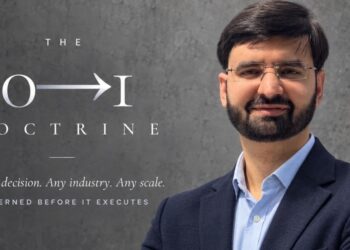
Systems theorist, inventor, and serial entrepreneur Vatsal Soin holds grants in the US, Japan, India and more; filings span six continents; latest grant, AI footwear, August 2026. Inventions: footwear, apparel fit, Sharable Size Cards, digital twins, robotics, global governed data, archive triage, quantum-resilient cryptography, AI governance. SIM–RMIT and NTU alumnus. Every prior invention was a step; 0→1 is the destination.
SELECTED REFERENCES
Granted: US Patent 12,446,652 B2 · Japan Patent 7560909 · India Patents 454081 and 599317. Filed: PCT/IN2025/051943 · US 19/489,595 · India 202511115781 · Australia AU2022450649 · India 202611113867 (23 September 2026) · PCT/IN2026/052042 (1 October 2026).
DISCLAIMER
Informational only. Not scientific, medical, legal or investment advice. The team are inventors, not scientists, and claim no discovery. No institution named is affiliated. Examples are illustrative, not field results. Not certified.