
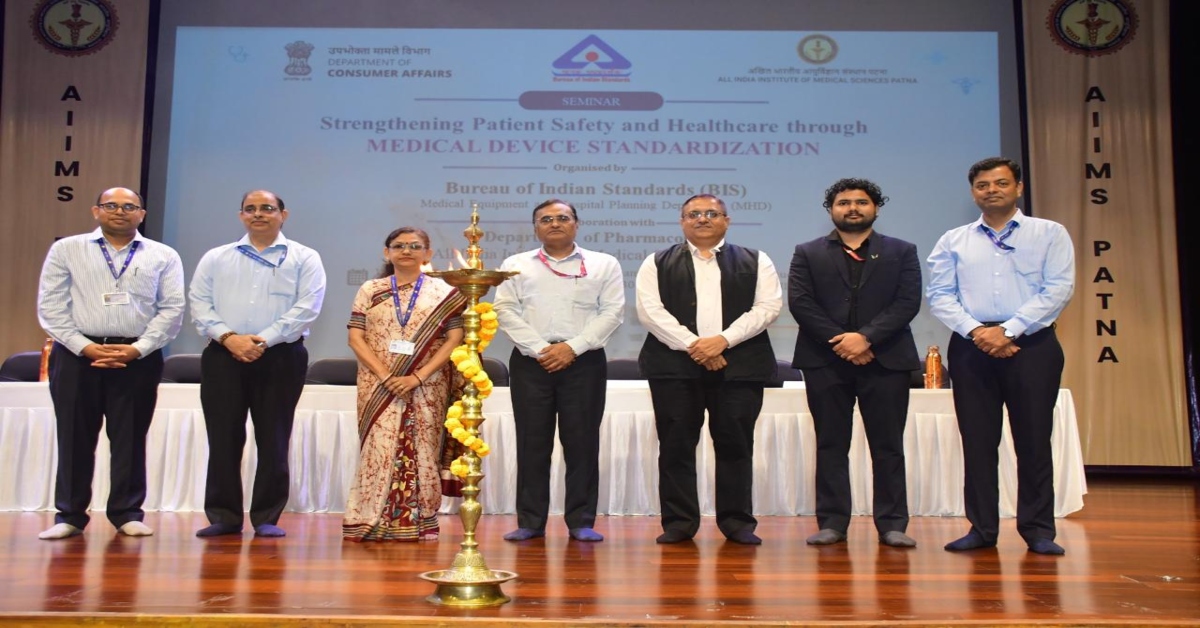
Patna : The All India Institute of Medical Sciences (AIIMS), Patna, and the Bureau of Indian Standards (BIS) jointly organised a seminar on strengthening patient safety through medical device standardisation on Wednesday, focusing on quality assurance, safety monitoring and collaboration between healthcare institutions and standard-setting bodies.

The seminar, titled Strengthening Patient Safety and Healthcare Through Medical Device Standardisation, brought together medical professionals and BIS representatives to discuss the role of national quality standards in ensuring the reliability and safety of medical devices.
The discussions also covered safety surveillance of medical devices and in-vitro diagnostic devices (IVDs), highlighting the need to identify potential risks and strengthen safeguards for patients.

AIIMS Patna Director Emphasises Quality Assurance
Prof. (Brig.) Dr. Raju Agarwal, Executive Director and CEO of AIIMS Patna, emphasised that medical device standardisation was essential for patient safety and the delivery of quality healthcare.
He said reliable medical devices, supported by strong quality standards and effective monitoring, were important for improving clinical outcomes and strengthening patient confidence.
The inaugural session was attended by Prof. (Dr.) Punam Prasad Bhadani, Dean (Academics); Prof. (Dr.) Sanjay Pandey, Dean (Research); Prof. (Dr.) Prashant Kumar Singh, Medical Superintendent; Sumit Senger, Director and Head of the Medical and Hospital Equipment Department at BIS; and Dr. Pramod Kumar Manjhi, Additional Professor and Head of the Department of Pharmacology at AIIMS Patna.
BIS Highlights Role Of National Quality Standards
Sumit Senger highlighted the importance of standardisation in ensuring the quality, safety and reliability of medical devices.
He said strong standards, effective safety surveillance and closer coordination between standard-setting organisations and healthcare institutions could improve confidence in medical technologies and contribute to safer patient care.
Karthik Reddy, Scientist-B at the Medical and Hospital Equipment Department of BIS, delivered a session on India’s national quality ecosystem and the role of BIS in standardisation.
Dr. Sameer Dhingra, Regional Training Centre Coordinator for the Indian Pharmacopoeia Commission’s Materiovigilance Programme of India at NIPER Hajipur, discussed safety surveillance of medical devices and in-vitro diagnostic devices.
His session focused on monitoring potential risks associated with medical devices and strengthening systems to protect patients.
Pawan Kumar, Scientist-B at BIS’s Medical and Hospital Equipment Department, explained the department’s role in developing standards for medical devices and related equipment.
Experts Discuss Patient Safety In Clinical Practice
A key highlight of the seminar was a panel discussion titled “BIS SNAP and Learnings from the Field on Patient Safety”, moderated by Karthik Reddy.
The panel brought together specialists from several departments at AIIMS Patna to discuss patient safety experiences and the importance of reliable medical devices in clinical practice.
The panellists included Dr. Sanjeev Kumar, Professor and Head of the Department of Cardiothoracic and Vascular Surgery; Dr. Anup Kumar, Professor and Head of the Department of Orthopaedics; Dr. Anupam Bhambhani, Additional Professor and Head of the Department of Cardiology; and Dr. Pragati Kapoor, Additional Professor in the Department of Cardiothoracic and Vascular Surgery.
The programme also featured an open house discussion, allowing participants to exchange views on medical device standardisation, safety monitoring and ways to improve patient protection.
Collaboration To Support Safer Healthcare
The seminar highlighted the importance of cooperation between healthcare professionals, medical institutions and standard-setting bodies in improving the reliability of medical devices.
Robust quality standards and effective safety surveillance can help identify potential risks, strengthen confidence in medical technologies and support safer healthcare delivery.
The discussions reinforced the need to integrate standardisation and monitoring into healthcare systems to improve patient protection and the quality of clinical care.