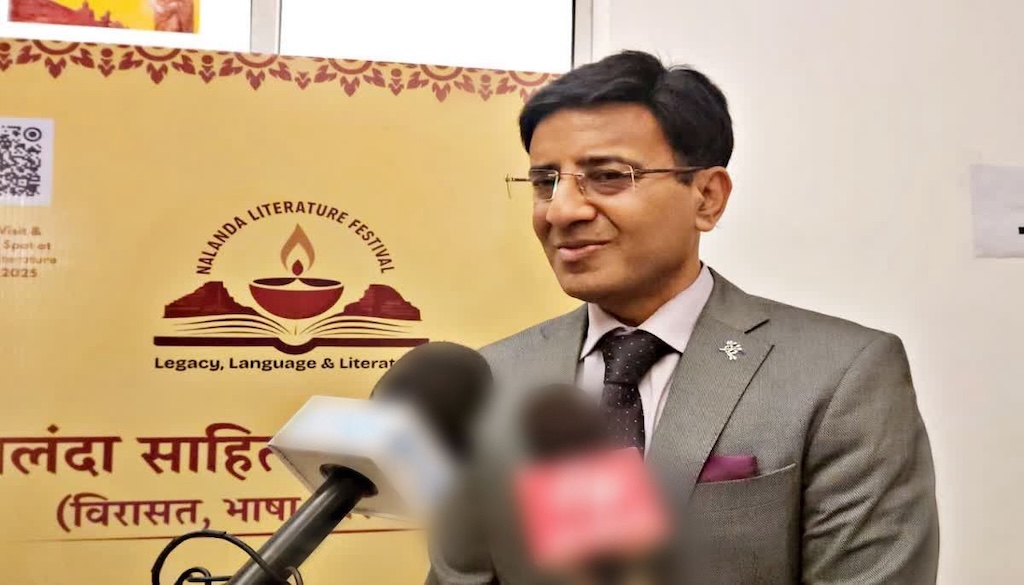
Patna: At a venue better known for conversations about books than crime, Amit Lodha offered a rare glimpse into the inner life of a policeman. Addressing the “Writing India in English” session at the Nalanda Literature Festival in Rajgir, the Bihar cadre IPS officer spoke about empathy, memory and the uneasy marriage between a rigid uniform and a reflective pen.

Lodha, widely recognised for his hardline approach to organised crime, said the popular image of the police often misses a crucial truth. “There is a human being behind the uniform,” he told the audience. Discipline, he said, was indispensable in policing, but without sensitivity it could not deliver justice. Understanding a victim’s suffering, he argued, required emotional intelligence as much as authority.
The officer-author suggested that writing could humanise institutions often seen as distant or coercive. Memoirs written honestly and “from the heart”, he said, had the power to reach readers beyond official narratives and public mistrust. His own decision to write during service—rather than waiting for retirement, as many officers do—came not from literary ambition but from lived experience. “Some stories happened to me that I felt compelled to write down,” he said.

The setting itself carried personal resonance. Lodha recalled that he once travelled through Nalanda and Sheikhpura districts in pursuit of criminals; returning now for a literature festival felt like a full-circle moment. He described the transformation of Rajgir—with its international-standard stadium and convention facilities—as emblematic of a changing Bihar, adding that sustained law and order had played a role in creating the conditions for such civic renewal.
Asked about future projects, Lodha said he was currently focused on his professional responsibilities and not developing any screen adaptations. “But I will definitely write more memoirs,” he added, noting that feedback from readers had challenged stereotypes about the police.
He closed by hailing the Nalanda Literature Festival as an encouraging start for Bihar’s youth. Long associated with learning, art and culture, the state, he said, needed platforms that allowed young people to discover and showcase their talents. The session was moderated by Dr Pankaj K.P. Shreyaskar and drew a packed audience.